April 8, 2026
One Health Summit 2026
Why in News ? The One Health Summit recently took place in Lyon, France, with the High-Level Summit on 7 April, coinciding with World Health Day.
Hosted by the French Government as one of the flagship events of the G7 French Presidency, the Summit will convene Heads of State and government, international organizations, scientists, civil society, youth and local actors to advance global action on One Health.
The Summit will highlight the interdependence of human, animal, plant and ecosystem health, and the need for coordinated, science-based approaches to address shared health threats. It will showcase the Quadripartite partnership between, FAO, UNEP, WHO and WOAH, as well as the role of the WHO Academy and WHO’s work across country, regional and global levels.
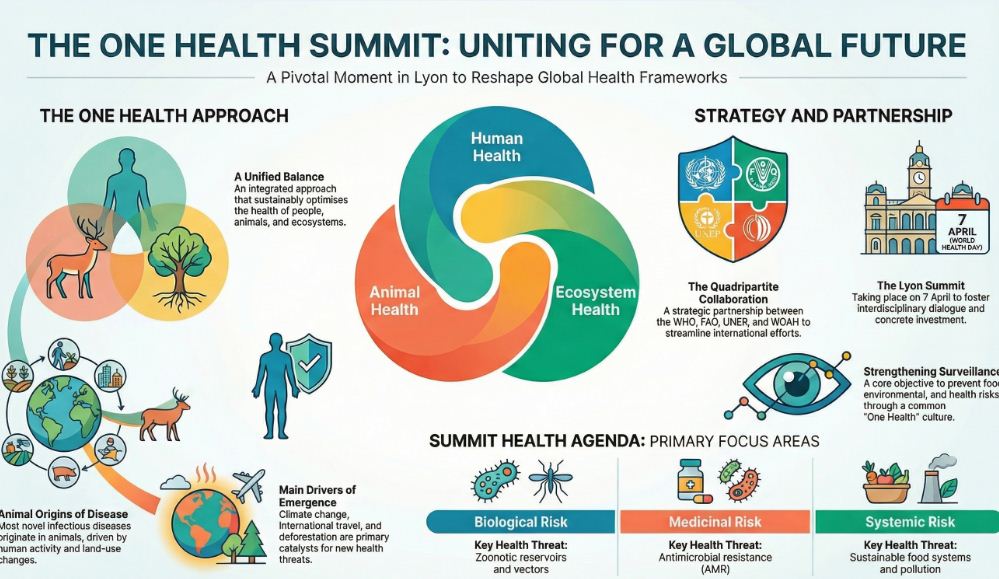
Summit’s objectives:
Foster international and interdisciplinary dialogue about global issues by deploying, for instance, cooperation and research programmes.
- Reshape global institutional frameworks by creating a common “One Health” culture
- Engage all public and private stakeholders to invest in deploying concrete actions
- Develop solutions to strengthen health and surveillance systems in order to prevent health, food, and environmental risks that impact our populations
- Fundamental Principles
- The importance of science, research, and innovation
- The promotion of action-oriented multilateralism and international partnerships
The One Health Summit will focus on the main factors contributing to infectious and non-communicable diseases:
- Zoonotic reservoirs and vectors
- Antimicrobial resistance
- Sustainable food systems
- Exposure to pollutions
What is “One Health”?
One Health is an integrated, unifying approach that aims to sustainably balance and optimize the health of people, animals, and ecosystems.
Key Drivers of Disease Emergence:
According to the “Manhattan Principles” (2004), the majority of novel infectious diseases originate in animals. The main drivers include:
- Anthropogenic Activity: Deforestation and trade in wild animals.
- Land Use Changes: Urbanization and intensification of agriculture.
- Climate Change: Extreme weather events and ecosystem shifts.
- Global Connectivity: International travel and trade.
Global Frameworks:
- The Quadripartite Collaboration: Led by four major organizations:
- World Health Organization (WHO)
- Food and Agriculture Organization (FAO)
- United Nations Environment Programme (UNEP)
- World Organisation for Animal Health (WOAH)
- One Health Joint Plan of Action: Launched in October 2022 to streamline international efforts.
National One Health Mission (India):
India has fast-tracked its own collaborative framework to address future health security.
Core Objectives:
- Integration: Breaking silos between human health, veterinary sciences, and environmental departments.
- Pandemic Preparedness: Building infrastructure for early warning and rapid response.
- Zoonotic Disease Control: Monitoring pathogens in livestock and wildlife before they jump to humans.
- Disease Surveillance: Integrating data from multiple sectors for a unified health picture.
State-Level Examples in India:
| State | Initiative | Focus |
| Odisha | Climate Budget | Tracking expenditures for climate-resilient development. |
| Kerala | Meenangadi Plan | A participatory, carbon-neutral community model. |
| Tamil Nadu | Green Climate Co. | Large-scale climate mitigation and “Cool Roof” projects. |

October 17, 2025
October 16, 2025
October 6, 2025
September 24, 2025

