October 12, 2026
Nuclear Clocks: परमाणु नाभिकीय घड़ियाँ
GS Paper III: Science and Technology | Prelims + Mains
Why in News?
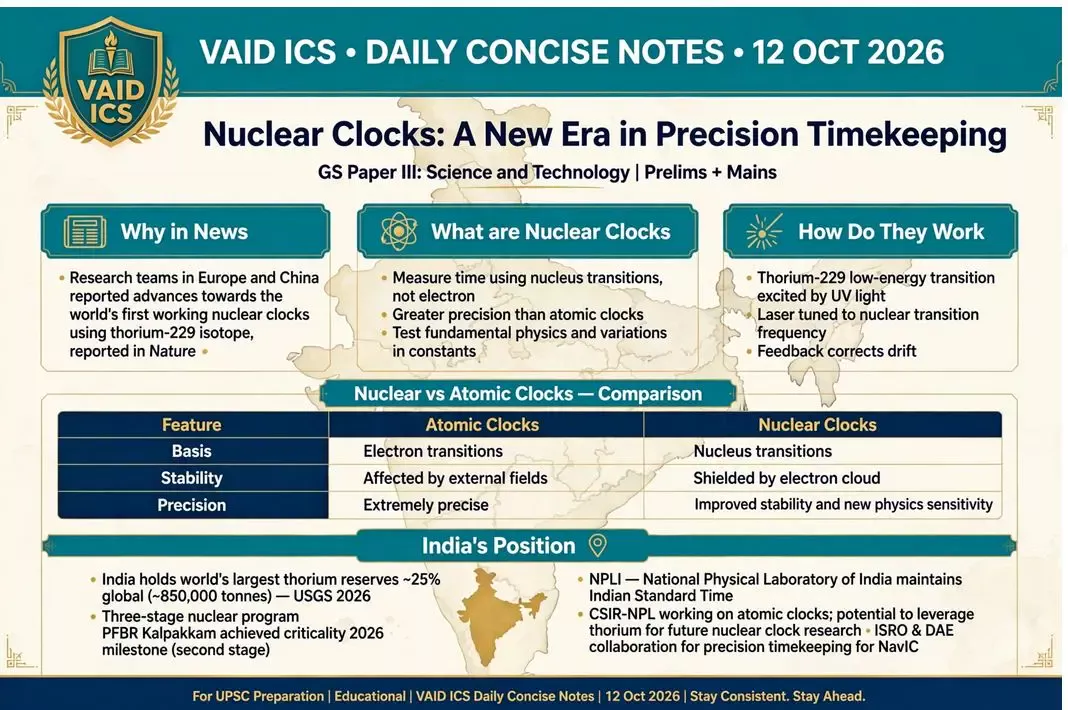
Research teams in Europe and China have reported advances towards the world’s first working nuclear clocks, using the thorium-229 isotope. The research was reported in Nature.
What are Nuclear Clocks?
-
Nuclear clocks measure time using energy transitions within an atom’s nucleus, rather than transitions of electrons.
-
They have the potential to achieve greater precision and stability than the best atomic clocks.
-
They may help test fundamental physical theories and detect possible variations in fundamental constants.
How Do They Work?
-
Thorium-229: Its nucleus has an exceptionally low-energy transition that can be excited using ultraviolet light.
-
Laser system: A laser is tuned to the nuclear transition frequency.
-
Feedback mechanism: The laser frequency is continuously checked and corrected to minimise drift.
Nuclear Clocks vs Atomic Clocks
Atomic Clocks
-
Use transitions between electron energy levels.
-
Can be affected by external electric and magnetic fields.
-
Already provide extremely precise timekeeping.
Nuclear Clocks
-
Use transitions within the atomic nucleus.
-
The nucleus is relatively shielded from external disturbances by the electron cloud.
-
May offer improved stability and sensitivity to new physics.
Significance:
-
Dark matter research: Comparing nuclear and atomic clocks may help detect possible effects of dark matter.
-
Fundamental constants: Could test whether constants of nature change over time.
-
Precision technology: May improve future timekeeping, navigation and scientific measurements.
-
Fundamental physics: Could provide new ways to test theories beyond the Standard Model.
Key Concepts:
Thorium-229: An isotope with an unusually low-energy nuclear transition, making laser-based nuclear spectroscopy possible.
Fundamental Forces: The four known fundamental interactions are gravitational, electromagnetic, strong and weak.
Dark Matter: Matter inferred from its gravitational effects but not directly observed through electromagnetic radiation.
Challenges:
-
Current prototypes have not yet surpassed the best atomic clocks in precision.
-
Nuclear transitions are difficult to excite and measure accurately.
-
Further improvements in lasers, measurement systems and long-term stability are required.
Conclusion:
Nuclear clocks represent a promising development in precision measurement. Although still at an early stage, they could eventually surpass atomic clocks and open new avenues for research into dark matter, fundamental constants and the laws of physics.
परमाणु नाभिकीय घड़ियाँ (Nuclear Clocks): सटीक समय मापन का नया युग
सामान्य अध्ययन प्रश्नपत्र–III: विज्ञान एवं प्रौद्योगिकी | प्रारंभिक परीक्षा एवं मुख्य परीक्षा
चर्चा में क्यों?
चीन एवं यूरोप के वैज्ञानिकों ने थोरियम-229 समस्थानिक का उपयोग करके नाभिकीय घड़ियों के विकास में महत्त्वपूर्ण प्रगति की है। इससे संबंधित शोध Nature पत्रिका में प्रकाशित हुए हैं।
नाभिकीय घड़ियाँ क्या हैं?
-
नाभिकीय घड़ियाँ परमाणु के नाभिक के भीतर होने वाले ऊर्जा संक्रमणों के आधार पर समय मापती हैं।
-
इसके विपरीत, पारंपरिक परमाणु घड़ियाँ इलेक्ट्रॉनों के ऊर्जा संक्रमणों का उपयोग करती हैं।
-
इनमें अत्यधिक सटीक एवं स्थिर समय मापन की क्षमता है।
-
ये मूलभूत भौतिक नियतांकों में संभावित परिवर्तन का अध्ययन करने में भी सहायक हो सकती हैं।
कार्यप्रणाली:
-
थोरियम-229: इसके नाभिक में असाधारण रूप से कम ऊर्जा वाला संक्रमण होता है, जिसे पराबैंगनी प्रकाश से उत्तेजित किया जा सकता है।
-
लेजर प्रणाली: लेजर को नाभिकीय संक्रमण की विशिष्ट आवृत्ति के अनुरूप समायोजित किया जाता है।
-
प्रतिक्रिया तंत्र: लेजर की आवृत्ति का लगातार मिलान एवं सुधार किया जाता है, ताकि समय मापन में विचलन न्यूनतम रहे।
नाभिकीय घड़ी एवं परमाणु घड़ी में अंतर:
परमाणु घड़ी:
-
इलेक्ट्रॉनों के ऊर्जा स्तरों के बीच संक्रमण पर आधारित।
-
बाहरी विद्युत एवं चुंबकीय क्षेत्रों से प्रभावित हो सकती है।
-
वर्तमान में अत्यंत सटीक समय मापन के लिए व्यापक रूप से उपयोग की जाती है।
नाभिकीय घड़ी:
-
परमाणु के नाभिक के भीतर ऊर्जा संक्रमण पर आधारित।
-
इलेक्ट्रॉन बादल के कारण नाभिक बाहरी विक्षोभों से अपेक्षाकृत सुरक्षित रहता है।
-
भविष्य में अधिक स्थिरता एवं नई भौतिक घटनाओं के प्रति बेहतर संवेदनशीलता प्रदान कर सकती है।
महत्त्व:
-
डार्क मैटर का अध्ययन: परमाणु एवं नाभिकीय घड़ियों की तुलना से डार्क मैटर के संभावित प्रभावों का पता लगाने में सहायता मिल सकती है।
-
मूलभूत नियतांक: प्रकृति के मूलभूत नियतांकों में समय के साथ होने वाले संभावित परिवर्तनों की जाँच।
-
सटीक प्रौद्योगिकी: भविष्य में समय मापन, नेविगेशन एवं वैज्ञानिक अनुसंधान में उपयोग।
-
मूलभूत भौतिकी: मानक मॉडल से परे संभावित भौतिक घटनाओं के परीक्षण के नए अवसर।
प्रमुख वैज्ञानिक अवधारणाएँ:
थोरियम-229: थोरियम का एक समस्थानिक, जिसके नाभिक में अत्यंत कम ऊर्जा वाला संक्रमण पाया जाता है। यह विशेषता इसे नाभिकीय घड़ियों के विकास के लिए उपयोगी बनाती है।
मूलभूत बल: प्रकृति में चार मूलभूत बल हैं—गुरुत्वाकर्षण बल, विद्युतचुंबकीय बल, प्रबल नाभिकीय बल एवं दुर्बल नाभिकीय बल।
डार्क मैटर: पदार्थ का एक संभावित रूप, जिसकी उपस्थिति का अनुमान मुख्यतः उसके गुरुत्वाकर्षण प्रभावों से लगाया जाता है, लेकिन जो विद्युतचुंबकीय विकिरण के माध्यम से प्रत्यक्ष रूप से दिखाई नहीं देता।
प्रमुख चुनौतियाँ:
-
वर्तमान प्रोटोटाइप अभी सर्वोत्तम परमाणु घड़ियों से अधिक सटीक नहीं हैं।
-
नाभिकीय संक्रमणों को उत्तेजित करना एवं सटीक रूप से मापना कठिन है।
-
लेजर प्रौद्योगिकी, मापन प्रणालियों एवं दीर्घकालिक स्थिरता में सुधार आवश्यक है।
निष्कर्ष:
नाभिकीय घड़ियाँ सटीक समय मापन के क्षेत्र में एक महत्त्वपूर्ण वैज्ञानिक प्रगति हैं। भविष्य में ये परमाणु घड़ियों से अधिक सटीक सिद्ध हो सकती हैं तथा डार्क मैटर, मूलभूत भौतिक नियतांकों और प्रकृति के नियमों के अध्ययन के नए अवसर प्रदान कर सकती हैं।

May 19, 2026
October 17, 2025
October 16, 2025
October 6, 2025

