April 2, 2026
Non-Deliverable Forward (NDF)
A Non-Deliverable Forward (NDF) is a critical instrument in the world of international finance, especially for businesses and investors dealing with “restricted” currencies. Since these currencies cannot be easily traded outside their home country due to government regulations (capital controls), the NDF allows parties to hedge risk without ever actually touching the restricted currency.
Mechanism of an NDF:
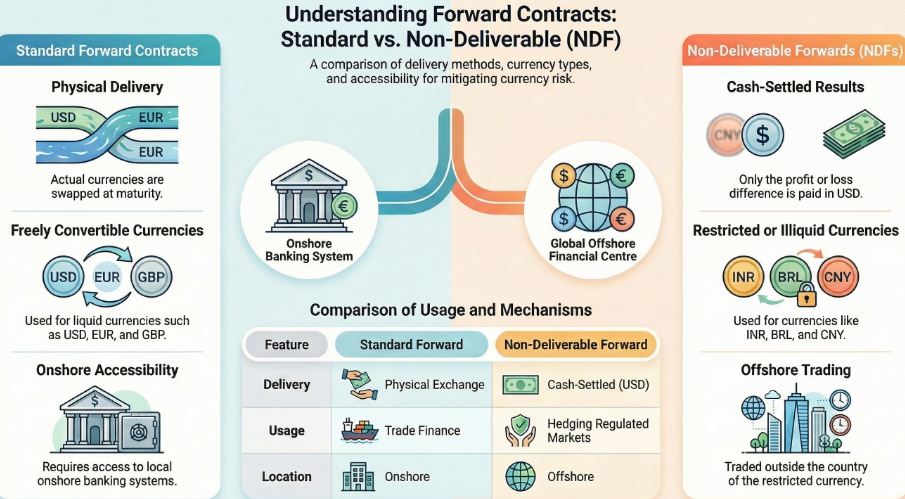
The defining feature of an NDF is Cash Settlement. Instead of physically exchanging Currency A for Currency B at the end of the contract, the two parties calculate the difference between the agreed-upon NDF Rate and the prevailing Spot Rate (Market Rate) at maturity.
- Settlement Currency: Usually a freely convertible reserve currency, most commonly the US Dollar (USD).
- Fixing Date: The date when the spot rate is checked against the contract rate.
- Settlement Date: The date when the “net” cash difference is paid.
Key Components:
- Notional Amount: The face value of the contract (e.g., $1 million) which is never actually exchanged.
- Restricted Currencies: Primarily used for emerging markets such as the Indian Rupee (INR), Chinese Yuan (CNY), Brazilian Real (BRL), and South Korean Won (KRW).
- Trading Hubs: These are traded Over-the-Counter (OTC), meaning they aren’t on a public exchange. Major hubs include Singapore, Hong Kong, London, and New York.
Why Use NDFs?
- Hedging: A company expecting revenue in a restricted currency (like INR) can lock in an exchange rate to protect against the currency devaluing before they get paid.
- Speculation: Traders can bet on the direction of a restricted currency without needing a local bank account in that country.
- Arbitrage: Exploiting price differences between the “onshore” (domestic) market and the “offshore” (NDF) market.
Risks Involved:
- Market Risk: The exchange rate moves drastically against your position.
- Counterparty Risk: The other party in the OTC contract fails to pay the settlement amount.
- Liquidity Risk: During financial crises, it may be difficult to find someone to take the other side of the trade, leading to wide price gaps.
Comparison: NDF vs. Standard Forward Contract:
| Feature | Standard Forward Contract | Non-Deliverable Forward (NDF) |
| Delivery | Physical: Actual currencies are exchanged at maturity. | Cash-Settled: Only the profit/loss difference is paid in USD. |
| Currency Type | Freely convertible (e.g., USD, EUR, JPY, GBP). | Restricted or Illiquid (e.g., INR, BRL, CNY). |
| Accessibility | Requires access to local onshore banking systems. | Traded “Offshore” (outside the country of the currency). |
| Usage | Standard trade finance and commercial imports/exports. | Hedging in markets with capital controls or heavy regulation. |

October 17, 2025
October 16, 2025
October 6, 2025
September 24, 2025

