NHAI Bee Corridor Initiative (Pollinator Corridor)

Home   »  NHAI Bee Corridor Initiative (Pollinator Corridor)

February 19, 2026

NHAI Bee Corridor Initiative (Pollinator Corridor)

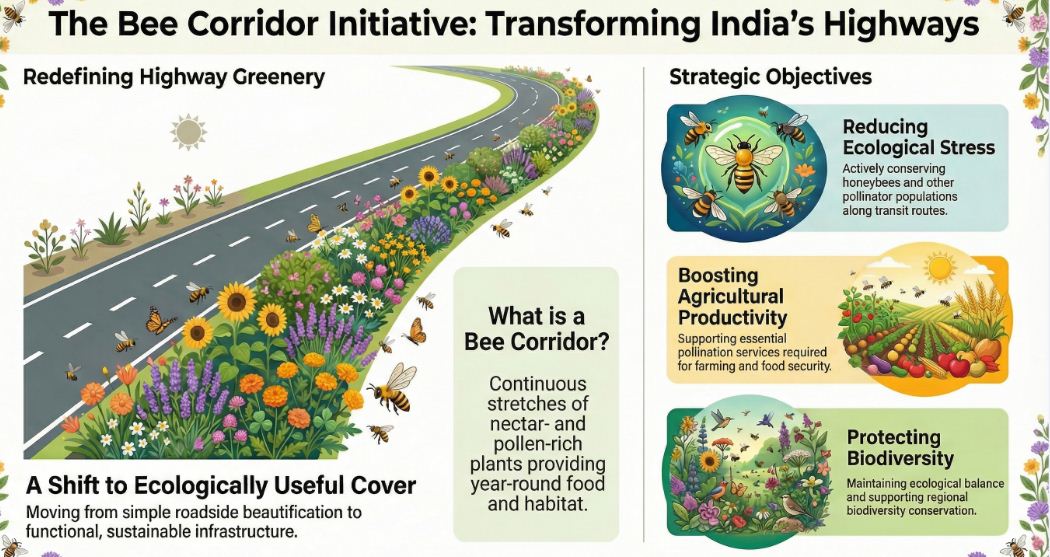
The National Highways Authority of India (NHAI) has launched a first-of-its-kind initiative to develop Pollinator Corridors (Bee Corridors) along national highways as part of its sustainable infrastructure programme. This initiative reflects a shift from conventional roadside beautification plantations to ecologically useful green cover.

What is a Bee Corridor?

Bee Corridor is a continuous stretch of vegetation along highways consisting of nectar- and pollen-rich plants that support honeybees and other pollinators. The aim is to ensure year-round availability of food and habitat for pollinating species.

Objectives

The Bee Corridor initiative aims to:

  • Conserve honeybees and other pollinators

  • Reduce ecological stress on pollinator populations

  • Support pollination services, which are crucial for:

    • agricultural productivity

    • biodiversity conservation

    • ecological balance

  • Promote environmentally responsible highway development

Key Features of the Initiative:

1. Ecological plantation approach:

  • Plantation will focus on native and flowering species, not ornamental plants.

  • A mix of trees, shrubs, herbs, and grasses will be developed.

2. Year-round flowering plan:

  • Plantation design will ensure staggered flowering across seasons, creating a near-continuous blooming cycle.

  • This will provide continuous nectar and pollen supply throughout the year.

3. Habitat-friendly corridor design:

The corridor will also include:

  • allowing flowering weeds to grow naturally

  • retaining natural structures such as:

    • dead wood

    • hollow tree trunks
      These act as nesting and shelter sites for pollinators.

Plant Species Selected:

NHAI has proposed plantation of nectar/pollen-rich species such as:

  • Neem

  • Karanj

  • Mahua

  • Palash

  • Bottle Brush

  • Jamun

  • Siris

These species are known to attract bees and support pollinator diversity.

Implementation Strategy:

  • Corridors will be developed along selected highway stretches and vacant NHAI land parcels.

  • Plantation will be decided based on agro-climatic suitability.

  • Field offices will identify locations where clusters of flowering trees can be planted at intervals of:

    • 500 metres to 1 km
      This is aligned with the average foraging range of honeybees.

Targets (2026–27):

  • NHAI plans to develop at least three pollinator corridors during 2026–27.

  • Around 40 lakh trees will be planted along national highways.

  • About 60% of plantation will be done under the Bee Corridor initiative.

Significance:

The initiative is important because:

  • Pollinators are essential for crop yield and biodiversity.

  • Decline in bees threatens food security and ecosystem stability.

  • Bee corridors will help create green ecological highways.

  • It integrates infrastructure development with environment conservation.

Conclusion

The NHAI Bee Corridor initiative is a major step towards sustainable highway development, focusing on conservation of pollinators through native flowering plantations. It not only strengthens biodiversity but also supports agriculture and ecological stability by protecting essential pollination services.

एनएचएआई (NHAI) ‘बी कॉरिडोर’ / परागणकर्ता गलियारा पहल :

राष्ट्रीय राजमार्ग प्राधिकरण (NHAI) ने सतत अवसंरचना (Sustainable Infrastructure) कार्यक्रम के अंतर्गत एक अद्वितीय पहल की घोषणा की है, जिसके तहत राष्ट्रीय राजमार्गों के किनारे परागणकर्ता गलियारे (Pollinator Corridor) अथवा ‘बी कॉरिडोर’ विकसित किए जाएंगे। यह पहल सड़क किनारे केवल सजावटी पौधारोपण की जगह पर्यावरणीय रूप से उपयोगी हरित आवरण विकसित करने की दिशा में महत्वपूर्ण कदम है।

बी कॉरिडोर क्या है?

बी कॉरिडोर से तात्पर्य राष्ट्रीय राजमार्गों के किनारे विकसित ऐसे हरित क्षेत्र से है, जहाँ मधुमक्खियों एवं अन्य परागणकर्ताओं के लिए अनुकूल पौधों, झाड़ियों और वृक्षों का निरंतर रोपण किया जाएगा। इसका उद्देश्य पूरे वर्ष पराग (Pollen) और मधुरस (Nectar) की उपलब्धता सुनिश्चित करना है।

पहल के उद्देश्य:

इस योजना के प्रमुख उद्देश्य निम्नलिखित हैं:

  • मधुमक्खियों तथा अन्य परागणकर्ताओं का संरक्षण करना।

  • परागणकर्ताओं पर बढ़ते पारिस्थितिक दबाव (Ecological Stress) को कम करना।

  • परागण सेवाओं को सुरक्षित करना, जो निम्न क्षेत्रों में अत्यंत महत्वपूर्ण हैं:

    • कृषि उत्पादकता

    • खाद्य सुरक्षा

    • जैव विविधता संरक्षण

    • पारिस्थितिक संतुलन बनाए रखना

  • राष्ट्रीय राजमार्ग विकास को पर्यावरण-अनुकूल एवं सतत बनाना।

योजना की प्रमुख विशेषताएँ:

1. सजावटी नहीं, पारिस्थितिक पौधारोपण

  • यह योजना सड़क किनारे केवल सुंदरता बढ़ाने वाले पौधों के बजाय पर्यावरणीय उपयोगिता वाले वृक्षों और वनस्पतियों पर केंद्रित होगी।

  • गलियारे में वृक्ष, झाड़ियाँ, औषधियाँ (Herbs) तथा घास का संतुलित मिश्रण होगा।

2. वर्षभर पुष्पन (Year-round flowering)

  • पौधों का चयन इस प्रकार किया जाएगा कि विभिन्न ऋतुओं में अलग-अलग प्रजातियाँ खिलें, जिससे पूरे वर्ष मधुमक्खियों को भोजन उपलब्ध हो सके।

  • इससे लगभग निरंतर पुष्पन चक्र (Continuous blooming cycle) बना रहेगा।

3. परागणकर्ताओं के लिए प्राकृतिक आवास

  • योजना के अंतर्गत केवल पौधारोपण ही नहीं, बल्कि मधुमक्खियों के अनुकूल प्राकृतिक वातावरण तैयार किया जाएगा।

  • इसके लिए:

    • फूल देने वाली जंगली घासों को बढ़ने दिया जाएगा।

    • सूखी लकड़ी, खोखले तने एवं पुराने वृक्षों के हिस्सों को संरक्षित रखा जाएगा, जो परागणकर्ताओं के लिए आश्रय स्थल बनते हैं।

प्रस्तावित पौधों/वृक्षों की प्रजातियाँ

एनएचएआई द्वारा चयनित प्रमुख पराग एवं मधुरस युक्त वृक्षों में शामिल हैं:

  • नीम

  • करंज

  • महुआ

  • पलाश

  • बॉटल ब्रश

  • जामुन

  • सिरिस

ये प्रजातियाँ मधुमक्खियों को आकर्षित करने और परागण सेवाओं को बढ़ाने में सहायक मानी जाती हैं।

कार्यान्वयन रणनीति

  • यह गलियारा कृषि-जलवायु अनुकूलता (Agro-climatic suitability) के आधार पर राष्ट्रीय राजमार्गों के किनारे तथा एनएचएआई की रिक्त भूमि पर विकसित किया जाएगा।

  • एनएचएआई के फील्ड कार्यालय उन स्थानों की पहचान करेंगे जहाँ:

    • हर 500 मीटर से 1 किलोमीटर के अंतराल पर फूलदार वृक्षों के समूह लगाए जा सकें।

  • यह दूरी मधुमक्खियों की औसत खोज दूरी (Foraging range) के अनुरूप रखी गई है।

लक्ष्य (2026-27)

  • एनएचएआई का लक्ष्य वर्ष 2026-27 में कम से कम तीन परागणकर्ता गलियारे विकसित करना है।

  • इसी अवधि में राष्ट्रीय राजमार्गों के किनारे लगभग 40 लाख वृक्ष लगाए जाएंगे।

  • इनमें से लगभग 60% वृक्षारोपण बी कॉरिडोर पहल के अंतर्गत किया जाएगा।

महत्त्व

यह पहल अत्यंत महत्वपूर्ण है क्योंकि:

  • परागणकर्ता कृषि उत्पादन में महत्वपूर्ण भूमिका निभाते हैं।

  • मधुमक्खियों की संख्या में गिरावट से फसल उत्पादन, फल-फूलों की पैदावार तथा जैव विविधता पर गंभीर प्रभाव पड़ता है।

  • यह योजना राजमार्ग विकास को हरित, टिकाऊ एवं पर्यावरण-संतुलित बनाने में सहायक होगी।

  • इससे भारत में सतत विकास के लक्ष्यों को भी बल मिलेगा।

निष्कर्ष

एनएचएआई की ‘बी कॉरिडोर’ पहल एक अभिनव प्रयास है, जो सड़क निर्माण एवं पर्यावरण संरक्षण के बीच संतुलन स्थापित करने की दिशा में महत्वपूर्ण कदम है। यह योजना परागणकर्ताओं के संरक्षण के साथ-साथ कृषि उत्पादकता और पारिस्थितिक स्थिरता को भी मजबूत करेगी


Get In Touch

B-36, Sector-C, Aliganj – Near Aliganj, Post Office Lucknow – 226024 (U.P.) India

vaidsicslucknow1@gmail.com

+91 8858209990, +91 9415011892

Newsletter

Subscribe now for latest updates.

Follow Us

© www.vaidicslucknow.com. All Rights Reserved.