November 24, 2026
New Strategic Arms Reduction Treaty (New START):नई सामरिक शस्त्र न्यूनीकरण संधि (न्यू स्टार्ट)
New Strategic Arms Reduction Treaty (New START): Nuclear Arms Control
Why in News?
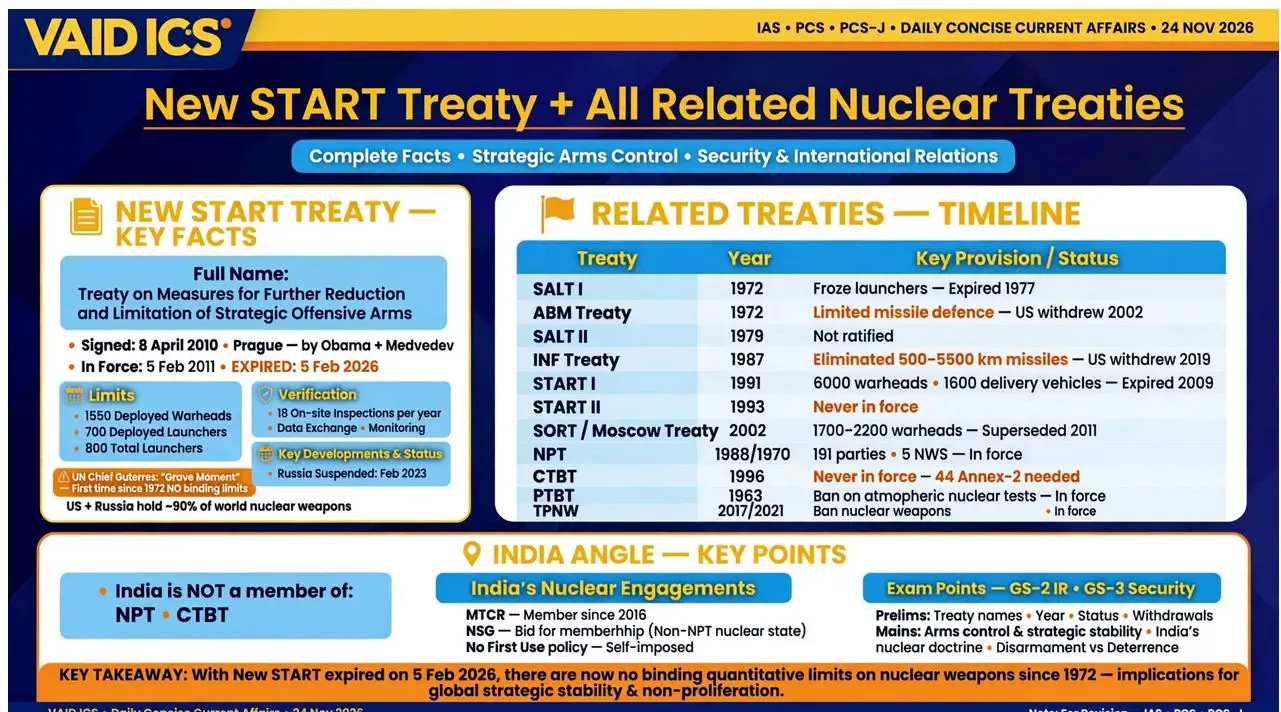
The New Strategic Arms Reduction Treaty (New START) expired without an operational successor, raising concerns about the absence of legally binding limits on the strategic nuclear arsenals of the United States and Russia.
Key Facts:
-
New START: A bilateral nuclear arms control treaty between the United States and Russia.
-
Treaty Expiry: Its expiry ended the existing framework of legally binding limits on their deployed strategic nuclear weapons.
-
Nuclear Arsenals: The United States and Russia each possess more than 5,000 nuclear warheads, while China’s estimated stockpile is around 620 warheads.
-
APEC Summit: Leaders of the United States, Russia and China issued a joint declaration on reducing nuclear risks at the Asia-Pacific Economic Cooperation (APEC) Summit.
-
US Position: Washington supports a trilateral arms control agreement involving the United States, Russia and China.
-
China’s Position: Beijing opposes binding limits because of the significant difference between its nuclear arsenal and those of the United States and Russia.
Detailed Insights:
Background of Nuclear Arms Control:
-
The expiry of New START raises concerns about the future of the strategic arms control framework that began with the Strategic Arms Limitation Talks (SALT) in 1972.
-
The treaty provided limits and verification mechanisms for strategic nuclear weapons held by the United States and Russia.
Russia’s Position:
-
Russia had previously suspended bilateral verification inspections under New START.
-
It formally revoked its ratification of the Comprehensive Nuclear-Test-Ban Treaty (CTBT).
-
Russia demands that any future multilateral nuclear disarmament framework should also consider the nuclear arsenals of NATO member countries.
China’s Nuclear Policy:
-
China follows a policy of No First Use (NFU) of nuclear weapons.
-
It maintains strategic ambiguity regarding its nuclear capabilities.
-
It seeks to maintain a credible second-strike capability against potential threats, including missile defence systems.
Emerging Challenges:
-
Artificial Intelligence: Use of AI in nuclear command, control and communication systems may increase the risk of miscalculation and accidental escalation.
-
Lack of Transparency: Reduced verification and monitoring can weaken trust between nuclear powers.
-
Nuclear Competition: Differences in nuclear stockpiles make negotiations on equal limits difficult.
-
Absence of Treaty Framework: The lack of legally binding limits increases uncertainty in global nuclear security.
Proposed Confidence-Building Measures:
-
Launch Notifications: Advance communication about missile launches to avoid misunderstandings.
-
Crisis Hotlines: Direct communication channels between nuclear powers during emergencies.
-
Human Control: Maintaining meaningful human control over nuclear launch decisions rather than allowing automated systems to make such decisions.
Key Concepts:
New START:
A bilateral nuclear arms control treaty between the United States and Russia that placed limits on deployed strategic nuclear warheads and their delivery systems.
No First Use (NFU):
A nuclear policy under which a country pledges not to use nuclear weapons first and will use them only in response to a nuclear attack.
Second-Strike Capability:
The ability of a country to launch a nuclear retaliatory attack even after suffering an initial nuclear strike.
Confidence-Building Measures (CBMs):
Diplomatic and military arrangements designed to reduce mistrust, prevent misunderstandings and improve transparency between countries.
Nuclear Command, Control and Communications (NC3):
The systems and procedures used by a country to manage, communicate and control its nuclear forces and decisions.
Significance for Global Security:
-
Helps prevent nuclear conflict and accidental escalation.
-
Promotes transparency and trust among nuclear powers.
-
Reduces the risk of an uncontrolled nuclear arms race.
-
Strengthens international efforts towards nuclear disarmament and strategic stability.
Conclusion:
The expiry of New START creates a major challenge for global nuclear arms control. Renewed diplomatic engagement, confidence-building measures and effective human control over nuclear decisions are important for maintaining global nuclear stability.
नई सामरिक शस्त्र न्यूनीकरण संधि (न्यू स्टार्ट): परमाणु हथियार नियंत्रण
समाचारों में क्यों?
नई सामरिक शस्त्र न्यूनीकरण संधि (New START) बिना किसी प्रभावी उत्तराधिकारी समझौते के समाप्त हो गई है। इससे अमेरिका और रूस के सामरिक परमाणु हथियारों पर कानूनी रूप से बाध्यकारी सीमाओं के समाप्त होने को लेकर चिंताएँ बढ़ गई हैं।
प्रमुख तथ्य:
-
न्यू स्टार्ट: यह संयुक्त राज्य अमेरिका और रूस के बीच एक द्विपक्षीय परमाणु हथियार नियंत्रण संधि थी।
-
संधि की समाप्ति: इसके समाप्त होने से दोनों देशों के तैनात सामरिक परमाणु हथियारों पर कानूनी रूप से बाध्यकारी सीमाओं का मौजूदा ढाँचा समाप्त हो गया।
-
परमाणु हथियार भंडार: अमेरिका और रूस, दोनों के पास 5,000 से अधिक परमाणु आयुध हैं, जबकि चीन के पास लगभग 620 परमाणु आयुध होने का अनुमान है।
-
APEC शिखर सम्मेलन: अमेरिका, रूस और चीन के नेताओं ने एशिया-प्रशांत आर्थिक सहयोग (APEC) शिखर सम्मेलन में परमाणु जोखिमों को कम करने संबंधी संयुक्त घोषणा जारी की।
-
अमेरिका का रुख: अमेरिका, अमेरिका, रूस और चीन को शामिल करते हुए त्रिपक्षीय परमाणु हथियार नियंत्रण समझौते का समर्थन करता है।
-
चीन का रुख: चीन अपने परमाणु हथियार भंडार और अमेरिका तथा रूस के परमाणु हथियार भंडार के बीच बड़े अंतर का हवाला देते हुए बाध्यकारी सीमाओं का विरोध करता है।
विस्तृत विश्लेषण:
परमाणु हथियार नियंत्रण की पृष्ठभूमि:
-
न्यू स्टार्ट की समाप्ति से उस सामरिक हथियार नियंत्रण व्यवस्था के भविष्य पर चिंता बढ़ गई है, जिसकी शुरुआत 1972 में सामरिक शस्त्र परिसीमन वार्ता (SALT) से हुई थी।
-
इस संधि में अमेरिका और रूस के सामरिक परमाणु हथियारों पर सीमाएँ निर्धारित करने तथा उनके सत्यापन के लिए तंत्र उपलब्ध कराया गया था।
रूस का रुख:
-
रूस ने पहले ही न्यू स्टार्ट के अंतर्गत द्विपक्षीय सत्यापन निरीक्षणों को निलंबित कर दिया था।
-
रूस ने औपचारिक रूप से व्यापक परमाणु-परीक्षण प्रतिबंध संधि (CTBT) के अनुसमर्थन को निरस्त कर दिया।
-
रूस की माँग है कि भविष्य की बहुपक्षीय परमाणु निरस्त्रीकरण व्यवस्था में नाटो सदस्य देशों के परमाणु हथियार भंडार को भी ध्यान में रखा जाए।
चीन की परमाणु नीति:
-
चीन परमाणु हथियारों के प्रथम प्रयोग न करने (No First Use–NFU) की नीति का पालन करता है।
-
वह अपनी परमाणु क्षमताओं के संबंध में रणनीतिक अस्पष्टता बनाए रखता है।
-
चीन संभावित खतरों, जिनमें मिसाइल रक्षा प्रणालियाँ भी शामिल हैं, के विरुद्ध विश्वसनीय द्वितीय प्रहार क्षमता (Second-Strike Capability) बनाए रखना चाहता है।
उभरती चुनौतियाँ:
-
कृत्रिम बुद्धिमत्ता (AI): परमाणु कमान, नियंत्रण और संचार प्रणालियों में AI का उपयोग गलत आकलन तथा आकस्मिक सैन्य तनाव बढ़ने का जोखिम पैदा कर सकता है।
-
पारदर्शिता का अभाव: सत्यापन और निगरानी में कमी से परमाणु शक्तियों के बीच विश्वास कमजोर हो सकता है।
-
परमाणु प्रतिस्पर्धा: परमाणु हथियारों के भंडार में अंतर के कारण समान सीमाओं पर आधारित वार्ता कठिन हो जाती है।
-
संधि ढाँचे का अभाव: कानूनी रूप से बाध्यकारी सीमाओं के न होने से वैश्विक परमाणु सुरक्षा को लेकर अनिश्चितता बढ़ती है।
प्रस्तावित विश्वास-निर्माण उपाय:
-
प्रक्षेपण की पूर्व सूचना: गलतफहमियों से बचने के लिए मिसाइल प्रक्षेपण से पहले संबंधित देशों को सूचना देना।
-
संकट के समय हॉटलाइन: आपातकालीन परिस्थितियों में परमाणु शक्तियों के बीच प्रत्यक्ष संचार व्यवस्था स्थापित करना।
-
मानवीय नियंत्रण: परमाणु हथियारों के प्रयोग संबंधी निर्णयों में स्वचालित प्रणालियों के स्थान पर सार्थक मानवीय नियंत्रण बनाए रखना।
प्रमुख अवधारणाएँ:
न्यू स्टार्ट (New START):
अमेरिका और रूस के बीच एक द्विपक्षीय परमाणु हथियार नियंत्रण संधि, जिसके अंतर्गत तैनात सामरिक परमाणु आयुधों तथा उनके प्रक्षेपण साधनों पर सीमाएँ निर्धारित की गई थीं।
प्रथम प्रयोग न करने की नीति (No First Use–NFU):
ऐसी परमाणु नीति जिसके अंतर्गत कोई देश पहले परमाणु हथियारों का प्रयोग न करने तथा केवल परमाणु हमले के जवाब में उनका उपयोग करने की प्रतिबद्धता व्यक्त करता है।
द्वितीय प्रहार क्षमता (Second-Strike Capability):
किसी देश की वह क्षमता, जिसके माध्यम से वह पहले परमाणु हमले का शिकार होने के बाद भी जवाबी परमाणु हमला कर सकता है।
विश्वास-निर्माण उपाय (Confidence-Building Measures–CBMs):
ऐसी कूटनीतिक और सैन्य व्यवस्थाएँ, जिनका उद्देश्य देशों के बीच अविश्वास कम करना, गलतफहमियों को रोकना तथा पारदर्शिता बढ़ाना है।
परमाणु कमान, नियंत्रण एवं संचार प्रणाली (NC3):
वे प्रणालियाँ और प्रक्रियाएँ, जिनके माध्यम से कोई देश अपने परमाणु हथियारों तथा उनसे संबंधित निर्णयों का प्रबंधन, संचार और नियंत्रण करता है।
वैश्विक सुरक्षा के लिए महत्त्व:
-
परमाणु संघर्ष और आकस्मिक सैन्य तनाव को रोकने में सहायता।
-
परमाणु शक्तियों के बीच पारदर्शिता और विश्वास को बढ़ावा।
-
अनियंत्रित परमाणु हथियारों की प्रतिस्पर्धा के जोखिम को कम करना।
-
परमाणु निरस्त्रीकरण और सामरिक स्थिरता के लिए अंतरराष्ट्रीय प्रयासों को मजबूत करना।
निष्कर्ष:
न्यू स्टार्ट की समाप्ति वैश्विक परमाणु हथियार नियंत्रण के समक्ष एक बड़ी चुनौती प्रस्तुत करती है। वैश्विक परमाणु स्थिरता बनाए रखने के लिए नए सिरे से कूटनीतिक प्रयास, विश्वास-निर्माण उपाय तथा परमाणु हथियारों के प्रयोग संबंधी निर्णयों पर प्रभावी मानवीय नियंत्रण आवश्यक हैं।

May 19, 2026
October 17, 2025
October 16, 2025
October 6, 2025

