April 24, 2026
National Panchayati Raj Day :
Introduction National Panchayati Raj Day is celebrated every year on April 24th to commemorate the institutionalization of local self-government in India. It marks the day the 73rd Constitutional Amendment Act, 1992 came into force in 1993, transferring power to the grassroots level.
Why Celebrated?
- Constitutional Recognition: To celebrate the day Panchayats were given constitutional status as the “Third Tier” of Indian democracy.
- Democracy at Grassroots: To recognize the role of Gram Sabhas and Panchayats in rural development and decentralized planning.
- Awareness: To sensitize rural populations about their rights and the functioning of local governance.
Constitutional Provisions:
- Article 40 (DPSP): Originally directed the State to organize village panchayats.
- Part IX: Inserted by the 73rd Amendment, titled “The Panchayats.”
- Article 243 to 243-O: Covers definitions, composition, reservations, and powers.
- 11th Schedule: Lists 29 functional items (e.g., agriculture, health, education) over which Panchayats have jurisdiction.
- Key Features: Mandatory 3-tier structure (Village, Intermediate, District), 1/3rd reservation for women, and the establishment of State Finance Commissions and State Election Commissions.
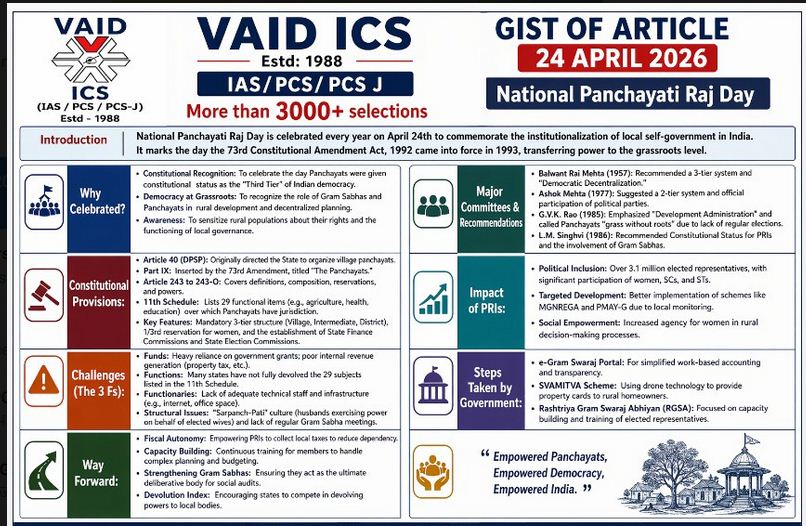
Major Committees & Recommendations:
- Balwant Rai Mehta (1957): Recommended a 3-tier system and “Democratic Decentralization.”
- Ashok Mehta (1977): Suggested a 2-tier system and official participation of political parties.
- G.V.K. Rao (1985): Emphasized “Development Administration” and called Panchayats “grass without roots” due to lack of regular elections.
- L.M. Singhvi (1986): Recommended Constitutional Status for PRIs and the involvement of Gram Sabhas.
Impact of PRIs:
- Political Inclusion: Over 3.1 million elected representatives, with significant participation of women, SCs, and STs.
- Targeted Development: Better implementation of schemes like MGNREGA and PMAY-G due to local monitoring.
- Social Empowerment: Increased agency for women in rural decision-making processes.
Challenges (The 3 Fs):
- Funds: Heavy reliance on government grants; poor internal revenue generation (property tax, etc.).
- Functions: Many states have not fully devolved the 29 subjects listed in the 11th Schedule.
- Functionaries: Lack of adequate technical staff and infrastructure (e.g., internet, office space).
- Structural Issues: “Sarpanch-Pati” culture (husbands exercising power on behalf of elected wives) and lack of regular Gram Sabha meetings.
Steps Taken by Government:
- e-Gram Swaraj Portal: For simplified work-based accounting and transparency.
- SVAMITVA Scheme: Using drone technology to provide property cards to rural homeowners.
- Rashtriya Gram Swaraj Abhiyan (RGSA): Focused on capacity building and training of elected representatives.
Way Forward:
- Fiscal Autonomy: Empowering PRIs to collect local taxes to reduce dependency.
- Capacity Building: Continuous training for members to handle complex planning and budgeting.
- Strengthening Gram Sabhas: Ensuring they act as the ultimate deliberative body for social audits.
- Devolution Index: Encouraging states to compete in devolving powers to local bodies.

Citizenship (Amendment) Rules, 2026
May 19, 2026
Gist of daily Article /The Hindu 17oct 2025
October 17, 2025
Daily Gist of the Hindu/Indian Express : 16 Oct 2025
October 16, 2025
Daily Gist of The Hindu/Indian Express: 6 Oct 2025
October 6, 2025

