August 7, 2026
National Handloom Day : Issues & Challenges -Way forward
Why in news?:
Observed annually on 7 August, National Handloom Day celebrates India’s rich weaving heritage, commemorating the launch of the Swadeshi Movement in 1905. The 2026 observance honors 35.22 lakh weavers and allied workers (over 72% of whom are women) while highlighting the sector’s evolution through contemporary design, digital platforms, and global market expansion.
Evolution and Significance of the Sector:
-
Historical Roots: Traces date back to the Indus Valley Civilisation, with references found in the Rigveda, Ramayana, Mahabharata, and Kautilya’s works.
-
National Platform: Instituted in 2015, National Handloom Day recognizes the socio-economic and cultural contributions of handloom workers.
-
Workforce Demographics: The Fourth All India Handloom Census (2019-20) recorded 31.45 lakh handloom households and 35.22 lakh workers (including 8.48 lakh allied workers in pre- and post-loom activities).
-
Inclusivity: Women account for 25.46 lakh workers (>72%), supported by 4.84 lakh SC workers, 6.28 lakh ST workers, and 12.67 lakh OBC workers. Nearly 9 out of 10 handlooms are located in rural areas.
Ecosystem of Support and Government Schemes:
-
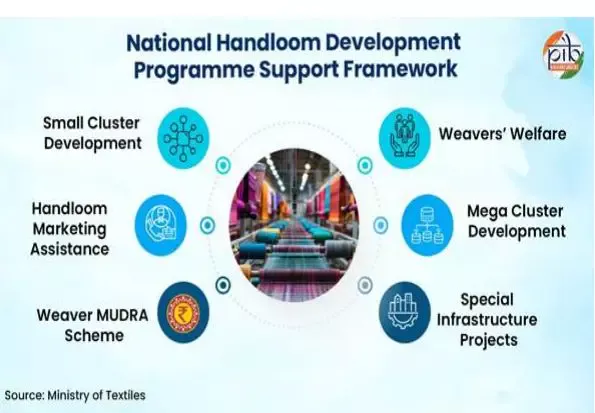
National Handloom Development Programme (NHDP): Focuses on the integrated development of the sector and weaver welfare through a need-based approach.
-
Small Cluster Development Programme (SCDP): Provides funding up to ₹2 crore per cluster. Interventions like workshed construction and Electronic Jacquards have significantly boosted daily production, working hours, and average daily earnings (e.g., electronic jacquards increased average daily wages from ₹360 to ₹560).
-
Handloom Marketing Assistance (HMA): Facilitates direct sales via expos, craft melas, and national awards like the Sant Kabir Handloom Award (₹3.5 lakh) and the National Handloom Award (₹2 lakh).
-
Concessional Credit (Weaver MUDRA Scheme): Offers loans at a concessional 6% interest rate supported by a 7% government interest subvention.
-
Welfare Measures: Provides life and accident insurance via PMJJBY and PMSBY, alongside scholarships of up to ₹2 lakh annually for children of handloom workers.
-
Raw Material Supply Scheme (RMSS): Ensures access to yarn through freight reimbursement and a 15% price subsidy on specified yarns.
Policy and Budgetary Pushes (2026-27):
-
GST Rationalisation: Tax rates on 36 handicraft items, cotton handloom rugs, handwoven carpets, and sewing machines were reduced from 12% to 5%.
-
Union Budget 2026-27 Measures: * National Fibre Scheme: Strengthens the natural and man-made raw-material base.
-
Textile Expansion and Employment Scheme: Modernises traditional clusters with capital support for machinery and testing centres.
-
Mahatma Gandhi Gram Swaraj Initiative: Focuses on global market linkages, branding, training, and quality improvements for khadi, handloom, and handicrafts.
-
Design, Innovation, and Market Access:
-
Global Showcases: Initiatives like Vishwa Sutra (at Femina Miss India 2026), Breathing Threads (Bharat Tex 2025), and Handloom Sarees in Motion (IFFI 2025) successfully integrate traditional weaves into international silhouettes and cinematic narratives.
-
Innovation Platforms: Events like Weave The Future 4.0 (circular design/upcycling) and the Handloom Hackathon 2026 drive modern solutions for sustainability and entrepreneurship.
-
Exports: India’s handloom exports reached ~₹1,330.96 crore in 2025-26, led by destinations like the UAE, USA, France, UK, and Spain.
-
Digital & Authenticity Safeguards: * e-Pehchan Portal: Expanded digital registration for workers.
-
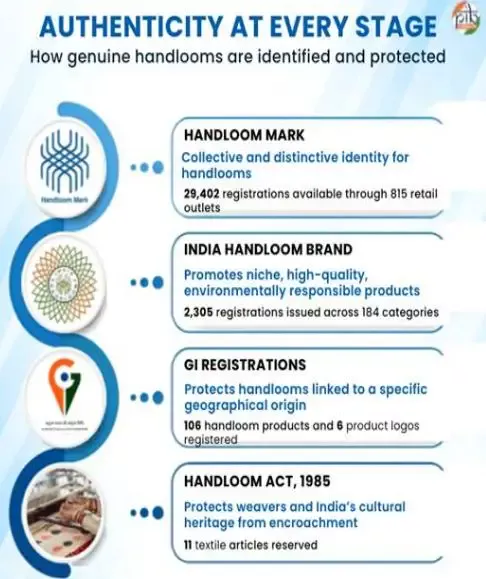
Handloom Mark & India Handloom Brand: Guarantee genuine handwoven status, zero defects, and eco-friendly production.
-
GI Tags: Protecting 106 handloom products and regional identities under the GI Act, 1999.
-
Handlooms Act, 1985: Reserves 11 specified textile articles exclusively for handloom production to prevent encroachment by powerlooms.
Challenges:
Key Challenges:
-
Technological Obsolescence: Many weavers still rely on traditional, outdated looms and manual pre-loom processes, limiting large-scale productivity and consistent quality.
-
Credit Constraints and Debt: Despite schemes like Weaver MUDRA, many rural weavers struggle with formal institutional credit access and often depend on local moneylenders at high interest rates.
-
Supply Chain and Raw Material Vulnerability: Fluctuations in yarn prices (cotton, silk, and wool) directly squeeze the profit margins of small-scale weaver households.
-
Market Competition and Powerloom Encroachment: Powermills and cheaper machine-made synthetic substitutes frequently undercut authentic handloomed products, despite protective legislation like the Handlooms Act.
-
Ageing Workforce and Skill Migration: Younger generations in weaver families are increasingly moving away from traditional crafts due to lower relative earnings and arduous working conditions, threatening the intergenerational transfer of skills.

Way Forward:
-
Digitisation and Direct-to-Consumer Access: Expand digital onboarding on platforms like the Indiahandmade portal and GeM to eliminate middlemen and ensure direct remuneration for weavers.
-
Modernisation through Innovation: Scale up the adoption of Electronic Jacquards and modern common facility centres to enhance intricate design capabilities, speed, and overall income.
-
Strengthening Formal Credit and Welfare: Streamline the disbursement of concessional loans under the MUDRA scheme and enhance awareness of social security nets (PMJJBY and PMSBY) across remote rural clusters.
-
Enhanced Quality Assurance and GI Enforcement: Rigorously enforce the Handloom Mark, India Handloom Brand, and strict implementation of the Handlooms Act, 1985 to penalise illegal powerloom imitation of reserved items and protect GI-tagged heritage.
-
Fostering Skill Development and Youth Engagement: Introduce formal textile designing courses, design incubators, and innovation challenges like the Handloom Hackathon to attract tech-savvy youth into sustainable circular fashion and handloom entrepreneurship.
-
-
-
समाचारों में क्यों?:
प्रत्येक वर्ष 7 अगस्त को मनाया जाने वाला राष्ट्रीय हथकरघा दिवस भारत की समृद्ध बुनाई विरासत का जश्न मनाता है, जो 1905 में स्वदेशी आंदोलन की शुरुआत की याद दिलाता है। वर्ष 2026 का यह अवसर 35.22 लाख बुनकरों और संबद्ध कामगारों (जिनमें से 72% से अधिक महिलाएं हैं) को सम्मानित करता है, साथ ही समकालीन डिजाइन, डिजिटल प्लेटफॉर्म और वैश्विक बाजार विस्तार के माध्यम से इस क्षेत्र के विकास को रेखांकित करता है।
इस क्षेत्र का विकास और महत्व:
-
ऐतिहासिक जड़ें: इसके प्रमाण सिंधु घाटी सभ्यता से मिलते हैं, और ऋग्वेद, रामायण, महाभारत तथा कौटिल्य के ग्रंथों में भी इसका उल्लेख है।
-
राष्ट्रीय मंच: वर्ष 2015 में स्थापित राष्ट्रीय हथकरघा दिवस हथकरघा कामगारों के सामाजिक-आर्थिक और सांस्कृतिक योगदान को मान्यता देता है।
-
कार्यबल जनसांख्यिकी: चौथी अखिल भारतीय हथकरघा जनगणना (2019-20) के अनुसार देश में 31.45 लाख हथकरघा परिवार और 35.22 लाख कामगार (पूर्व-करघा और पश्चात-करघा गतिविधियों वाले 8.48 लाख संबद्ध कामगारों सहित) दर्ज किए गए।
-
समावेशिता: कुल कामगारों में 25.46 लाख महिलाएं (>72%) हैं। इसके अलावा 4.84 लाख अनुसूचित जाति (SC), 6.28 लाख अनुसूचित जनजाति (ST) और 12.67 लाख अन्य पिछड़ा वर्ग (OBC) के कामगार शामिल हैं। प्रत्येक 10 में से लगभग 9 हथकरघा ग्रामीण क्षेत्रों में स्थित हैं।
सहायता और सरकारी योजनाओं का पारिस्थितिकी तंत्र:
-
राष्ट्रीय हथकरघा विकास कार्यक्रम (NHDP): आवश्यकता-आधारित दृष्टिकोण के माध्यम से हथकरघा क्षेत्र के एकीकृत विकास और बुनकरों के कल्याण पर ध्यान केंद्रित करता है।
-
लघु क्लस्टर विकास कार्यक्रम (SCDP): प्रति क्लस्टर ₹2 करोड़ तक की वित्तीय सहायता प्रदान करता है। कार्यशेड निर्माण और इलेक्ट्रॉनिक जैकार्ड जैसी पहलों ने दैनिक उत्पादन, काम के घंटों और औसत दैनिक आय में उल्लेखनीय वृद्धि की है (जैसे इलेक्ट्रॉनिक जैकार्ड से औसत दैनिक मजदूरी ₹360 से बढ़कर ₹560 हो गई)।
-
हथकरघा विपणन सहायता (HMA): प्रदर्शनियों, शिल्प मेलों और राष्ट्रीय पुरस्कारों जैसे संत कबीर हथकरघा पुरस्कार (₹3.5 लाख) और राष्ट्रीय हथकरघा पुरस्कार (₹2 लाख) के माध्यम से प्रत्यक्ष बिक्री को बढ़ावा देती है।
-
रियायती ऋण (बुनकर मुद्रा योजना): सरकार द्वारा 7% ब्याज छूट के सहयोग से 6% की रियायती ब्याज दर पर ऋण उपलब्ध कराती है।
-
कल्याणकारी उपाय: PMJJBY और PMSBY के माध्यम से जीवन और दुर्घटना बीमा के साथ-साथ हथकरघा कामगारों के बच्चों के लिए प्रति वर्ष ₹2 लाख तक की छात्रवृत्ति प्रदान की जाती है।
-
कच्चा माल आपूर्ति योजना (RMSS): माल ढुलाई प्रतिपूर्ति और निर्दिष्ट धागों पर 15% मूल्य सब्सिडी के माध्यम से धागे की उपलब्धता सुनिश्चित करती है।
नीति और बजटीय प्रावधान (2026-27):
-
GST युक्तिकरण: 36 हस्तशिल्प वस्तुओं, सूती हथकरघा दरी, हाथ से बुने हुए कालीनों और सिलाई मशीनों पर कर की दर को 12% से घटाकर 5% कर दिया गया है।
-
केंद्रीय बजट 2026-27 के उपाय: * राष्ट्रीय फाइबर योजना: प्राकृतिक और मानव निर्मित कच्चे माल के आधार को मजबूत करती है।
-
वस्त्र विस्तार और रोजगार योजना: मशीनरी, प्रौद्योगिकी उन्नयन और सामान्य परीक्षण केंद्रों के लिए पूंजीगत सहायता के साथ पारंपरिक क्लस्टर का आधुनिकीकरण करती है।
-
महात्मा गांधी ग्राम स्वराज्य पहल: खादी, हथकरघा और हस्तशिल्प के लिए वैश्विक बाजार संबंधों, ब्रांडिंग, प्रशिक्षण, कौशल विकास और उत्पादन प्रक्रियाओं तथा गुणवत्ता में सुधार पर ध्यान केंद्रित करती है।
-
डिजाइन, नवाचार और बाजार पहुंच:
-
वैश्विक प्रदर्शन: विश्व सूत्र (फेमिना मिस इंडिया 2026 में), ब्रीदिंग थ्रेड्स (भारत टेक्स 2025) और हथकरघा साड़ियां इन मोशन (IFFI 2025) जैसी पहल पारंपरिक बुनाई को अंतरराष्ट्रीय परिधानों और सिनेमाई कथाओं में सफलतापूर्वक एकीकृत करती हैं।
-
नवाचार मंच: वीव द फ्यूचर 4.0 (सर्कुलर डिजाइन/अपसाइक्लिंग) और हथकरघा हैकाथॉन 2026 जैसे आयोजन स्थिरता और उद्यमिता के लिए आधुनिक समाधान को बढ़ावा देते हैं।
-
निर्यात: वर्ष 2025-26 में भारत का हथकरघा निर्यात ~₹1,330.96 करोड़ तक पहुंच गया, जिसमें संयुक्त अरब अमीरात, अमेरिका, फ्रांस, ब्रिटेन और स्पेन प्रमुख गंतव्य रहे।
-
डिजिटल और प्रमाणिकता सुरक्षा उपाय: * ई-पहचान पोर्टल: कामगारों के लिए डिजिटल पंजीकरण का विस्तार।
-
हथकरघा चिह्न (Handloom Mark) और इंडिया हथकरघा ब्रांड: वास्तविक हाथ से बुने होने की स्थिति, शून्य दोष (zero defects) और पर्यावरण-अनुकूल उत्पादन की गारंटी देते हैं।
-
जीआई टैग (GI Tags): जीआई अधिनियम, 1999 के तहत 106 हथकरघा उत्पादों और क्षेत्रीय पहचान की सुरक्षा करते हैं।
-
हथकरघा अधिनियम, 1985: पावरलूम के अतिक्रमण को रोकने के लिए हथकरघा उत्पादन के लिए 11 विशिष्ट कपड़ा वस्तुओं को आरक्षित करता है।
-
चुनौतियाँ और आगे की राह:
मुख्य चुनौतियाँ:
-
तकनीकी पिछड़ापन: कई बुनकर अभी भी पारंपरिक, पुराने करगारों और मैनुअल पूर्व-करघा प्रक्रियाओं पर निर्भर हैं, जिससे बड़े पैमाने पर उत्पादकता और एक समान गुणवत्ता सीमित होती है।
-
ऋण बाधाएं और कर्ज: बुनकर मुद्रा जैसी योजनाओं के बावजूद, कई ग्रामीण बुनकर औपचारिक संस्थागत ऋण पहुंच के लिए संघर्ष करते हैं और अक्सर उच्च ब्याज दरों पर स्थानीय साहूकारों पर निर्भर रहते हैं।
-
आपूर्ति श्रृंखला और कच्चे माल की सुभेद्यता: सूती, रेशम और ऊन के धागों की कीमतों में उतार-चढ़ाव सीधे तौर पर छोटे बुनकर परिवारों के लाभ मार्जिन को प्रभावित करता है।
-
बाजार की प्रतिस्पर्धा और पावरलूम का अतिक्रमण: हथकरघा अधिनियम जैसे सुरक्षात्मक कानूनों के बावजूद, पावरमिल और सस्ते मशीन से बने सिंथेटिक विकल्प अक्सर असली हथकरघा उत्पादों को नुकसान पहुंचाते हैं।
-
वृद्ध कार्य कार्यबल और कौशल पलायन: बुनकर परिवारों की युवा पीढ़ियां कम सापेक्ष आय और कठिन कार्य परिस्थितियों के कारण पारंपरिक शिल्पों से दूर हो रही हैं, जिससे कौशल का अंतर-पीढ़ीगत हस्तांतरण खतरे में पड़ रहा है।
आगे की राह:
-
डिजिटलीकरण और सीधे उपभोक्ता तक पहुंच (Direct-to-Consumer): बिचौलियों को खत्म करने और बुनकरों को सीधा पारिश्रमिक सुनिश्चित करने के लिए Indiahandmade पोर्टल और GeM जैसे प्लेटफार्मों पर डिजिटल ऑनबोर्डिंग का विस्तार करना।
-
नवाचार के माध्यम से आधुनिकीकरण: जटिल डिजाइन क्षमताओं, गति और समग्र आय को बढ़ाने के लिए इलेक्ट्रॉनिक जैकार्ड और आधुनिक सामान्य सुविधा केंद्रों को अपनाना।
-
औपचारिक ऋण और कल्याण को सुदृढ़ करना: मुद्रा योजना के तहत रियायती ऋणों के वितरण को सुव्यवस्थित करना और दूरदराज के ग्रामीण क्लस्टरों में सामाजिक सुरक्षा योजनाओं (PMJJBY और PMSBY) के बारे में जागरूकता बढ़ाना।
-
उन्नत गुणवत्ता आश्वासन और जीआई प्रवर्तन: हथकरघा चिह्न, इंडिया हथकरघा ब्रांड और हथकरघा अधिनियम, 1985 के कड़ाई से कार्यान्वयन को अनिवार्य बनाना ताकि आरक्षित वस्तुओं की अवैध पावरलूम नकल को दंडित किया जा सके और जीआई-टैग वाली विरासत की रक्षा की जा सके।
-
कौशल विकास और युवा जुड़ाव को बढ़ावा देना: तकनीकी रूप से दक्ष युवाओं को टिकाऊ सर्कुलर फैशन और हथकरघा उद्यमिता की ओर आकर्षित करने के लिए औपचारिक कपड़ा डिजाइनिंग पाठ्यक्रम, डिजाइन इनक्यूबेटर और हथकरघा हैकाथॉन जैसी नवाचार चुनौतियों को शुरू करना।

May 19, 2026
October 17, 2025
October 16, 2025
October 6, 2025

