September 24, 2026
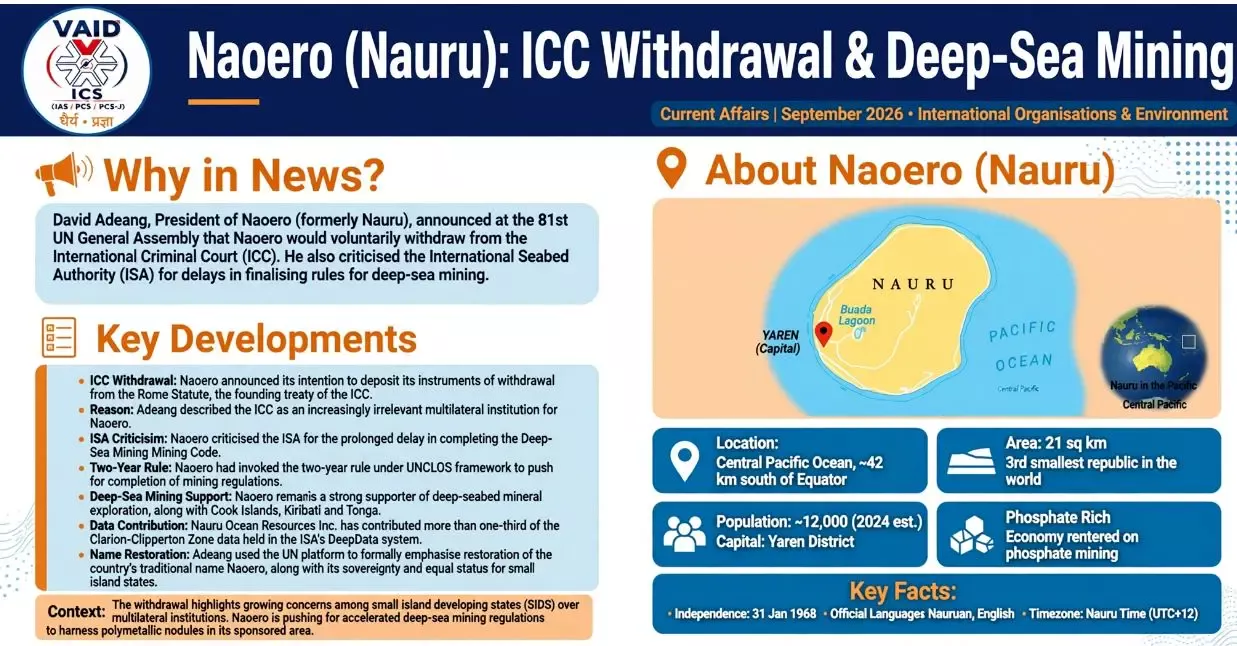
Naoero (Nauru): ICC Withdrawal & Deep-Sea Mining
Why in News?
David Adeang, President of Naoero (formerly Nauru), announced at the 81st UN General Assembly that Naoero would voluntarily withdraw from the International Criminal Court (ICC). He also criticised the International Seabed Authority (ISA) for delays in finalising rules for deep-sea mining.
Key Developments:
-
ICC Withdrawal: Naoero announced its intention to deposit its instruments of withdrawal from the Rome Statute, the founding treaty of the ICC.
-
Reason: Adeang described the ICC as an increasingly irrelevant multilateral institution for Naoero.
-
ISA Criticism: Naoero criticised the ISA for the prolonged delay in completing the Deep-Sea Mining “Mining Code”.
-
Two-Year Rule: Naoero had invoked the two-year rule under the UN Convention on the Law of the Sea (UNCLOS) framework to push for completion of mining regulations.
-
Deep-Sea Mining Support: Naoero remains a strong supporter of deep-seabed mineral exploration, along with Cook Islands, Kiribati and Tonga.
-
Data Contribution: Nauru Ocean Resources Inc. has reportedly contributed more than one-third of the Clarion-Clipperton Zone data held in the ISA’s DeepData system.
-
Name Restoration: Adeang used the UN platform to formally emphasise restoration of the country’s traditional name Naoero, along with its sovereignty and equal status for small island states.
Deep-Sea Mining & ISA:
-
The ISA regulates mineral-related activities in the international seabed area beyond national jurisdiction.
-
The Clarion-Clipperton Zone (CCZ) in the central Pacific is considered highly prospective for polymetallic nodules.
-
The unresolved Mining Code has delayed the establishment of a comprehensive regulatory framework for commercial deep-sea mining.
-
Naoero argues that prolonged regulatory delays undermine the interests of small developing island states seeking to utilise marine resources.
Significance for UPSC:
-
UNCLOS: Highlights challenges in governing resources beyond national jurisdiction.
-
Global Commons: Deep seabed minerals raise issues of equitable resource sharing and environmental protection.
-
Small Island States: Reflects concerns over sovereignty, development opportunities and equal representation in multilateral institutions.
-
Multilateralism: Naoero’s ICC decision raises questions about the effectiveness and continued participation of small states in international institutions.
Clarion–Clipperton Zone (CCZ):
Clarion–Clipperton Zone (CCZ) is a vast area of the central Pacific Ocean seabed, located between Hawaii and Mexico. It is one of the world’s most important regions for deep-sea mineral resources.
Key Points:
-
Location: Central Pacific Ocean, covering about 6 million sq. km.
-
Governance: The area lies beyond national jurisdiction and is regulated under the framework of the International Seabed Authority (ISA).
-
Major resource: CCZ contains large quantities of polymetallic nodules lying on or near the seabed.
-
These nodules contain economically important metals such as:
-
Nickel
-
Cobalt
-
Copper
-
Manganese
-
-
Deep-sea mining: Countries and private entities have obtained exploration contracts through the ISA to study these mineral deposits.
-
Environmental concern: Mining may disturb deep-sea ecosystems, including organisms that are still poorly understood, and could create sediment plumes and habitat loss.
-
Legal basis: Activities in the international seabed area are governed primarily by Part XI of the UN Convention on the Law of the Sea (UNCLOS).
-
The seabed and its mineral resources beyond national jurisdiction are treated as the “common heritage of mankind” under UNCLOS.
About International Criminal Court (ICC):
The International Criminal Court (ICC) is a permanent international court that prosecutes individuals for the most serious international crimes.
Key Facts:
-
Established: 2002
-
Headquarters: The Hague, Netherlands
-
Legal basis: Rome Statute of 1998
-
Nature: Permanent international criminal court
-
Current States Parties: 125 countries
-
Important distinction: ICC is not an organ of the United Nations, although it cooperates with the UN.
Crimes within ICC Jurisdiction:
The ICC has jurisdiction over four core crimes:
-
Genocide
-
Crimes against humanity
-
War crimes
-
Crime of aggression
नाओएरो (नाउरू): ICC से वापसी एवं गहरे समुद्र में खनन
चर्चा में क्यों?
नाओएरो (पूर्व नाम नाउरू) के राष्ट्रपति डेविड अडेंग ने संयुक्त राष्ट्र महासभा के 81वें सत्र में घोषणा की कि नाओएरो अंतर्राष्ट्रीय आपराधिक न्यायालय (ICC) से स्वैच्छिक रूप से बाहर निकलने के लिए रोम संविधि से वापसी के दस्तावेज जमा करेगा। उन्होंने अंतर्राष्ट्रीय समुद्रतल प्राधिकरण (ISA) की गहरे समुद्र में खनन संबंधी नियम बनाने में देरी की भी आलोचना की।
प्रमुख घटनाक्रम:
-
ICC से वापसी: नाओएरो ने रोम संविधि से हटने की प्रक्रिया शुरू करने की घोषणा की।
-
ICC पर रुख: राष्ट्रपति अडेंग ने ICC को नाओएरो के लिए बढ़ती अप्रासंगिकता वाला बहुपक्षीय संस्थान बताया।
-
ISA की आलोचना: गहरे समुद्र में खनन के लिए Mining Code को अंतिम रूप देने में लंबे समय से हो रही देरी पर चिंता व्यक्त की गई।
-
Two-Year Rule: नाओएरो ने खनन नियमों को शीघ्र अंतिम रूप देने के लिए दो-वर्षीय नियम का आह्वान किया था।
-
गहरे समुद्र में खनन का समर्थन: नाओएरो, कुक द्वीप, किरिबाती और टोंगा के साथ गहरे समुद्र में खनन का प्रमुख समर्थक है।
-
डेटा योगदान: Nauru Ocean Resources Inc. ने ISA के DeepData तंत्र में उपलब्ध Clarion-Clipperton Zone (CCZ) संबंधी डेटा का एक-तिहाई से अधिक योगदान किया है।
-
नाम की पुनर्स्थापना: नाओएरो ने अपनी पारंपरिक पहचान, संप्रभुता तथा छोटे द्वीपीय देशों को बहुपक्षीय संस्थाओं में समान दर्जा देने की आवश्यकता पर बल दिया।
गहरे समुद्र में खनन एवं ISA:
-
ISA राष्ट्रीय अधिकार-क्षेत्र से बाहर अंतरराष्ट्रीय समुद्रतल क्षेत्र में खनिज संसाधनों से संबंधित गतिविधियों को विनियमित करता है।
-
Clarion-Clipperton Zone (CCZ) प्रशांत महासागर का एक क्षेत्र है, जो बहुधात्विक पिंडों (Polymetallic Nodules) के लिए महत्वपूर्ण माना जाता है।
-
Mining Code के लंबित रहने से वाणिज्यिक गहरे समुद्र में खनन के लिए व्यापक नियामक ढाँचा अभी पूर्ण नहीं हो पाया है।
-
यह मुद्दा संसाधन उपयोग, पर्यावरण संरक्षण तथा विकासशील द्वीपीय देशों के हितों के बीच संतुलन से जुड़ा है।
UPSC के लिए महत्त्व:
-
UNCLOS: राष्ट्रीय अधिकार-क्षेत्र से बाहर समुद्री संसाधनों के वैश्विक शासन की चुनौती।
-
वैश्विक साझा संसाधन: समुद्रतल खनिजों के उपयोग के साथ पर्यावरणीय संरक्षण का प्रश्न।
-
छोटे द्वीपीय देश: विकास, संप्रभुता और समान प्रतिनिधित्व की चिंताएँ।
-
बहुपक्षवाद: अंतरराष्ट्रीय संस्थाओं की प्रभावशीलता और सदस्य देशों की भागीदारी से जुड़े प्रश्न।
UPSC Mains Takeaway:
नाओएरो का रुख वैश्विक साझा संसाधनों के शासन में विकासात्मक हितों, पर्यावरणीय संरक्षण और बहुपक्षीय संस्थाओं की प्रभावशीलता के बीच संतुलन की चुनौती को दर्शाता है।

May 19, 2026
October 17, 2025
October 16, 2025
October 6, 2025

