February 23, 2026
Namo Bharat Regional Rapid Transit System (RRTS)
Why in News ? The inauguration of the full 82 km Delhi–Meerut Namo Bharat (RRTS) corridor by Prime Minister Narendra Modi is more than just a transportation milestone—it is a blueprint for India’s future urban evolution. By connecting Delhi’s Sarai Kale Khan to Modipuram, this high-speed arterial network is officially launching India into the era of the Mega-Urban Conurbation.
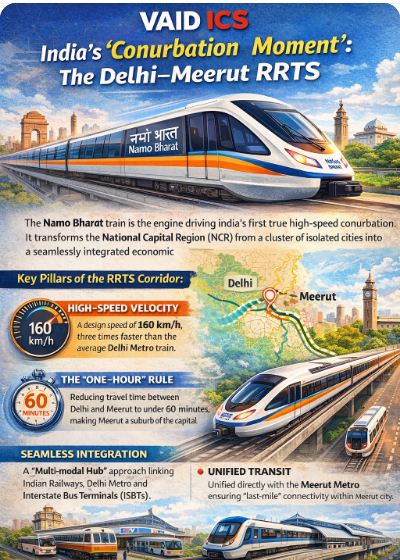
Key Pillars of the RRTS Corridor:
- High-Speed Velocity: A design speed of 160 km/h, making it three times faster than the average Delhi Metro train.
- The “One-Hour” Rule: Reducing travel time between Delhi and Meerut to under 60 minutes, effectively making Meerut a suburb of the capital.
- Seamless Integration: A “Multi-modal Hub” approach that links the RRTS with Indian Railways, the Delhi Metro, and Interstate Bus Terminals (ISBTs).
- Unified Transit: The system integrates directly with the Meerut Metro, ensuring “last-mile” connectivity within the destination city.
The Impact: The “Twin Cities” Vision:
This project supports a fundamental shift in how Indians live and work:
- Reduced Migration Pressure: People no longer need to migrate to Delhi and live in cramped conditions. They can enjoy the lower cost of living in Meerut while accessing high-paying jobs in Delhi.
- Economic Decentralization: New businesses and tech hubs are likely to sprout along the 82 km stretch, turning “transit stops” into “economic nodes.”
- Sustainability: By shifting thousands of commuters from private cars to high-speed electric rail, the RRTS significantly lowers the carbon footprint of the region.
The Vision: From Transit Project to “Conurbation”
A Conurbation, a term popularized by urban geographer Patrick Geddes, describes a region comprising several cities and large towns that, through population growth and physical expansion, have merged into one continuous industrial and service network.
The Global Context (The USA Model):
In the United States, this model has defined economic powerhouses for decades:
- BosWash: The massive urban string stretching from Boston to Washington, D.C.
- SoCal Stretch: The integrated economic zone between Los Angeles and San Diego.
In these regions, high-speed connectivity allows the workforce to treat multiple cities as a single labor market—living in one and working in another without the friction of long-distance travel.
India’s “Conurbation Moment”: The Delhi–Meerut RRTS
The Namo Bharat train is the engine driving India’s first true high-speed conurbation. It transforms the National Capital Region (NCR) from a cluster of isolated cities into a seamlessly integrated economic corridor.

October 17, 2025
October 16, 2025
October 6, 2025
September 24, 2025

