July 4, 2026
Nameri National Park and Tiger Reserve
Why in News?
The Nameri National Park and Tiger Reserve has reported a significant four-fold increase in its tiger population, rising from three in 2022 to 12 by the end of 2025. This success has been officially validated by the Wildlife Institute of India (WII), marking a major milestone in Assam’s wildlife conservation efforts.
Key Points:
-
Population Growth: The number of tigers in the reserve grew from 3 to 12 within a three-year period.
-
Return to Habitat: Two tigers have been sighted in the Sonai-Rupai Wildlife Sanctuary after being absent for decades, which is being seen as a crucial expansion of their habitat.
-
Collaborative Success: The state Forest and Environment Minister attributed this achievement to dedicated forest conservation efforts under the guidance of the state government.
-
Validation: The findings have been confirmed by the Wildlife Institute of India (WII), adding credibility to the census data.
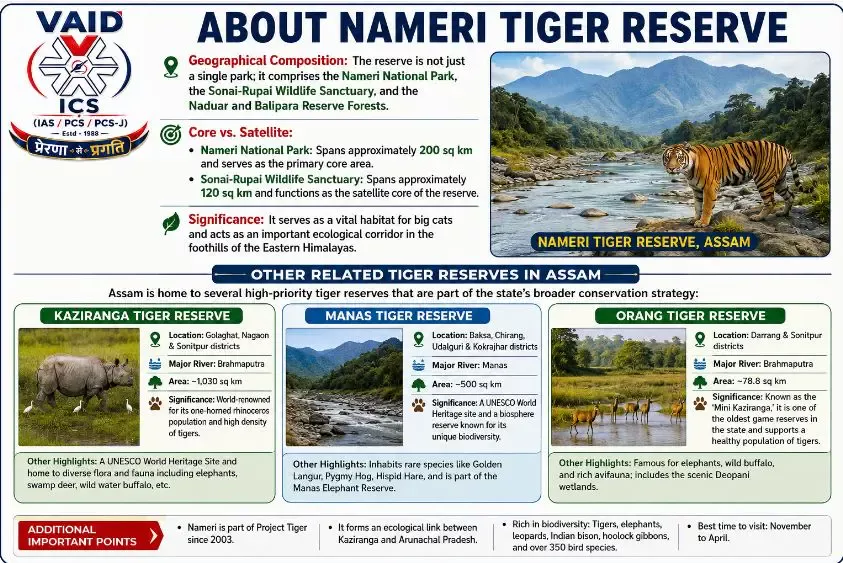
About Nameri Tiger Reserve:
-
Geographical Composition: The reserve is not just a single park; it comprises the Nameri National Park, the Sonai-Rupai Wildlife Sanctuary, and the Naduar and Balipara Reserve Forests.
-
Core vs. Satellite:
-
Nameri National Park: Spans approximately 200 sq km and serves as the primary core area.
-
Sonai-Rupai Wildlife Sanctuary: Spans approximately 120 sq km and functions as the satellite core of the reserve.
-
-
Significance: It serves as a vital habitat for big cats and acts as an important ecological corridor in the foothills of the Eastern Himalayas.
About WII:
Wildlife Institute of India (WII) is a premier autonomous institution under the Ministry of Environment, Forest and Climate Change (MoEFCC), Government of India. It plays a critical role in shaping wildlife research, management, and policy in India.
Overview:
- Established: 1982
- Headquarters: Chandrabani, Dehradun, Uttarakhand
- Nature: Autonomous Institution
- Ministry: Ministry of Environment, Forest and Climate Change (MoEFCC
About The National Tiger Conservation Authority (NTCA):
It is the apex statutory body in India responsible for the implementation of the Project Tiger and the overall management of tiger reserves across the country.
Overview:
- Established: December 2005 (following the recommendations of the Tiger Task Force).
- Statutory Status: It was given statutory status through an amendment to the Wildlife (Protection) Act, 1972, in 2006.
Ministry: It operates under the administrative control of the Ministry of Environment, Forest and Climate Change (MoEFCC).
नामरी नेशनल पार्क और टाइगर रिज़र्व:
समाचार में क्यों:
असम के नामरी नेशनल पार्क और टाइगर रिज़र्व में बाघों की संख्या में चार गुना वृद्धि दर्ज की गई है। बाघों की संख्या 2022 में तीन थी जो 2025 के अंत तक बढ़कर 12 हो गई है। इस उपलब्धि की पुष्टि वाइल्डलाइफ इंस्टीट्यूट ऑफ इंडिया (WII) द्वारा की गई है, जिसे राज्य के संरक्षण प्रयासों में एक बड़ी सफलता माना जा रहा है।
मुख्य बिंदु:
-
जनसंख्या वृद्धि: तीन वर्षों के भीतर बाघों की संख्या 3 से बढ़कर 12 हो गई है।
-
आवास में वापसी: दशकों की अनुपस्थिति के बाद सोनाई-रूपई वन्यजीव अभयारण्य (Sonai-Rupai Wildlife Sanctuary) में दो बाघों को देखा गया है, जिसे वन्यजीव संरक्षण के लिए एक महत्वपूर्ण मील का पत्थर माना जा रहा है।
-
सफल प्रयास: राज्य के वन और पर्यावरण मंत्री जयंत मल्ला बरुआ ने इस सफलता का श्रेय राज्य सरकार के निरंतर वन संरक्षण प्रयासों को दिया है।
-
आधिकारिक पुष्टि: इन आंकड़ों को वाइल्डलाइफ इंस्टीट्यूट ऑफ इंडिया द्वारा प्रमाणित किया गया है।
नामरी टाइगर रिज़र्व के बारे में:
-
भौगोलिक संरचना: यह रिज़र्व केवल एक पार्क तक सीमित नहीं है, बल्कि इसमें नामरी नेशनल पार्क, सोनाई-रूपई वन्यजीव अभयारण्य, और नदुआ और बालीपारा रिज़र्व फॉरेस्ट शामिल हैं।
-
कोर और सैटेलाइट क्षेत्र: * नामरी नेशनल पार्क: लगभग 200 वर्ग किमी में फैला है और यह रिज़र्व का मुख्य ‘कोर’ क्षेत्र है।
-
सोनाई-रूपई वन्यजीव अभयारण्य: लगभग 120 वर्ग किमी में फैला है और यह रिज़र्व के ‘सैटेलाइट कोर’ के रूप में कार्य करता है।
-
-
महत्व: यह क्षेत्र बड़ी बिल्लियों (बाघों) के लिए एक महत्वपूर्ण आवास है और पूर्वी हिमालय की तलहटी में एक प्रमुख पारिस्थितिक गलियारे के रूप में कार्य करता है।
असम के अन्य टाइगर रिज़र्व:
असम की संरक्षण रणनीति के तहत राज्य में कई अन्य महत्वपूर्ण टाइगर रिज़र्व भी हैं:
-
काजीरंगा टाइगर रिज़र्व: एक सींग वाले गैंडों और बाघों की उच्च घनत्व वाली आबादी के लिए विश्व प्रसिद्ध है।
-
मानस टाइगर रिज़र्व: एक यूनेस्को विश्व धरोहर स्थल और बायोस्फीयर रिज़र्व है, जो अपनी अनूठी जैव विविधता के लिए जाना जाता है।
-
ओरांग टाइगर रिज़र्व: इसे ‘मिनी काजीरंगा’ के नाम से भी जाना जाता है और यहाँ बाघों की स्वस्थ आबादी पाई जाती है।

May 19, 2026
October 17, 2025
October 16, 2025
October 6, 2025

