June 2, 2026
Mission LiFE (Lifestyle for Environment)
Why in news ? The National Zoological Park has recently inaugurated Swachhata Pakhwada 2026 with the objective of promoting cleanliness, environmental stewardship, sustainable lifestyles and public participation in conservation initiatives in alignment with the vision of Swachh Bharat Mission and Mission LiFE (Lifestyle for Environment).
What is LiFE?
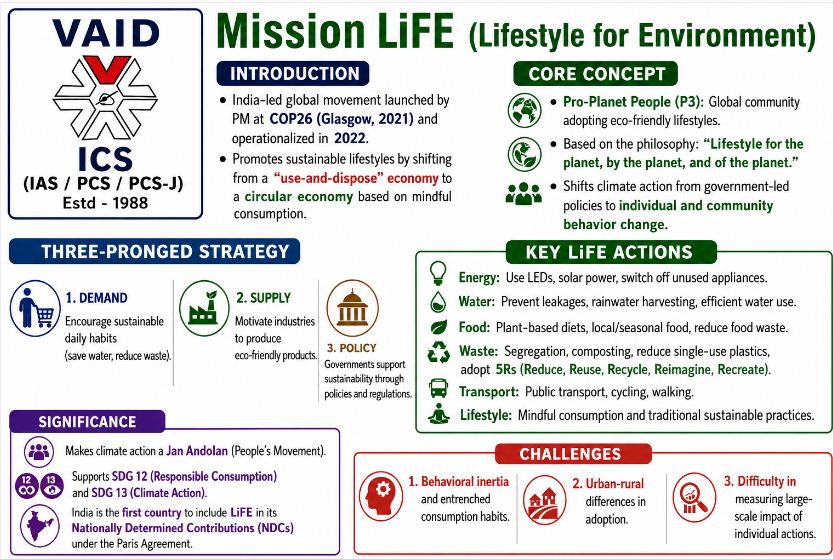
Mission LiFE is an India-led global mass movement to nudge individuals and communities to practice sustainable lifestyles. Launched by the Prime Minister of India at COP26 (Glasgow, 2021) and officially operationalized in 2022, it aims to transform the prevalent “use-and-dispose” economy—governed by mindless consumption—into a circular economy defined by mindful and deliberate utilization.
Core Concept:
- Pro-Planet People (P3): The mission seeks to create a global network of individuals, known as “Pro-Planet People,” who are committed to adopting and promoting environmentally friendly lifestyles.
- Philosophy: It is based on the principle of “Lifestyle of the planet, for the planet, and by the planet.”
- Shift in Focus: It shifts the climate action narrative from macro-level government policies to micro-level individual and community behavioral changes.
The Three-Pronged Implementation Strategy:
Mission LiFE operates on a three-pillar approach to drive behavioral change:
- Demand (Individual Behavior): Encourages individuals to adopt simple, environmentally friendly actions in their daily lives (e.g., reducing food waste, saving water).
- Supply (Industrial Change): Motivates industries and markets to respond to the shift in consumer demand by producing more sustainable and eco-friendly products.
- Policy (Governmental Reinforcement): Governments integrate sustainability into development planning, planning frameworks, and regulations to support sustainable living.
Key Focus Areas (LiFE Actions):
The mission identifies various daily actions categorized for ease of adoption:
- Energy Consumption: Promoting the use of LED bulbs, solar energy, and turning off appliances when not in use.
- Water Conservation: Preventing leakages, utilizing rainwater harvesting, and opting for bucket-based cleaning over hose pipes.
- Sustainable Food Systems: Adopting plant-based diets, consuming locally sourced/seasonal food, and reducing food waste.
- Waste Management (Swachhata Actions): Segregation of wet and dry waste, composting at home, reducing single-use plastics, and adopting the “5 Rs” (Reduce, Reuse, Recycle, Reimagine, Recreate).
- Sustainable Transportation: Encouraging the use of public transport, cycling, or walking.
- Healthy Lifestyles: Promoting mindful consumption and traditional sustainable practices.
Global and Strategic Significance:
- Democratizing Climate Action: It makes the fight against climate change a “Jan Andolan” (people’s movement), ensuring that everyone can contribute based on their capacity.
- Alignment with International Goals: The mission directly supports the UN Sustainable Development Goals (SDGs), particularly SDG 12 (Responsible Consumption and Production) and SDG 13 (Climate Action).
- India’s Contribution: India is the first country to include “LiFE” in its Nationally Determined Contributions (NDCs) under the Paris Agreement, highlighting the country’s commitment to low-carbon development through a bottom-up approach.
Challenges to Implementation:
- Behavioral Inertia: Overcoming deep-rooted “use-and-dispose” habits is difficult.
- Urban-Rural Divide: Tailoring sustainable practices to diverse socioeconomic contexts remains a challenge.
- Scalability: Measuring the real-time impact of decentralized individual actions on a global scale is complex.

May 19, 2026
October 17, 2025
October 16, 2025
October 6, 2025

