October 6, 2026
Mining Amendment, 2026: Centre–State Fiscal Federalism
Why in News?
The Mines and Minerals (Development and Regulation) Amendment Act, 2026 has triggered a debate between the Centre and States over mining regulation, taxation and States’ fiscal autonomy.
What has the Amendment changed?
- Expanded the Centre’s regulatory powers to include mineral-bearing lands, besides mines and mineral development.
- Restricted States from imposing fresh taxes on mineral rights and mineral-bearing lands, except under conditions prescribed by the Union.
- Invalidated certain uncollected mineral-related taxes imposed by States before the amendment came into force.
- Thus, the amendment affects both mining regulation and State fiscal autonomy.
Constitutional Framework:
- Entry 23, State List: States have power over regulation of mines and mineral development, subject to Entry 54 of the Union List.
- Entry 54, Union List: Parliament can regulate mines and mineral development in the public interest.
- Entry 50, State List: States can levy taxes on mineral rights, subject to limitations imposed by Parliament.
- Entry 49, State List: States can levy taxes on lands and buildings.
Supreme Court Position, 2024:
- States possess the power to tax mineral rights, subject to Parliament’s constitutional power to impose limitations.
- The power to tax mineral-bearing land cannot be curtailed merely through Parliament’s powers under Entry 54.
- The 2026 amendment has therefore raised questions regarding the constitutional balance between Union authority and State fiscal powers.
Major Concerns of States:
- Revenue Loss: Mineral-rich States may lose an important source of revenue.
- Fiscal Autonomy: Restrictions on taxation reduce States’ independent revenue-raising capacity.
- Past Dues: Cancellation of certain uncollected dues may cause substantial revenue loss.
- Federalism: States argue that excessive Union control may weaken fiscal federalism.
Fiscal Dependence of States:
- Jharkhand: Mineral receipts — about 85% of non-tax revenue.
- Odisha: About 80%.
- Karnataka: About 48%.
- Madhya Pradesh: About 41%.
- Rajasthan: About 39%.
- Telangana: About 11%.
- Chhattisgarh: About 6%.
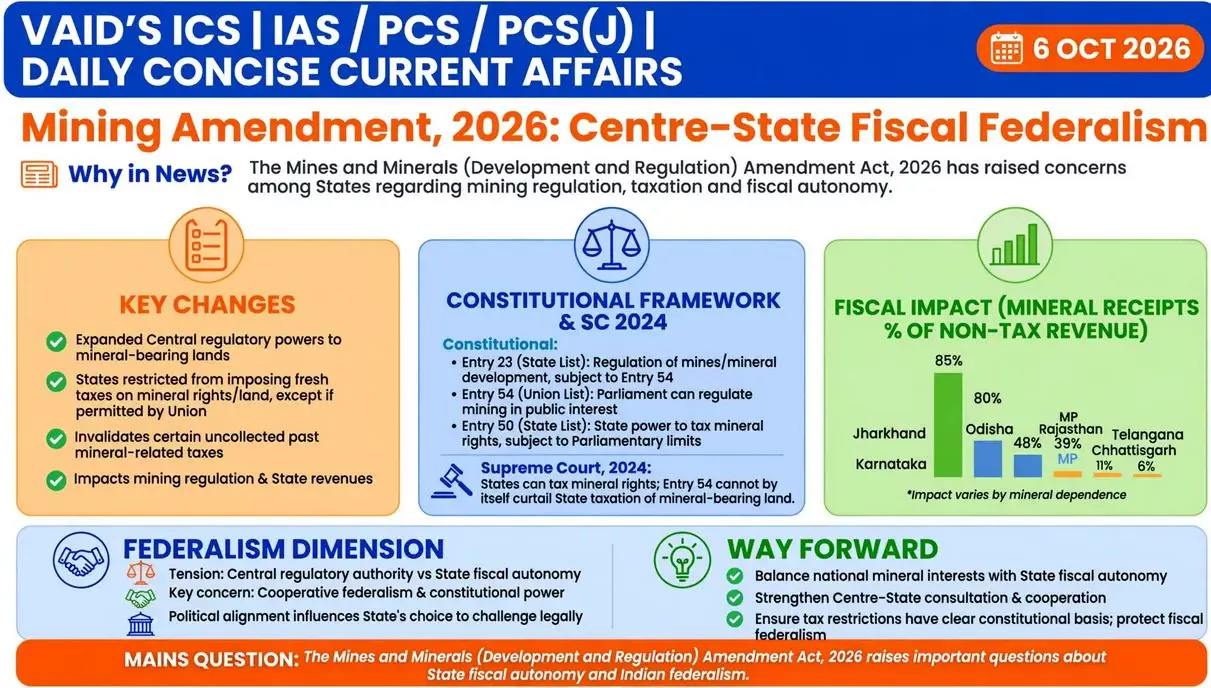
Thus, the financial impact is likely to be greater for highly mineral-dependent States.
Why are States responding differently?
Economic Dependence: States heavily dependent on mineral revenues have greater financial stakes in opposing the amendment.
Political Alignment: Political relations between the Centre and State governments may influence whether economic concerns develop into an organised federal challenge.
Fiscal Federalism in India:
- The Centre has relatively greater taxation powers.
- States have substantial expenditure responsibilities.
- States depend significantly on tax devolution, grants and Central transfers.
- Union influence over State borrowing and financial transfers can affect State fiscal autonomy.
Broader Centre–State Issues:
The mining amendment adds another dimension to existing debates concerning:
- GST compensation
- Finance Commission
- National Education Policy
- Citizenship Amendment Act
- All India Services rules
- Distribution of financial resources
Way Forward:
- Balance national mineral interests with State fiscal autonomy.
- Ensure that restrictions on State taxation have a clear constitutional basis.
- Strengthen Centre–State consultation before changes affecting State revenues.
- Protect the principles of cooperative and fiscal federalism.
- Develop appropriate mechanisms to address legitimate revenue losses of mineral-rich States.
Conclusion:
The mining amendment highlights the continuing Centre–State contest over legislative authority and fiscal resources. A balanced approach is necessary to promote national mineral development while preserving the constitutional and financial autonomy of States.
खनन संशोधन, 2026: केंद्र–राज्य वित्तीय संघवाद
समाचारों में क्यों?
खान एवं खनिज (विकास एवं विनियमन) संशोधन अधिनियम, 2026 ने खनन विनियमन, कराधान तथा राज्यों की वित्तीय स्वायत्तता को लेकर केंद्र और राज्यों के बीच विवाद उत्पन्न किया है।
संशोधन द्वारा क्या परिवर्तन किए गए हैं?
- केंद्र की विनियामक शक्तियों का विस्तार कर इसमें खानों एवं खनिज विकास के साथ खनिज-अंतर्वाही भूमि को भी शामिल किया गया है।
- राज्यों को खनिज अधिकारों तथा खनिज-अंतर्वाही भूमि पर नए कर लगाने से प्रतिबंधित किया गया है, सिवाय उन परिस्थितियों के जिन्हें केंद्र सरकार निर्धारित करे।
- संशोधन से पूर्व राज्यों द्वारा लगाए गए कुछ अवसूलित खनिज-संबंधी करों को अमान्य कर दिया गया है।
- इस प्रकार, संशोधन का प्रभाव खनन विनियमन के साथ-साथ राज्यों की वित्तीय स्वायत्तता पर भी पड़ता है।
संवैधानिक ढाँचा:
- राज्य सूची, प्रविष्टि 23: खान एवं खनिज विकास के विनियमन की शक्ति राज्यों को प्राप्त है, जो संघ सूची की प्रविष्टि 54 के अधीन है।
- संघ सूची, प्रविष्टि 54: संसद को लोकहित में खान एवं खनिज विकास के विनियमन की शक्ति प्राप्त है।
- राज्य सूची, प्रविष्टि 50: राज्यों को खनिज अधिकारों पर कर लगाने की शक्ति प्राप्त है, जिस पर संसद सीमाएँ निर्धारित कर सकती है।
- राज्य सूची, प्रविष्टि 49: राज्यों को भूमि एवं भवनों पर कर लगाने की शक्ति प्राप्त है।
सर्वोच्च न्यायालय का दृष्टिकोण, 2024:
- राज्यों को खनिज अधिकारों पर कर लगाने की शक्ति प्राप्त है, यद्यपि संसद संवैधानिक प्रावधानों के अधीन इस पर सीमाएँ लगा सकती है।
- खनिज-अंतर्वाही भूमि पर कर लगाने की राज्य की शक्ति को केवल प्रविष्टि 54 के आधार पर सीमित नहीं किया जा सकता।
- अतः 2026 के संशोधन ने संघीय अधिकार एवं राज्य की वित्तीय शक्तियों के बीच संवैधानिक संतुलन पर प्रश्न उठाए हैं।
राज्यों की प्रमुख चिंताएँ:
- राजस्व हानि: खनिज-समृद्ध राज्यों के महत्वपूर्ण राजस्व स्रोत पर प्रभाव पड़ सकता है।
- वित्तीय स्वायत्तता: कराधान पर प्रतिबंध राज्यों की स्वतंत्र राजस्व-सृजन क्षमता को सीमित कर सकते हैं।
- पूर्व बकाया: कुछ अवसूलित करों को अमान्य करने से राज्यों को राजस्व हानि हो सकती है।
- संघवाद: राज्यों के अनुसार अत्यधिक केंद्रीय नियंत्रण वित्तीय संघवाद को कमजोर कर सकता है।
राज्यों की खनिज-राजस्व पर निर्भरता:
- झारखंड: गैर-कर राजस्व का लगभग 85%
- ओडिशा: लगभग 80%
- कर्नाटक: लगभग 48%
- मध्य प्रदेश: लगभग 41%
- राजस्थान: लगभग 39%
- तेलंगाना: लगभग 11%
- छत्तीसगढ़: लगभग 6%
इसलिए, अत्यधिक खनिज-निर्भर राज्यों पर संशोधन का वित्तीय प्रभाव अधिक हो सकता है।
राज्य अलग-अलग प्रतिक्रिया क्यों दे रहे हैं?
आर्थिक निर्भरता: जिन राज्यों की आय खनिज क्षेत्र पर अधिक निर्भर है, उनके लिए संभावित राजस्व हानि अधिक महत्वपूर्ण है।
राजनीतिक संरेखण: केंद्र एवं राज्य सरकारों के बीच राजनीतिक संबंध यह प्रभावित कर सकते हैं कि आर्थिक चिंता किस सीमा तक संघीय चुनौती का रूप लेती है।
भारत में वित्तीय संघवाद:
- केंद्र के पास अपेक्षाकृत अधिक कराधान शक्तियाँ हैं।
- राज्यों पर महत्वपूर्ण व्यय संबंधी दायित्व हैं।
- राज्य कर अंतरण, अनुदान एवं केंद्रीय हस्तांतरण पर काफी निर्भर रहते हैं।
- राज्यों के उधार एवं वित्तीय संसाधनों पर केंद्र का प्रभाव भी उनकी वित्तीय स्वायत्तता को प्रभावित करता है।
व्यापक केंद्र–राज्य मुद्दे:
खनन संशोधन निम्नलिखित विषयों से जुड़े केंद्र–राज्य विवादों में एक और आयाम जोड़ता है:
- GST क्षतिपूर्ति
- वित्त आयोग
- राष्ट्रीय शिक्षा नीति
- नागरिकता संशोधन अधिनियम
- अखिल भारतीय सेवाओं से संबंधित नियम
- वित्तीय संसाधनों का वितरण
आगे की राह:
- राष्ट्रीय खनिज हितों और राज्य की वित्तीय स्वायत्तता के बीच संतुलन स्थापित किया जाए।
- राज्य की कराधान शक्तियों पर प्रतिबंध का स्पष्ट संवैधानिक आधार सुनिश्चित किया जाए।
- राज्यों के राजस्व को प्रभावित करने वाले विधायी परिवर्तनों से पूर्व केंद्र–राज्य परामर्श को सुदृढ़ किया जाए।
- सहकारी संघवाद एवं वित्तीय संघवाद के सिद्धांतों की रक्षा की जाए।
- खनिज-समृद्ध राज्यों की वैध राजस्व हानि के समाधान हेतु उचित व्यवस्था विकसित की जाए।
निष्कर्ष:
खनन संशोधन, 2026 विधायी अधिकार एवं वित्तीय संसाधनों को लेकर केंद्र–राज्य संबंधों में जारी तनाव को रेखांकित करता है। राष्ट्रीय खनिज विकास को बढ़ावा देते हुए राज्यों की संवैधानिक एवं वित्तीय स्वायत्तता की रक्षा करना भारतीय संघवाद की मूल भावना के अनुरूप होगा।

May 19, 2026
October 17, 2025
October 16, 2025
October 6, 2025

