September 1, 2025
Mini-cloudbursts
Why in the News?
According to the India Meteorological Department (IMD), even as an increase in cloudbursts in India has not been observed; the number of mini-cloudbursts has been on the increase over the past few years. This was noted by IMD Director-General Mrutyunjay Mohapatra, when he gave a press conference (Aug 2025).
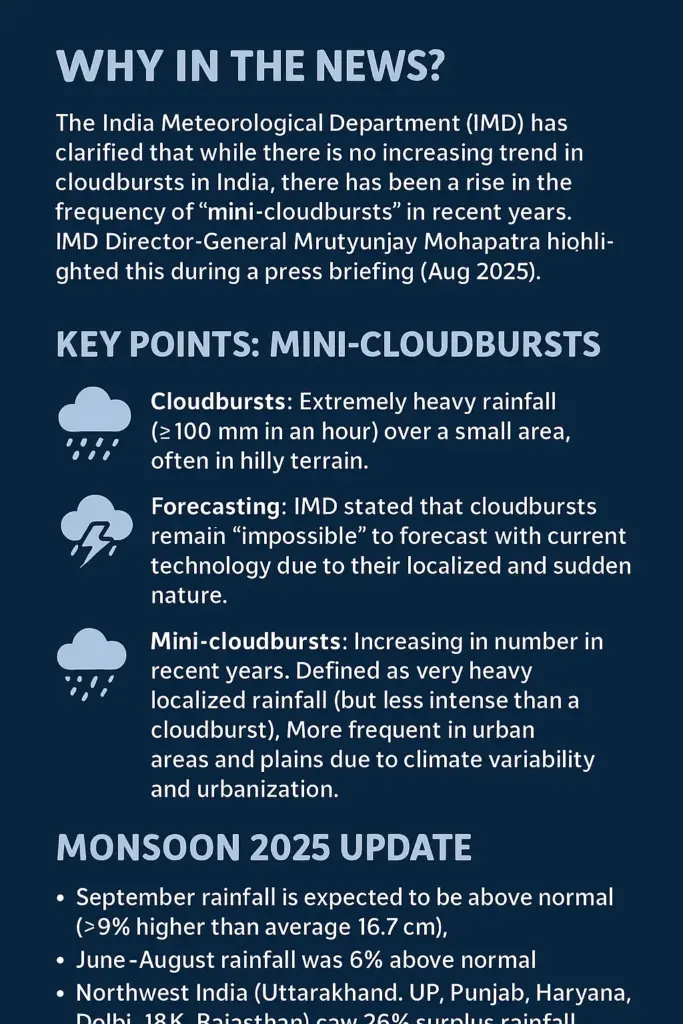
Key Points: Mini-cloudbursts
- Cloudbursts: Extremely heavy rainfall (≥100 mm in an hour) over a small area, often in hilly terrain.
- The reason why cloudbursts are unpredictable: Cloudbursts according to IMD can never be forecasted using the current technology as they are constrained and local.
Mini-cloudbursts:
- Increasing in number in recent years.
- Defined as very heavy localized rainfall (but less intense than a cloudburst).
- More frequent in urban areas and plains due to climate variability and urbanization.
Monsoon 2025 Update:
- Rainfall in September is likely to be above the usual level, projected to be around 9% higher than the long-term average of 16.7 cm.
- June–August rainfall was 6% above normal.
- Northwest India (Uttarakhand, UP, Punjab, Haryana, Delhi, J&K, Rajasthan) saw 26% surplus rainfall.
- Eastern & Northeastern India had a 17% rainfall deficit.
August 2025:
- Northern India rainfall: highest since 2001 (26.5 cm).
- Southern Peninsula rainfall: 3rd highest since 2001 (25 cm).
- >700 instances of heavy rain (20 cm/day) recorded – 2nd highest after 2024.
What is a Cloudburst?
A cloudburst is a sudden, intense rainfall event over a small area, leading to flash floods.
- Definition (IMD): Rainfall of ≥100 mm (10 cm) in one hour over a localized area (often less than 20–30 sq. km).
- Nature: Extremely localized → cannot be predicted precisely.
- Typical Region: Mostly occurs in hilly and mountainous regions (Himalayas, Western Ghats), but can also occur in urban areas.
Characteristics of Cloudbursts:
- Sudden onset – happens within minutes.
- High intensity – very heavy downpour in a short span of time.
- Localized impact – confined to small geographical areas.
- The effects can range from flash floods and landslides to destruction of infrastructure and loss of lives.
Causes of Cloudbursts:
- Orographic lifting: When moist air is forced upward by mountains, it cools quickly and condenses.
- Convective activity: Strong vertical clouds (cumulonimbus) with high moisture.
- Blocked winds: When monsoon currents collide with mountains, they slow down and release intense rainfall in a short span.
Examples:
- Kedarnath (2013, Uttarakhand) – catastrophic flooding.
- Leh (2010, Ladakh) – flash floods due to cloudburst killed hundreds.
- Himachal Pradesh, J&K, Uttarakhand – frequent recent cases.

Citizenship (Amendment) Rules, 2026
May 19, 2026
Gist of daily Article /The Hindu 17oct 2025
October 17, 2025
Daily Gist of the Hindu/Indian Express : 16 Oct 2025
October 16, 2025
Daily Gist of The Hindu/Indian Express: 6 Oct 2025
October 6, 2025

