December 12, 2025
Marine Protected Areas (MPAs )
Why in News? The Earth Sciences Ministry stated in the Lok Sabha that offshore blocks made available for mineral mining to private companies were carved out after excluding regions known to be Marine Protected Areas (MPAs). This statement came in response to political protests, particularly in Kerala, against the proposed auction.
- Context: The assurance follows protests, mainly in Kerala, over the proposal to auction 13 blocks for mining construction-grade sand and other minerals.
Key Points:
- Government Assurance: The government confirmed that 130 Marine Protected Areas and 106 Important Coastal and Marine Biodiversity Areas (ICMBAs) have been notified and were excluded from the auctioned offshore blocks.
- Policy Mechanism: The government cited the Offshore Areas Mineral Conservation and Development Rules, 2024, which mandate:
- No production operations can start without a Production Plan.
- The Production Plan must include an Environmental Management Plan with impact assessment and mitigation measures.
- Financial Safeguard: An Offshore Areas Mineral Trust has been established with coastal States as members. Funds from this trust will be used for research, studies, and mitigation of any adverse impact on the offshore ecology.
Marine Protected Areas (MPAs):
- Marine Protected Areas (MPAs) are defined geographical spaces in the ocean, intertidal, or estuarine environments, dedicated and managed through legal or other effective means, to achieve the long-term conservation of nature with associated ecosystem services and cultural values.
- MPAs are one of the most effective tools for protecting marine biodiversity, helping ecosystems recover from fishing pressure, pollution, and climate change impacts.
Key Goals and Benefits of MPAs:
MPAs are established with multiple objectives, including:
- Biodiversity Conservation: Protecting habitats, ecosystems, and vulnerable species (like corals, mangroves, and nesting sites).
- Fisheries Management: Acting as ‘spillover zones’ where fish populations can recover and grow, subsequently enhancing fish stocks in surrounding, unprotected fishing grounds.
- Climate Change Resilience: Protecting habitats like coral reefs and mangroves, which provide essential coastal protection and sequester carbon, making the coastal region more resilient to climate change impacts.
- Research and Education: Providing areas for scientific research and monitoring of marine ecosystems in a near-natural state.
Types and Management Zones:
MPAs are not uniformly strict; their effectiveness depends on the management regime applied. They often include various zones:
- No-Take Zones (Core Zones): These are the most restrictive areas where no fishing or removal of marine resources is allowed. They are crucial for stock recovery and biodiversity conservation.
- Buffer Zones: Areas surrounding the core zone where some limited, sustainable activities (like controlled tourism or traditional fishing) may be permitted.
- Multiple-Use Zones: Larger areas where sustainable uses (like regulated commercial fishing and shipping) are permitted, often forming the outermost layer of the MPA.
MPAs in India:
In India, MPAs are primarily notified under the Wildlife (Protection) Act, 1972 (WPA), classified as National Parks, Sanctuaries, or Conservation Reserves.
- The Ministry of Environment, Forest and Climate Change (MoEF&CC) is responsible for the overall notification and oversight.
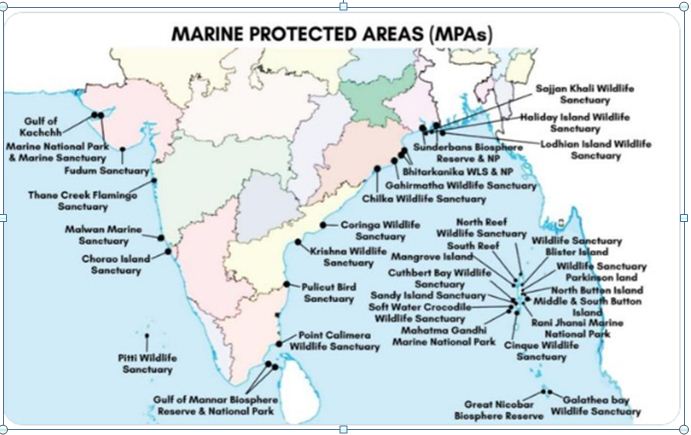
- As of recent data, India has over 130 Marine Protected Areas along its coastline and around its island territories (Andaman & Nicobar and Lakshadweep).
- Prominent Examples:
- Gulf of Mannar Marine National Park (Tamil Nadu): Protects coral reefs and sea grasses, known for dugongs (sea cows).
- Gulf of Kachchh Marine National Park (Gujarat): Protects coral reefs and mangroves.
- Mahatma Gandhi Marine National Park (Andaman Islands): Famous for its diverse coral reefs and unique island ecosystems.

October 17, 2025
October 16, 2025
October 6, 2025
September 24, 2025

