April 15, 2026
Lok Sabha Redistribution & Delimitation Framework
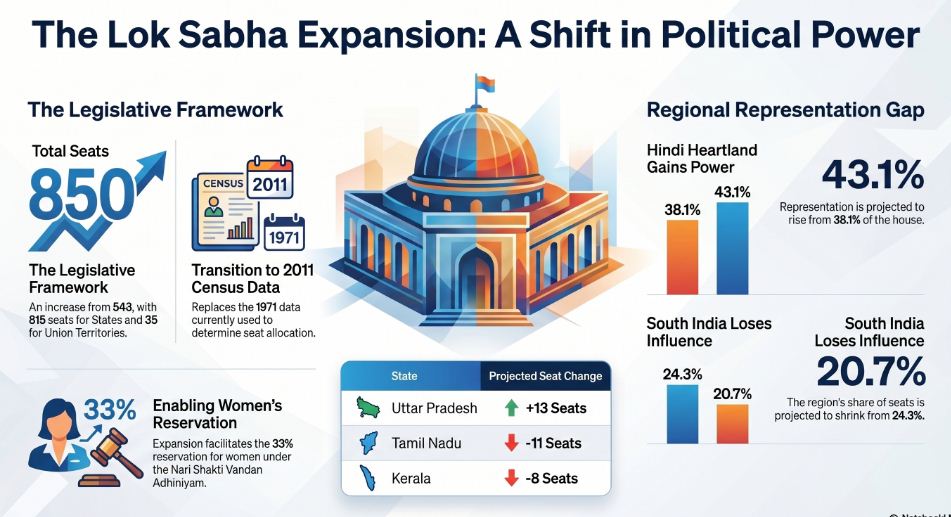
Why in News ? The Central Government has introduced drafts for the Constitution (131st) Amendment Bill and the Delimitation Bill. These aim to increase the size of the Lok Sabha and reallocate seats using 2011 Census data instead of the currently used 1971 data.
Key Legislative Proposals:
- Increase in Strength: Total Lok Sabha seats to rise from 543 to a maximum of 850.
- 815 seats allocated for States.
- 35 seats allocated for Union Territories.
- Population Base: Redistribution shifts from the 1971 Census to the 2011 Census.
- Women’s Reservation: The expansion is intended to facilitate the implementation of 33% reservation for women (Nari Shakti Vandan Adhiniyam) in the Lok Sabha and State Assemblies.
Regional Impact (The North-South Divide):
The redistribution will cause a significant shift in political power due to varying population growth rates:
- Hindi Heartland (Gain): Current share of 38.1% is projected to rise to 1%. Major gains are expected for states like Uttar Pradesh (+13 seats) and Bihar (+10 seats).
- South India (Loss): Current share of 24.3% is projected to shrink to 7%. States like Tamil Nadu (-11 seats) and Kerala (-8 seats) face significant losses.
- West Bengal: Projected to lose approximately 2 seats.
Constitutional Provisions & Legal Framework:
- Article 81: Defines the composition of the House of the People.
- Article 82: Mandates the readjustment of Lok Sabha seats after every Census. It allows Parliament to enact a Delimitation Act and establish a Delimitation Commission.
- Article 170: Governs the readjustment of constituencies for State Legislative Assemblies after every Census.
- Article 327: Empowers Parliament to make laws regarding elections and the delimitation of constituencies.
- Article 329 (Bar to Interference): Orders of the Delimitation Commission are final, have the force of law, and cannot be challenged in any court.
Historical Context: The “Freeze”:
- 42nd Amendment (1976): Froze seat allocation based on the 1971 Census to ensure states implementing family planning were not penalized.
- 84th Amendment (2001): Extended this freeze until the results of the first census taken after 2026 are published. The new bills seek to move past this timeline.
The Delimitation Commission:
The Delimitation Bill sets the process for redrawing boundaries. The Commission (typically led by a retired Supreme Court judge) is tasked with:
- Determining state-wise seat allocation based on population.
- Redrawing the boundaries of individual constituencies.
- Ensuring Electoral Parity (the principle of “One Person, One Vote”).
Major Arguments and Concerns:
- Arguments FOR:
- Democratic Representation: Addresses the under-representation of high-population states (UP, Bihar).
- Administrative Efficiency: Smaller constituencies allow MPs to better serve their voters.
- Necessary Update: The 1971 data is over 50 years old and no longer reflects demographic reality.
- Arguments AGAINST:
- “Punishing Success”: Southern states argue they are being penalized for successful social development and population control.
- Federal Imbalance: Critics fear the Hindi Heartland will gain overwhelming control, marginalizing regional voices.
- Constitutional Break: Opponents argue it violates the spirit of the previous agreement to wait until 2026.
Summary of Proposed Changes:
- Total Seats: From 543 to up to 850.
- Population Basis: From 1971 Census to 2011 Census.
- Hindi Heartland Share: From ~38% to ~43%.
- Southern States Share: From ~24% to ~20%.
- Women’s Reservation Status: From 0% (statutory) to 33% (constitutional).

Citizenship (Amendment) Rules, 2026
May 19, 2026
Gist of daily Article /The Hindu 17oct 2025
October 17, 2025
Daily Gist of the Hindu/Indian Express : 16 Oct 2025
October 16, 2025
Daily Gist of The Hindu/Indian Express: 6 Oct 2025
October 6, 2025

