November 13, 2026
KURUMBA TRIBE AND ENDANGERED KURUMBA LANGUAGE
Why in News?
The Kurumba language, spoken by the Kurumba tribal community in Attappady, Palakkad district of Kerala, is facing the threat of extinction due to migration, declining use among younger generations and lack of written documentation.
About the Kurumba Community:
Tribal Status: Kurumbas are recognised as a Particularly Vulnerable Tribal Group (PVTG) in Kerala.
Location: They mainly inhabit the hilly and forest regions of Attappady in Palakkad district, Kerala.
Population: The reported population is approximately 2,719 (2024).
Language: They speak Kurumba, an oral language without its own script.
Cultural Identity: Their language preserves traditional knowledge, customs, folklore and indigenous practices.
Why Is the Kurumba Language Endangered?
Migration: Migration for education and employment increases interaction with dominant languages.
Language Shift: Younger members increasingly use Malayalam instead of traditional Kurumba words. For example, Malayalam’s chechi is increasingly replacing the Kurumba word akke for elder sister.
Lack of Script: Being primarily an oral language, it faces difficulties in documentation and preservation.
Low Number of Speakers: Its small speaker population increases the risk of language extinction.
Census Recognition: Languages with fewer than 10,000 speakers are generally grouped under the category of Others in Census language reporting, reducing their separate visibility.
Government Initiative:
Scheme for Protection and Preservation of Endangered Languages (SPPEL), 2013:
Launched by the Ministry of Education to:
- Document and preserve endangered Indian languages.
- Prepare dictionaries, grammar and linguistic records.
- Record oral traditions, folklore and cultural knowledge.
- Promote research and revitalisation of endangered mother tongues.
Other Important Facts:
People’s Linguistic Survey of India (PLSI): Has documented approximately 800 languages in India, highlighting the country’s linguistic diversity.
Census of India: The Census recognises and reports a smaller number of languages under its language-classification methodology. The figures are not directly comparable because the two exercises use different methods of classification.
ABOUT PARTICULARLY VULNERABLE TRIBAL GROUPS (PVTGs):
Meaning:
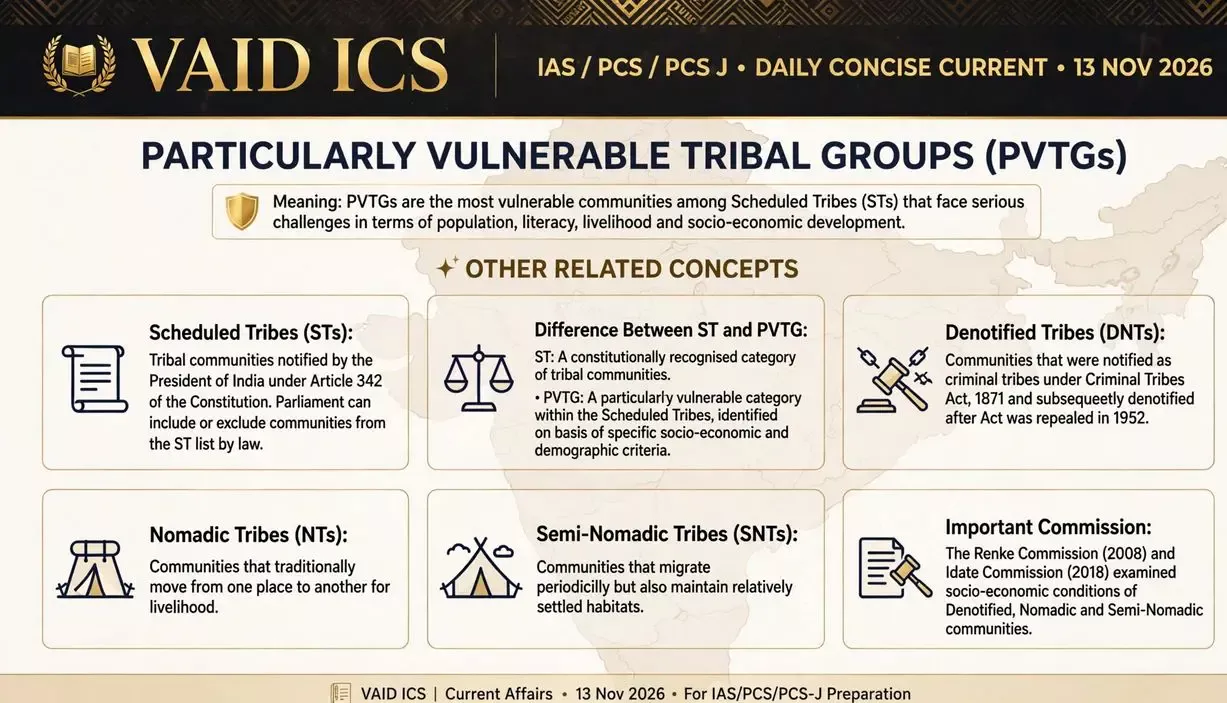
PVTGs are the most vulnerable communities among Scheduled Tribes (STs) that face serious challenges in terms of population, literacy, livelihood and socio-economic development.
Identification of PVTGs:
Initially, 52 tribal groups were identified as Primitive Tribal Groups (PTGs) in 1973. The category was renamed Particularly Vulnerable Tribal Groups (PVTGs) in 2006.
Criteria for Identification:
Pre-agricultural Technology: Dependence on traditional methods of hunting, gathering and primitive agriculture.
Low Literacy: Extremely low levels of literacy.
Population: Stagnant or declining population.
Subsistence Economy: Dependence mainly on subsistence-based livelihoods.
Number and Distribution:
- 75 PVTGs have been identified in India.
- Spread across 18 States and 1 Union Territory (Andaman and Nicobar Islands).
Tribal Affairs India+1
- They form the most vulnerable section among India’s tribal communities.
PVTGs in Kerala:
Kerala has five PVTGs:
Cholanaikayan: Mainly found in Nilambur valley, Malappuram.
Kadar: Found in parts of Palakkad and Thrissur.
Kattunayakan: Mainly found in Wayanad and adjoining districts.
Kurumbas: Mainly found in Attappady hills, Palakkad.
Koraga: Mainly found in Kasaragod.
Government Initiatives for PVTGs:
PM-JANMAN (2023): Pradhan Mantri Janjati Adivasi Nyaya Maha Abhiyan aims to provide basic facilities such as housing, drinking water, healthcare, education, roads, electricity and livelihood opportunities to 75 PVTG communities.
Development of PVTGs Scheme: Provides support for housing, education, healthcare, agriculture, animal husbandry and livelihood development.
Eklavya Model Residential Schools (EMRS): Provides quality residential education to ST students, including PVTG children.
Dharti Aaba Janjatiya Gram Utkarsh Abhiyan (DAJGUA): Aims to improve infrastructure and basic services in tribal-majority villages.
OTHER RELATED CONCEPTS
Scheduled Tribes (STs):
Tribal communities notified by the President of India under Article 342 of the Constitution. Parliament can include or exclude communities from the ST list by law.
Difference Between ST and PVTG:
ST: A constitutionally recognised category of tribal communities.
PVTG: A particularly vulnerable category within the Scheduled Tribes, identified on the basis of specific socio-economic and demographic criteria.
Denotified Tribes (DNTs):
Communities that were notified as criminal tribes under the Criminal Tribes Act, 1871 and subsequently denotified after the Act was repealed in 1952.
Nomadic Tribes (NTs):
Communities that traditionally move from one place to another for their livelihood.
Semi-Nomadic Tribes (SNTs):
Communities that migrate periodically but also maintain relatively settled habitats.
Important Commission: The Renke Commission (2008) and Idate Commission (2018) examined the socio-economic conditions of Denotified, Nomadic and Semi-Nomadic communities.
IMPORTANT CONCEPT: ENDANGERED LANGUAGES
Endangered Language: A language at risk of disappearing because fewer people, particularly younger generations, speak or transmit it.
Language Shift: A situation in which a community gradually replaces its traditional language with a more dominant language.
SPPEL (2013): Scheme for Protection and Preservation of Endangered Languages, initiated by the Ministry of Education and implemented through the Central Institute of Indian Languages (CIIL), Mysuru. It aims to document, archive and revitalise endangered languages, particularly those spoken by fewer than 10,000 people.
Key Concern:
The disappearance of tribal languages means the loss of indigenous knowledge, traditional medicine, folklore, cultural identity and community heritage.
Conclusion:
Protection of tribal communities must go beyond economic development and include the preservation of their languages, traditional knowledge, culture and identity.

May 19, 2026
October 17, 2025
October 16, 2025
October 6, 2025

