February 25, 2026
Kerala is named as “Keralam”
Why in the News? The Union Cabinet, led by the Prime Minister, has officially given its consent to rename the state. This follows two resolutions passed by the Kerala Legislative Assembly (the first in 2023 and again in 2024) urging the Central Government to make this change in the First Schedule of the Constitution.
- Cultural Identity: The name “Kerala” is often viewed as a colonial or anglicized version. “Keralam” reflects the state’s “glorious culture” and its linguistic roots.
- Political Timing: The move comes just before the state heads to polls, fulfilling a long-standing local demand.
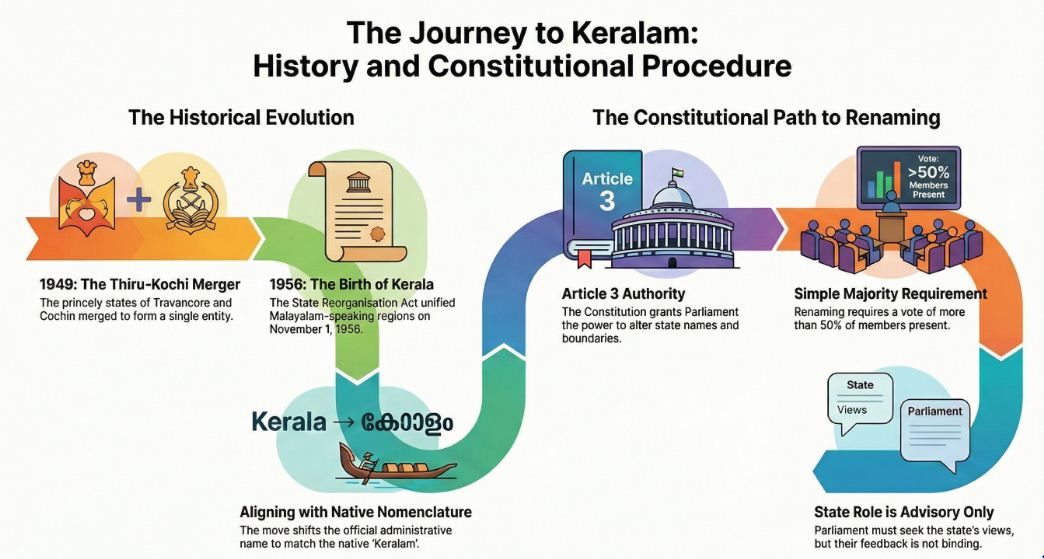
Article 3: The Constitutional Process
Under the Indian Constitution, the power to change the name, boundaries, or area of a state rests with the Parliament, not the state itself. The process follows a specific sequence under Article 3:
Step-by-Step Procedure:
- Presidential Reference: The President refers the proposed Bill (The Kerala (Alteration of Name) Bill, 2026) to the Kerala State Legislature.
- State Assembly Views: The State Assembly must express its views within a specified timeframe. Note: The Parliament is not bound by the state’s views; it only needs to seek them.
- Presidential Recommendation: Once the views are received (or the time limit expires), the Union Government seeks the President’s recommendation to introduce the Bill in Parliament.
- Parliamentary Approval: The Bill must be passed by a Simple Majority in both the Lok Sabha and the Rajya Sabha.
- Amendment of Schedules: Once passed and signed by the President, the First Schedule (which lists state names) and the Fourth Schedule (allocation of Rajya Sabha seats) are updated.
Historical Context: From Malabar to Keralam:
The history of the state’s naming is tied to the Aikya Kerala (United Kerala) movement:
- Pre-Independence: The region was divided into the princely states of Travancore and Cochin, and the Malabar district (under British Madras Presidency).
- 1949: Travancore and Cochin merged to form “Thiru-Kochi.”
- 1956 (State Reorganisation Act): On November 1, 1956, based on linguistic lines, the Malayalam-speaking regions were unified to form the state of Kerala.
- The Linguistic Nuance: While the state was officially called “Kerala” in English records, the people always referred to it as “Keralam” in Malayalam. The current move is essentially aligning the official English/Administrative name with the native nomenclature.
Key Points to Remember:
| Feature | Details |
| New Name | Keralam |
| Primary Article | Article 3 (Formation of new States and alteration of areas, boundaries or names) |
| Power Center | The Parliament of India |
| Majority Required | Simple Majority (More than 50% of members present and voting) |
| Role of State | Advisory only; their “views” are sought but not mandatory to follow |
About Keralam:
The name Keralam is rooted in ancient Dravidian languages and Sanskrit, though there are two primary theories regarding its exact meaning.
Most scholars and linguists point to its connection to the landscape and the most iconic tree of the region.
1. The “Land of Coconuts” (Most Accepted)
The most popular etymology is that “Keralam” is derived from the word for the coconut tree.
- Kera: In Malayalam, Kera means “coconut tree.”
- Alam: Means “land” or “place.”
- Result: Keralam = “The Land of Coconut Trees.”

October 17, 2025
October 16, 2025
October 6, 2025
September 24, 2025

