October 15, 2026
Jeypore Ground Gecko: Balda Hills of Odisha
Why in News?
A proposed 147-hectare open-cast bauxite mining project in the Balda Hills of Odisha has raised concerns over the survival of the Jeypore ground gecko (Cyrtodactylus jeyporensis), an endangered reptile endemic to the Eastern Ghats.
The proposed mining site lies within the Nageswari Reserve Forest. The project has also triggered protests by local Bondo and Porja Adivasi communities, who assert their ancestral land and forest rights.
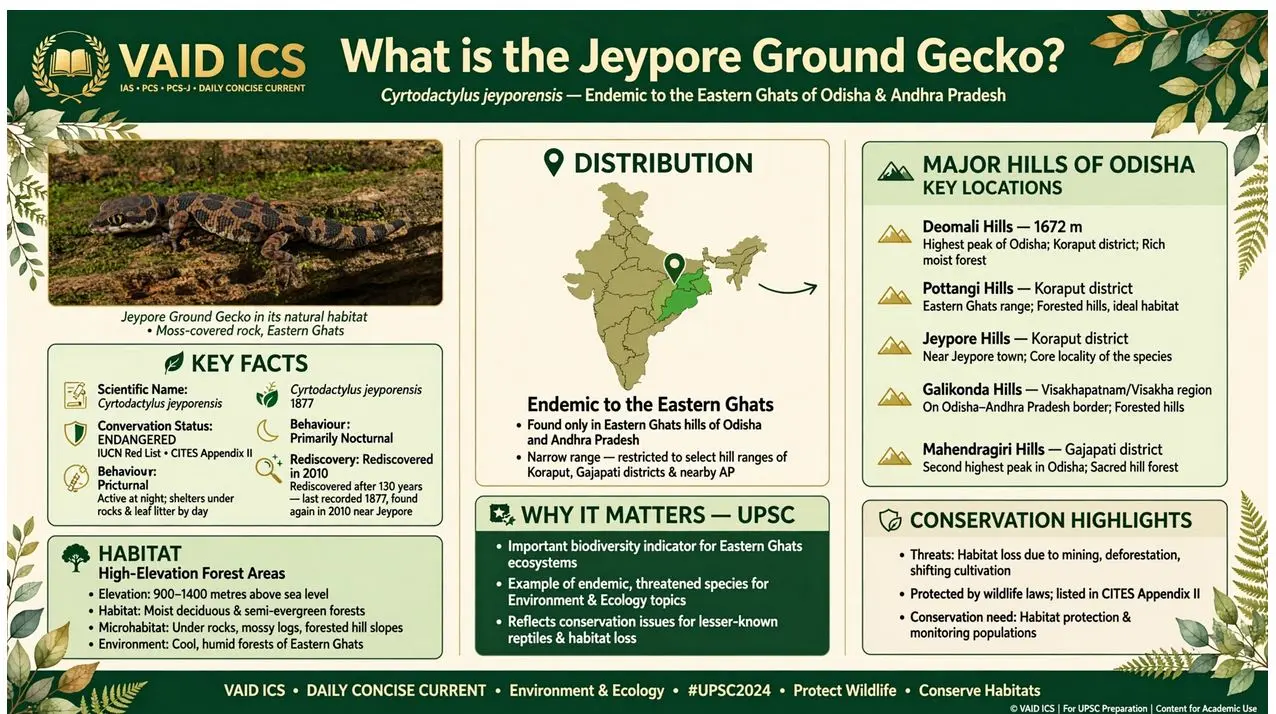
What is the Jeypore Ground Gecko?
-
Scientific name: Cyrtodactylus jeyporensis.
-
Distribution: Endemic to parts of the Eastern Ghats of Odisha and Andhra Pradesh.
-
Habitat: High-elevation forest areas, generally around 900–1,400 metres.
-
Behaviour: Primarily nocturnal, meaning it is active mainly at night.
-
Conservation status: Classified as Endangered on the IUCN Red List, as reported in the supplied information.
-
International protection: Listed under Appendix II of CITES, which regulates international trade to ensure that it does not threaten the survival of the species.
-
Rediscovery: Rediscovered in 2010 after approximately 130 years without confirmed records.
Why is the proposed mining project a concern?
-
Only four individuals were reportedly documented during the preceding year within the proposed mining site.
-
The species has a highly restricted distribution and depends on suitable forest and rocky habitats.
-
Open-cast mining can destroy or fragment its habitat, making local extinction more likely.
-
Its previous habitat in Potangi, Odisha, was reportedly lost due to bauxite mining by National Aluminium Company Limited (NALCO).
Key concern: The loss of a small, isolated habitat can threaten an endemic species even when its total population is not fully known.
What is the ecological significance of the Eastern Ghats?
The Eastern Ghats are a discontinuous mountain range along India’s eastern region, extending across parts of Odisha, Andhra Pradesh, Telangana, Karnataka and Tamil Nadu.
Their ecological importance includes:
-
Biodiversity and endemism: They support numerous plant and animal species, including species with restricted geographical distributions.
-
Habitat diversity: Tropical deciduous, moist forests, semi-evergreen forests and rocky habitats support diverse ecosystems.
-
Watershed functions: Forests help regulate runoff, reduce soil erosion and support local water systems.
-
Tribal livelihoods: Forests provide food, fuel, medicinal plants, minor forest produce and cultural resources to many Adivasi communities.
-
Ecological connectivity: Forest patches provide habitats and movement corridors for wildlife.
The Jeypore ground gecko’s restricted distribution makes the protection of its remaining habitats particularly important. The IUCN assessment identifies mining, deforestation, forest fires and conversion of natural habitats as significant threats.
How does bauxite mining affect the environment?
Bauxite is the principal ore used in the production of aluminium. Open-cast mining involves removing vegetation, soil and rock to access mineral deposits.
Major environmental impacts include:
-
Deforestation and habitat destruction: Removal of vegetation and rocky outcrops destroys the microhabitats used by reptiles and other wildlife.
-
Habitat fragmentation: Mining can divide continuous habitats into isolated patches, restricting movement and reproduction.
-
Soil erosion: Removal of vegetation increases soil loss and sedimentation in nearby streams.
-
Water-system disruption: Excavation, drainage changes and sediment runoff can affect groundwater recharge and local water bodies.
-
Biodiversity loss: Endemic and poorly studied species may disappear before their ecological requirements are fully understood.
-
Noise, dust and pollution: Mining operations, transport and associated infrastructure can disturb wildlife and nearby settlements.
-
Livelihood impacts: Forest degradation can reduce access to food, fuel, medicinal plants and other forest resources.
Critical issue: Environmental clearance should account not only for the area directly excavated but also for associated roads, transport infrastructure, drainage changes and the cumulative effects of mining.
What are the tribal rights issues involved?
The proposed project has generated opposition from Bondo and Porja Adivasi communities, who claim ancestral rights over the affected landscape.
The dispute raises questions concerning the recognition of customary rights, access to forest resources, community participation and the balance between mineral extraction and tribal livelihoods.
Forest Rights Act, 2006
The Scheduled Tribes and Other Traditional Forest Dwellers (Recognition of Forest Rights) Act, 2006, commonly called the Forest Rights Act (FRA), seeks to recognise and vest forest rights in eligible forest-dwelling Scheduled Tribes and Other Traditional Forest Dwellers.
Key provisions include:
-
Individual forest rights: Recognition of eligible rights to land under occupation for habitation or self-cultivation, subject to the Act.
-
Community rights: Recognition of customary access to and use of forest resources, including eligible community forest-resource rights.
-
Community forest resource management: Gram Sabhas and rights holders have roles in protecting, conserving and managing recognised community forest resources.
-
Role of the Gram Sabha: It initiates the process for determining forest rights and considers claims through the statutory procedure.
-
Safeguards against displacement: Section 4(5) prohibits eviction or removal of eligible forest dwellers from occupied forest land until the recognition and verification procedure is complete.
The Act does not automatically confer ownership over all forest land or provide an unconditional veto over every development project. Rights must be determined under the law, and forest diversion must comply with applicable statutory safeguards.
Why is Gram Sabha participation important?
-
It enables affected communities to participate in decisions concerning their customary forest use.
-
It helps ensure that claims are examined before forest land is diverted.
-
It supports informed consultation and protection of community resources.
-
It improves transparency and accountability in decisions affecting tribal areas.
The precise consent and procedural requirements depend on the applicable legal framework and the nature of the proposed diversion. The reported rejection of community forest-rights claims in this case raises concerns that require examination of the relevant decisions and records.
What is the way forward?
-
Independent biodiversity assessment: Conduct comprehensive seasonal surveys to establish the gecko’s distribution, population, breeding ecology and habitat requirements.
-
Precautionary approach: Avoid irreversible habitat destruction until the ecological risks and available alternatives have been adequately assessed.
-
Critical habitat protection: Identify and conserve important rocky outcrops, forest patches and ecological corridors.
-
Cumulative environmental assessment: Examine the combined impacts of mining, roads, transport and other nearby projects.
-
Proper implementation of the FRA: Ensure that eligible individual and community forest-rights claims are examined transparently before relevant decisions are taken.
-
Meaningful community participation: Involve Bondo and Porja communities in consultations, rights determination and decisions affecting their livelihoods.
-
Alternatives to habitat destruction: Assess alternative mining locations, project designs and mitigation measures, including whether the project can avoid critical habitats altogether.
-
Monitoring and accountability: Require independent monitoring, transparent disclosure of biodiversity data and enforcement of environmental conditions.
-
Ecological restoration: Where mining is permitted, ensure scientifically designed restoration and long-term monitoring. Restoration, however, cannot fully replace an irreplaceable habitat or guarantee the recovery of an endemic species.
Conclusion
The proposed Balda Hills mining project illustrates the conflict between mineral-led economic development, biodiversity conservation and the rights of forest-dwelling communities. The Jeypore ground gecko’s restricted range and documented habitat decline make precautionary decision-making essential. Development in ecologically sensitive and tribal landscapes must follow environmental safeguards, recognise legally established forest rights and ensure that irreversible ecological losses are not treated as an acceptable cost of mineral extraction.
जेयपोर ग्राउंड गेको: बॉक्साइट खनन, जैव विविधता एवं जनजातीय अधिकार
चर्चा में क्यों?
ओडिशा की बाल्दा पहाड़ियों में प्रस्तावित 147 हेक्टेयर क्षेत्र में खुले खनन (Open-cast Mining) की परियोजना ने जेयपोर ग्राउंड गेको (Cyrtodactylus jeyporensis) के अस्तित्व को लेकर चिंता बढ़ा दी है। यह पूर्वी घाट का एक संकटग्रस्त सरीसृप है, जिसे लगभग 130 वर्षों तक दर्ज न किए जाने के बाद 2010 में पुनः खोजा गया था।
-
प्रस्तावित खनन स्थल नागेश्वरी आरक्षित वन (Nageswari Reserve Forest) का हिस्सा है।
-
उपलब्ध जानकारी के अनुसार, पिछले एक वर्ष में प्रस्तावित खनन क्षेत्र के भीतर इस गेको के केवल चार व्यक्तियों को दर्ज किया गया।
-
परियोजना का प्रस्ताव कलिंग एल्युमिना लिमिटेड (Kalinga Alumina Ltd.) द्वारा दिया गया है, जिसे उपलब्ध विवरण में अडानी समूह से संबद्ध बताया गया है।
-
स्थानीय बोंडो और पोरजा आदिवासी समुदाय अपने पैतृक भूमि एवं वन अधिकारों की रक्षा के लिए विरोध कर रहे हैं।
-
ओडिशा के पोटांगी क्षेत्र में इस प्रजाति का पूर्व आवास कथित रूप से नेशनल एल्युमिनियम कंपनी लिमिटेड (NALCO) के बॉक्साइट खनन से नष्ट हो चुका है।
जेयपोर ग्राउंड गेको क्या है?
-
वैज्ञानिक नाम: Cyrtodactylus jeyporensis।
-
वितरण: ओडिशा और आंध्र प्रदेश के पूर्वी घाट के कुछ क्षेत्रों में स्थानिक।
-
आवास: सामान्यतः समुद्र तल से लगभग 900–1,400 मीटर की ऊँचाई वाले वन क्षेत्र।
-
व्यवहार: मुख्यतः रात्रिचर, अर्थात रात में अधिक सक्रिय।
-
संरक्षण स्थिति: उपलब्ध विवरण के अनुसार, IUCN की रेड लिस्ट में संकटग्रस्त (Endangered) श्रेणी में वर्गीकृत।
-
अंतरराष्ट्रीय संरक्षण: CITES के परिशिष्ट-II (Appendix II) में सूचीबद्ध। इसका उद्देश्य अंतरराष्ट्रीय व्यापार को नियंत्रित करना है, ताकि व्यापार से प्रजाति के अस्तित्व को खतरा न पहुँचे।
-
पुनः खोज: लगभग 130 वर्षों तक दर्ज न किए जाने के बाद 2010 में पुनः खोजा गया।
खनन परियोजना से खतरा क्यों है?
-
सीमित क्षेत्र में इसके केवल चार व्यक्तियों का दर्ज होना इसकी स्थानीय आबादी को लेकर गंभीर चिंता उत्पन्न करता है।
-
इसका भौगोलिक वितरण सीमित है और यह विशिष्ट वन तथा चट्टानी आवासों पर निर्भर करता है।
-
खुले खनन से प्राकृतिक आवास नष्ट हो सकता है तथा शेष आवास छोटे और अलग-अलग हिस्सों में बँट सकते हैं।
-
सीमित एवं पृथक आबादी के कारण स्थानीय विलुप्ति का जोखिम बढ़ सकता है।
मुख्य चिंता: किसी स्थानिक प्रजाति का छोटा-सा आवास भी नष्ट हो जाए, तो वह स्थानीय स्तर पर विलुप्त हो सकती है, भले ही उसकी कुल आबादी का सटीक आकलन उपलब्ध न हो।
पूर्वी घाट का पारिस्थितिक महत्त्व क्या है?
पूर्वी घाट भारत के पूर्वी भाग में स्थित एक असतत पर्वत शृंखला है, जो ओडिशा, आंध्र प्रदेश, तेलंगाना, कर्नाटक और तमिलनाडु के कुछ हिस्सों से होकर गुजरती है।
इसके प्रमुख पारिस्थितिक कार्य हैं:
-
जैव विविधता एवं स्थानिकता: अनेक वनस्पतियों और जीवों का आवास, जिनमें कुछ प्रजातियाँ सीमित भौगोलिक क्षेत्रों तक ही पाई जाती हैं।
-
विविध वन पारितंत्र: उष्णकटिबंधीय पर्णपाती, नम वन तथा अर्ध-सदाबहार वन सहित विभिन्न प्रकार के प्राकृतिक आवास।
-
जलागम संरक्षण: वन मृदा अपरदन और सतही अपवाह को कम करने तथा स्थानीय जल प्रणालियों को बनाए रखने में सहायता करते हैं।
-
जनजातीय आजीविका: वन अनेक आदिवासी समुदायों को भोजन, ईंधन, औषधीय पौधे, लघु वनोपज और सांस्कृतिक संसाधन प्रदान करते हैं।
-
पारिस्थितिक संपर्क: वन्यजीवों के आवागमन और विभिन्न आवासों के बीच संपर्क बनाए रखने में सहायता।
जेयपोर ग्राउंड गेको का सीमित वितरण उसके शेष प्राकृतिक आवासों के संरक्षण को विशेष रूप से महत्त्वपूर्ण बनाता है।
बॉक्साइट खनन के पर्यावरणीय प्रभाव क्या हैं?
बॉक्साइट एल्युमिनियम उत्पादन का प्रमुख अयस्क है। खुले खनन में खनिज तक पहुँचने के लिए वनस्पति, ऊपरी मृदा और चट्टानों को हटाया जाता है।
इसके प्रमुख पर्यावरणीय प्रभाव निम्नलिखित हैं:
-
वनों की कटाई एवं आवास विनाश: वनस्पतियों और चट्टानी संरचनाओं को हटाने से सरीसृपों तथा अन्य जीवों के प्राकृतिक आवास नष्ट होते हैं।
-
आवास विखंडन: निरंतर वन क्षेत्र छोटे और पृथक हिस्सों में बँट जाते हैं, जिससे जीवों की आवाजाही और प्रजनन प्रभावित होता है।
-
मृदा अपरदन: वनस्पति हटने से मिट्टी का कटाव तथा नदियों और जलधाराओं में गाद का जमाव बढ़ सकता है।
-
जल प्रणालियों में व्यवधान: खुदाई, जल निकासी में बदलाव और प्रदूषित अपवाह से भूजल पुनर्भरण तथा स्थानीय जल स्रोत प्रभावित हो सकते हैं।
-
जैव विविधता का ह्रास: स्थानिक और कम अध्ययन की गई प्रजातियाँ अपनी पारिस्थितिक आवश्यकताओं का पूरा आकलन होने से पहले ही विलुप्ति के जोखिम में आ सकती हैं।
-
धूल एवं ध्वनि प्रदूषण: खनन, परिवहन और संबंधित निर्माण गतिविधियाँ वन्यजीवों तथा आसपास की बस्तियों को प्रभावित कर सकती हैं।
-
आजीविका पर प्रभाव: वन क्षरण से भोजन, ईंधन, औषधीय पौधों और अन्य वन संसाधनों तक समुदायों की पहुँच कम हो सकती है।
मुख्य मुद्दा: पर्यावरणीय आकलन में केवल खुदाई वाले क्षेत्र को नहीं, बल्कि उससे जुड़ी सड़कों, परिवहन, जल निकासी तथा आसपास की अन्य खनन परियोजनाओं के संयुक्त प्रभावों को भी शामिल किया जाना चाहिए।
जनजातीय अधिकारों से संबंधित मुद्दे क्या हैं?
प्रस्तावित परियोजना का बोंडो और पोरजा आदिवासी समुदायों द्वारा विरोध किया जा रहा है। ये समुदाय प्रभावित क्षेत्र पर अपने पैतृक अधिकारों तथा पारंपरिक वन उपयोग के अधिकारों का दावा कर रहे हैं।
यह विवाद निम्नलिखित मुद्दों को सामने लाता है:
-
पारंपरिक भूमि एवं वन अधिकारों की मान्यता।
-
वन संसाधनों तक पहुँच और आजीविका की सुरक्षा।
-
विकास परियोजनाओं में स्थानीय समुदायों की भागीदारी।
-
विस्थापन तथा सांस्कृतिक संसाधनों के नुकसान का जोखिम।
-
खनिज दोहन और जनजातीय अधिकारों के बीच संतुलन।
वन अधिकार अधिनियम, 2006 क्या है?
अनुसूचित जनजाति और अन्य परंपरागत वन निवासी (वन अधिकारों की मान्यता) अधिनियम, 2006, जिसे सामान्यतः वन अधिकार अधिनियम (FRA) कहा जाता है, पात्र वनवासी अनुसूचित जनजातियों तथा अन्य परंपरागत वन निवासियों के वन अधिकारों को मान्यता देने और उन्हें निहित करने का प्रावधान करता है।
इसके प्रमुख प्रावधान हैं:
-
व्यक्तिगत वन अधिकार: अधिनियम के अंतर्गत पात्र व्यक्तियों के कब्जे वाली वन भूमि पर निवास या स्व-कृषि संबंधी अधिकारों की मान्यता, निर्धारित शर्तों के अधीन।
-
सामुदायिक वन अधिकार: पात्र समुदायों के पारंपरिक वन उपयोग तथा वन संसाधनों तक पहुँच से संबंधित अधिकारों की मान्यता।
-
सामुदायिक वन संसाधन प्रबंधन: ग्राम सभा और अधिकार प्राप्त समुदायों की मान्यता प्राप्त सामुदायिक वन संसाधनों के संरक्षण एवं प्रबंधन में भूमिका।
-
ग्राम सभा की भूमिका: वन अधिकारों के निर्धारण की प्रक्रिया आरंभ करना तथा निर्धारित प्रक्रिया के अंतर्गत दावों पर विचार करना।
-
बेदखली से सुरक्षा: अधिनियम की धारा 4(5) के अनुसार, पात्र वनवासियों को वन भूमि से तब तक बेदखल या हटाया नहीं जा सकता, जब तक वन अधिकारों की मान्यता और सत्यापन की प्रक्रिया पूरी नहीं हो जाती।
यह अधिनियम प्रत्येक वन भूमि पर स्वतः स्वामित्व या प्रत्येक विकास परियोजना पर बिना शर्त वीटो का अधिकार नहीं देता। अधिकारों का निर्धारण कानूनी प्रक्रिया के अनुसार किया जाता है तथा वन भूमि के उपयोग में परिवर्तन के लिए लागू वैधानिक सुरक्षा उपायों का पालन आवश्यक है।
ग्राम सभा की भागीदारी क्यों महत्त्वपूर्ण है?
-
वन अधिकारों के दावों के निर्धारण में स्थानीय समुदायों की भागीदारी सुनिश्चित होती है।
-
वन भूमि के उपयोग में परिवर्तन से पहले पात्र अधिकारों के परीक्षण में सहायता मिलती है।
-
समुदायों के संसाधनों से जुड़े निर्णयों में पारदर्शिता बढ़ती है।
-
आदिवासी आजीविका और पारंपरिक उपयोग संबंधी हितों की रक्षा को समर्थन मिलता है।
सहमति और प्रक्रिया संबंधी सटीक आवश्यकताएँ लागू कानूनी प्रावधानों तथा प्रस्तावित परियोजना की प्रकृति पर निर्भर करती हैं। इस मामले में वन अधिकारों के दावों को कथित रूप से अस्वीकार किए जाने के संबंध में संबंधित आदेशों और अभिलेखों की जाँच आवश्यक है।
आगे की राह
-
स्वतंत्र जैव विविधता आकलन: गेको के वितरण, आबादी, प्रजनन, आवास और मौसमी गतिविधियों का वैज्ञानिक सर्वेक्षण किया जाए।
-
सावधानीपूर्ण दृष्टिकोण: पारिस्थितिक जोखिमों और वैकल्पिक स्थलों का पर्याप्त आकलन होने तक अपरिवर्तनीय आवास विनाश से बचा जाए।
-
महत्त्वपूर्ण आवासों का संरक्षण: आवश्यक चट्टानी संरचनाओं, वन क्षेत्रों और वन्यजीव गलियारों की पहचान कर उनका संरक्षण किया जाए।
-
समग्र पर्यावरणीय आकलन: खनन, सड़कों, परिवहन और आसपास की अन्य परियोजनाओं के संयुक्त प्रभावों का अध्ययन किया जाए।
-
वन अधिकार अधिनियम का प्रभावी क्रियान्वयन: पात्र व्यक्तिगत एवं सामुदायिक वन अधिकारों के दावों की पारदर्शी जाँच सुनिश्चित की जाए।
-
स्थानीय समुदायों की सार्थक भागीदारी: बोंडो और पोरजा समुदायों को अधिकार निर्धारण, परामर्श और आजीविका को प्रभावित करने वाले निर्णयों में शामिल किया जाए।
-
वैकल्पिक स्थलों का मूल्यांकन: अन्य खनन स्थलों, परियोजना की वैकल्पिक संरचना तथा महत्त्वपूर्ण आवासों से बचने की संभावनाओं का अध्ययन किया जाए।
-
निगरानी एवं जवाबदेही: स्वतंत्र पर्यावरणीय निगरानी, जैव विविधता संबंधी आँकड़ों का सार्वजनिक प्रकटीकरण तथा पर्यावरणीय शर्तों का प्रभावी अनुपालन सुनिश्चित किया जाए।
-
पारिस्थितिक पुनर्स्थापन: जहाँ खनन की अनुमति दी जाए, वहाँ वैज्ञानिक पुनर्स्थापन और दीर्घकालिक निगरानी की व्यवस्था हो। हालाँकि, पुनर्स्थापन से किसी अपरिवर्तनीय प्राकृतिक आवास की पूरी भरपाई या प्रजाति की वापसी की गारंटी नहीं दी जा सकती।
निष्कर्ष
बाल्दा पहाड़ियों की प्रस्तावित खनन परियोजना खनिज-आधारित विकास, जैव विविधता संरक्षण और वनवासी समुदायों के अधिकारों के बीच उत्पन्न संघर्ष को दर्शाती है। सीमित भौगोलिक वितरण और आवास ह्रास के जोखिम के कारण जेयपोर ग्राउंड गेको का संरक्षण विशेष महत्त्व रखता है।
सतत विकास के लिए आवश्यक है कि खनिज संसाधनों के उपयोग के साथ पर्यावरणीय सुरक्षा, वन अधिकार अधिनियम का प्रभावी क्रियान्वयन और स्थानीय समुदायों की भागीदारी सुनिश्चित की जाए। पारिस्थितिक रूप से संवेदनशील तथा जनजातीय क्षेत्रों में विकास संबंधी निर्णय वैज्ञानिक प्रमाणों, कानूनी प्रक्रियाओं और दीर्घकालिक पर्यावरणीय हितों पर आधारित होने चाहिए।

May 19, 2026
October 17, 2025
October 16, 2025
October 6, 2025

