October 29, 2026
Inter-State Council — Rebuilding India’s Federal Equilibrium
Inter-State Council — Rebuilding India’s Federal Equilibrium
1. Context & Background
- Constitutional Provision: Article 263 of the Constitution empowers the President to establish an Inter-State Council (ISC) to investigate, discuss, and coordinate subjects of common interest between the Union and states.
- Evolution: Though envisioned by the framers as a vital federal mechanism, it lay dormant for decades until formally constituted in 1990 on the recommendation of the Sarkaria Commission.
- Current Status: The Council has suffered from institutional atrophy, long gaps between meetings, and treatment as a minor department under the Home Ministry rather than an independent administrative entity.
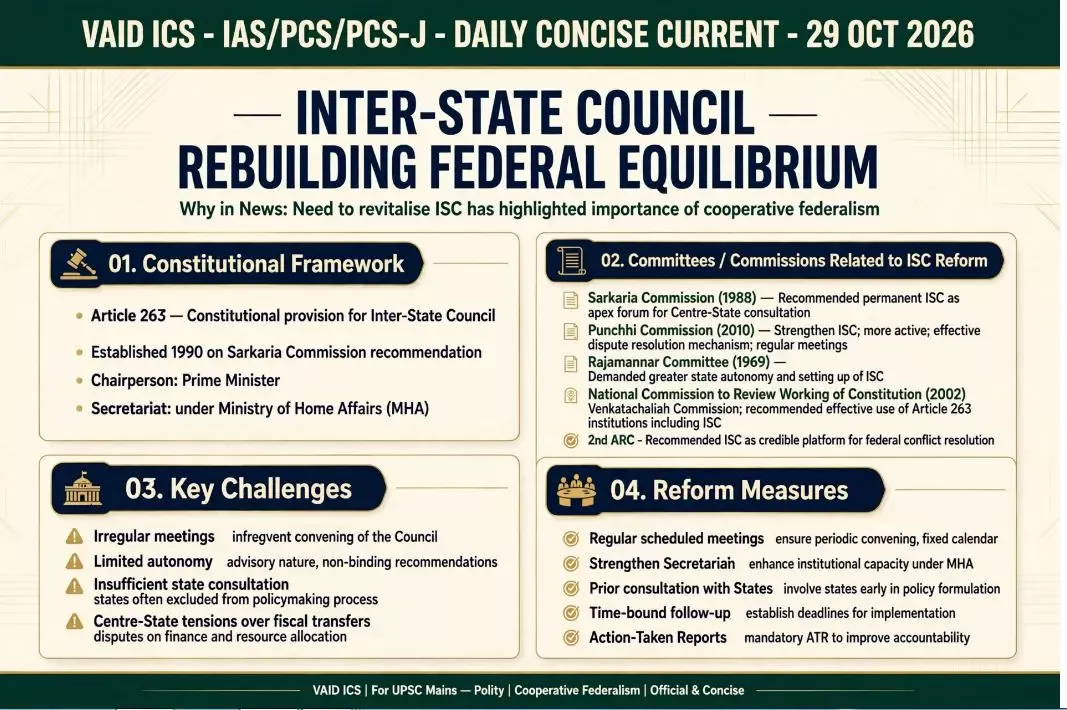
2. Key Issues & Challenges
- Lack of Operational Autonomy: Subordinated to bureaucratic imperatives and political priorities, making it largely ineffective in setting an unbiased national agenda.
- Violation of Statutory Obligation: The mandate to meet regularly has been disregarded by successive governments, leading to years of inactivity.
- Erosion of Trust: Unilateral central policymaking bypasses state consultations, fostering administrative resistance, political friction, and constitutional controversy (e.g., contentious issues like delimitation).
- Deficit in Federal Dialogue: In a diverse nation, the absence of an active ISC leaves a structural void at the heart of Indian federalism.
3. Recommendations for Rebuilding & Reform
- Autonomous Secretariat: Re-imagine the ISC’s secretariat as an independent statutory authority staffed by diverse civil servants and technical experts.
- Institutionalized Meeting Schedule: Ensure mandatory, predictable, and regular meetings chaired by the Prime Minister, involving key cabinet ministers and state Chief Ministers to deliberate on matters of shared national importance.
- Primary Locus for Negotiation: Serve as the core platform for major policy reforms, evaluating local impacts of national schemes, resource sharing, infrastructure, environmental management, and constitutional changes.
- Cooperative Federalism in Action: Transition Centre-state relations from an erratic cycle of political confrontation to a cooperative partnership grounded in mutual respect and constitutional legitimacy.

Citizenship (Amendment) Rules, 2026
May 19, 2026
Gist of daily Article /The Hindu 17oct 2025
October 17, 2025
Daily Gist of the Hindu/Indian Express : 16 Oct 2025
October 16, 2025
Daily Gist of The Hindu/Indian Express: 6 Oct 2025
October 6, 2025

