June 11, 2026
Indicators of Global Climate Change (IGCC) Report 2026
The release of the fourth edition of the Indicators of Global Climate Change (IGCC) report on 11 June 2026 provides a stark, data-driven update on the state of the Earth’s climate system.
Why in News:
This report is critical because it offers an annual, authoritative pulse-check on climate progress, filling the gap between the major, less frequent reports of the Intergovernmental Panel on Climate Change (IPCC). It confirms that the world is rapidly approaching the 1.5°C threshold set by the Paris Agreement and highlights that the rate of planetary warming is accelerating, primarily due to human-induced greenhouse gas emissions.
Key Points:
-
Human-Induced Warming: Human activity pushed global warming to 1.37°C in 2025. At the current pace, the 1.5°C limit is projected to be surpassed in approximately four years.
-
Carbon Budget Exhaustion: The “carbon budget”—the total CO2 that can still be emitted while keeping warming under 1.5°C—is now just 130 billion tonnes (as of the start of 2026). At current emission rates, this budget will be completely exhausted in about three years.
-
Record Emissions: Global greenhouse gas emissions reached a record high of 56.8 billion tonnes of CO2 equivalent in 2024.
-
Earth’s Energy Imbalance: The gap between heat entering the planet and heat escaping has more than doubled in recent decades. The Earth is now storing heat at a record-high rate, driving ocean warming, sea-level rise, and permafrost thawing.
-
Ocean Crisis:
-
Sea Levels: Global mean sea levels reached a new record in 2025, rising 23cm since 1901.
-
Marine Heatwaves: The number of days affected by marine heatwaves has more than tripled since 1991, severely impacting fish stocks and marine ecosystems.
-
-
Fragile Data Infrastructure: Scientists warned that funding cuts to climate monitoring programs—such as the recent closure of specific international air quality monitoring initiatives—are creating “dangerous gaps” in the evidence base needed for effective policy making.
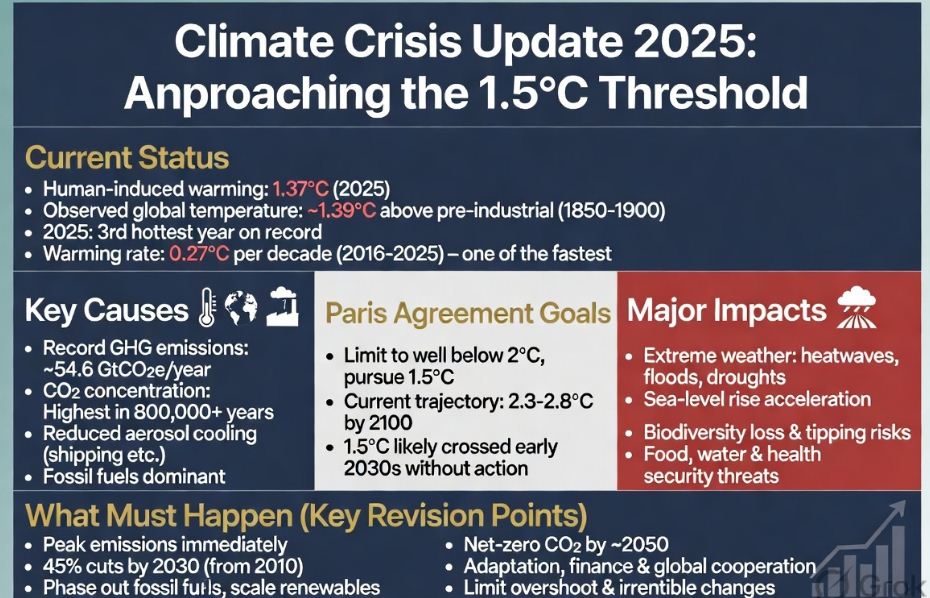
Context: The Paris Agreement 1.5°C Goal
The 1.5°C limit is the cornerstone of the 2015 Paris Agreement. It is important to note that breaching this limit for a single year does not mean the treaty has “failed”; the goal refers to a long-term average over multiple decades. However, the rapidly shrinking carbon budget signals that the window of opportunity to stay below this limit is closing almost entirely within this decade.
ग्लोबल क्लाइमेट चेंज के संकेतक (IGCC) रिपोर्ट 2026:
‘इंडिकेटर्स ऑफ ग्लोबल क्लाइमेट चेंज’ (IGCC) रिपोर्ट का चौथा संस्करण 11 जून 2026 को जारी किया गया है। यह रिपोर्ट पृथ्वी की जलवायु प्रणाली की स्थिति पर एक विश्वसनीय और डेटा-आधारित अपडेट प्रदान करती है।
चर्चा में क्यों है?:
यह रिपोर्ट इसलिए महत्वपूर्ण है क्योंकि यह जलवायु प्रगति पर एक वार्षिक, आधिकारिक रिपोर्ट पेश करती है। यह इस बात की पुष्टि करती है कि दुनिया पेरिस समझौते के 1.5°C के लक्ष्य के खतरनाक रूप से करीब पहुंच रही है और मानवीय गतिविधियों के कारण पृथ्वी के गर्म होने की दर में तेजी आ रही है।
मुख्य बिंदु (Key Points):
-
मानव-जनित वार्मिंग: मानवीय गतिविधियों के कारण 2025 में वैश्विक तापमान में 1.37°C की वृद्धि दर्ज की गई। यदि वर्तमान गति जारी रही, तो हम लगभग चार वर्षों के भीतर 1.5°C की सीमा को पार कर लेंगे।
-
कार्बन बजट समाप्त होना: 1.5°C से नीचे तापमान रखने के लिए बचा हुआ “कार्बन बजट” (जो CO2 उत्सर्जित की जा सकती है) 2026 की शुरुआत तक केवल 130 बिलियन टन है। वर्तमान उत्सर्जन स्तर पर, यह बजट लगभग तीन वर्षों में समाप्त हो जाएगा।
-
रिकॉर्ड उत्सर्जन: 2024 में वैश्विक ग्रीनहाउस गैस उत्सर्जन 56.8 बिलियन टन CO2 समकक्ष के रिकॉर्ड स्तर पर पहुंच गया।
-
पृथ्वी का ऊर्जा असंतुलन: पृथ्वी के वायुमंडल में आने वाली ऊष्मा और बाहर जाने वाली ऊष्मा के बीच का अंतर पिछले कुछ दशकों में दोगुना से अधिक हो गया है। पृथ्वी रिकॉर्ड दर पर ऊष्मा का संचय कर रही है, जिससे महासागर गर्म हो रहे हैं, समुद्र का जलस्तर बढ़ रहा है और पर्माफ्रॉस्ट पिघल रहा है।
-
महासागरीय संकट:
-
समुद्र का जलस्तर: 2025 में समुद्र का औसत स्तर एक नए रिकॉर्ड पर पहुंच गया, जो 1901 के बाद से 23 सेमी अधिक है।
-
मरीन हीटवेव: 1991 के बाद से मरीन हीटवेव (समुद्री गर्मी की लहरें) के दिनों की संख्या तीन गुना से अधिक बढ़ गई है, जिससे समुद्री पारिस्थितिक तंत्र और मछली भंडार को भारी नुकसान हो रहा है।
-
-
डेटा की कमी का खतरा: वैज्ञानिकों ने चेतावनी दी है कि जलवायु निगरानी कार्यक्रमों (जैसे वायु गुणवत्ता निगरानी) के लिए धन में कटौती से एक “खतरनाक कमी” पैदा हो रही है, जिससे भविष्य में जलवायु नीतियों को बनाना कठिन हो जाएगा।
पेरिस समझौता और 1.5°C का लक्ष्य
पेरिस समझौते का 1.5°C का लक्ष्य एक महत्वपूर्ण मानक है। हालांकि, यह ध्यान रखना आवश्यक है कि एक वर्ष के लिए इस सीमा को पार करने का अर्थ यह नहीं है कि समझौता विफल हो गया है; यह लक्ष्य कई दशकों के दीर्घकालिक औसत को संदर्भित करता है। लेकिन वर्तमान में तेजी से घटता कार्बन बजट यह संकेत दे रहा है कि इस दशक के अंत तक हमारे पास मौका बहुत कम बचा है।
आंकड़ों का सारांश (Summary Table)
| संकेतक | स्थिति/रुझान |
| मानव-जनित वार्मिंग | 1.37°C (2025 तक) |
| शेष कार्बन बजट | 130 बिलियन टन (2026 तक) |
| GHG उत्सर्जन | रिकॉर्ड स्तर (56.8 बिलियन टन) |
| समुद्र स्तर में वृद्धि | तेजी आ रही है (1901 से 23 सेमी) |
| मरीन हीटवेव | 1991 के बाद से तीन गुना वृद्धि |
निष्कर्ष: हालांकि डेटा चिंताजनक है, रिपोर्ट यह भी जोर देती है कि समाधान पहले से ही उपलब्ध हैं। जीवाश्म ईंधन को कम करने के लिए नवीकरणीय ऊर्जा (renewable energy) और विद्युतीकरण (electrification) की ओर तेजी से बढ़ना ही एकमात्र प्रभावी रास्ता है।

May 19, 2026
October 17, 2025
October 16, 2025
October 6, 2025

