June 16, 2026
India’s Vision for Viksit Bharat @ 2047/विकसित भारत @ 2047 के लिए भारत का दृष्टिको
India’s Vision for Viksit Bharat @ 2047
Source: Press Information Bureau (PIB)
Subject: Population and Associated Socio-Economic Issues
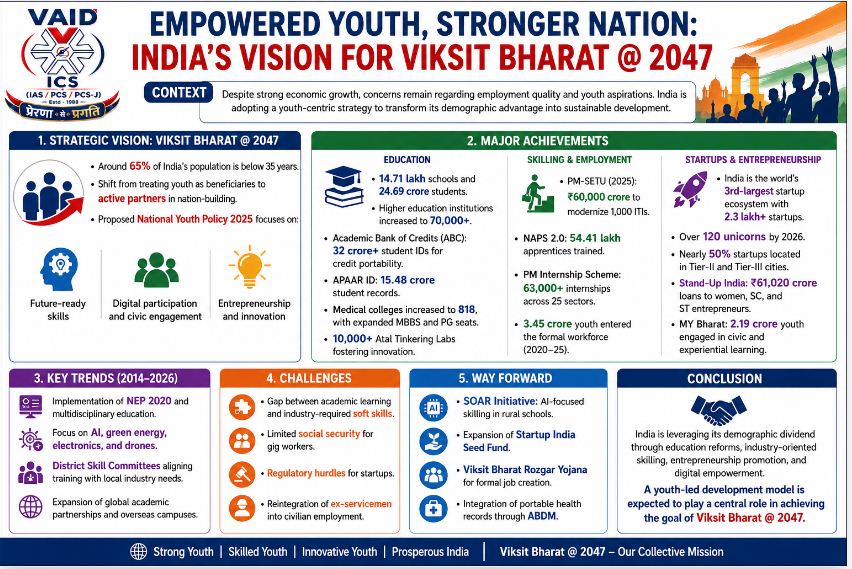
Context: Amid rising concerns regarding employment quality and youth aspirations, recent labor market assessments have highlighted a decade-long challenge in the employment rate despite sustained economic growth. This report outlines India’s strategic roadmap to address these issues through comprehensive youth-centric policy frameworks.
I: Strategic Vision: Viksit Bharat @ 2047:
With approximately 65 percent of its population under the age of 35, India is undergoing a structural paradigm shift. The nation is transitioning from viewing youth merely as passive beneficiaries of administrative schemes to engaging them as active, youth-led co-creators of national development.
Building upon the foundations of the National Youth Policy 2014, the newly proposed National Youth Policy 2025 framework prioritizes:
-
Future-ready skill development.
-
Increased digital participation and civic engagement.
-
Promotion of sustainable entrepreneurship to cultivate a highly competitive global workforce.
II: Key Data and Infrastructure Milestones:
Educational Restructuring:
-
Infrastructure Scale: India manages one of the world’s largest educational networks, comprising 14.71 lakh schools serving 24.69 crore students. Higher education institutions have expanded from 51,000 to over 70,000 as of June 2026.
-
Academic Bank of Credits (ABC): Anchored by NEP 2020, the platform has onboarded 2,469 institutions and issued over 32 crore student IDs, facilitating seamless credit portability.
-
Digital Registries (APAAR ID): The Automated Permanent Academic Account Registry has generated 15.48 crore verified student identifiers to track academic and skill-based progress.
-
Healthcare Education: Medical colleges increased to 818 in 2025–26, scaling capacity to 1,28,976 MBBS seats and 85,822 PG seats.
-
Innovation: Over 10,000 Atal Tinkering Labs have enabled 1.1 crore students to develop 16 lakh technological prototypes.
Skilling and Formalization:
-
PM-SETU Modernization: Launched in October 2025 with an outlay of ₹60,000 crore, this initiative upgrades 1,000 Industrial Training Institutes (ITIs) through a hub-and-spoke model.
-
Apprenticeship and Internships: NAPS 2.0 has engaged over 54.41 lakh apprentices since 2016. The PM Internship Scheme (PMIS), launched in October 2024, offers 63,000+ structured vacancies across 25 sectors, providing a monthly stipend of ₹9,000.
-
Workforce Formalization: EPFO data indicates that over 3.45 crore youth aged 18–28 entered the formal organized workforce between April 2020 and June 2025.
Startup Ecosystem and Inclusivity:
-
Global Standing: India is now the world’s third-largest startup ecosystem, with over 2.3 lakh recognized ventures by June 2026, creating 23 lakh jobs.
-
Unicorn Surge: Tech startups valued over $1 billion increased from 4 in 2014 to over 120 by early 2026.
-
Regional Growth: Nearly 50 percent of recognized startups are based in Tier-II and Tier-III cities.
-
Inclusive Entrepreneurship: Stand-Up India loan approvals for women, SC, and ST founders surged to ₹61,020.41 crore by March 2025.
-
MY Bharat: This phygital network has registered over 2.19 crore youth for experiential learning and civic engagement.
III: Core Trends (2014–2026);
-
Systemic Integration: Moving from fragmented programs to multidisciplinary systems under NEP 2020, aiming for a 50 percent Gross Enrolment Ratio (GER) by 2035.
-
High-Tech Skilling: Transitioning from basic vocational training to specialized training in AI, green energy, electronics, and drone aviation.
-
Local Alignment: Utilizing District Skill Committees (DSCs) across 776 districts to align workforce development with regional economic demands.
-
Global Footprint: Expanding international academic partnerships and establishing overseas campuses (such as IIT Zanzibar, IIT Abu Dhabi, and IIM Ahmedabad in Dubai).
IV: Challenges and Future Outlook:
Current Challenges:
-
Soft Skill Gap: Addressing the mismatch between technical academic degrees and the practical requirements of the corporate sector.
-
Gig Economy Security: Strengthening legal protections and financial safety nets for the growing population of digital gig workers.
-
Bureaucratic Hurdles: Reducing municipal red tape to accelerate operational approvals for early-stage startups.
-
Veteran Reintegration: Streamlining the transition of ex-armed forces personnel into civil services and private sector roles.
The Way Forward:
-
AI Readiness: Rolling out the Skilling for AI Readiness (SOAR) initiative to rural schools to establish core machine-learning competencies.
-
Seed Funding: Expanding the Startup India Seed Fund Scheme to provide greater access to proof-of-concept capital in Tier-III towns.
-
Employment Incentives: Deploying the Viksit Bharat Rozgar Yojana to incentivize formal-sector job creation for first-time entrants.
-
Digital Health Integration: Leveraging the Ayushman Bharat Digital Mission (ABDM) to ensure portable health records for the mobile youth workforce.
V: Conclusion:
India’s structural transition toward an active, youth-led enterprise model is a definitive milestone in its socio-economic evolution. By synchronizing flexible academic credentials, demand-driven skilling, and comprehensive startup funding, the nation is successfully building a resilient foundation to leverage its demographic dividend for a Viksit Bharat.
सशक्त युवा, सशक्त राष्ट्र: विकसित भारत @ 2047 के लिए भारत का दृष्टिकोण;
स्रोत: पत्र सूचना कार्यालय (PIB)
विषय: जनसंख्या और संबंधित सामाजिक-आर्थिक मुद्दे
संदर्भ: रोजगार की गुणवत्ता और युवाओं की आकांक्षाओं को लेकर बढ़ती चिंताओं के बीच, श्रम बाजार के हालिया आकलन ने निरंतर आर्थिक विकास के बावजूद रोजगार दर में एक दशक की चुनौती को रेखांकित किया है। यह रिपोर्ट इन मुद्दों को संबोधित करने के लिए भारत की रणनीतिक योजना प्रस्तुत करती है।
I: रणनीतिक दृष्टि: विकसित भारत @ 2047
भारत की लगभग 65 प्रतिशत जनसंख्या 35 वर्ष से कम आयु की है, जिसके कारण देश एक संरचनात्मक बदलाव के दौर से गुजर रहा है। राष्ट्र युवाओं को केवल प्रशासनिक योजनाओं के निष्क्रिय लाभार्थियों के रूप में देखने के बजाय, उन्हें राष्ट्रीय विकास के सक्रिय, युवा-नेतृत्व वाले सह-निर्माता (co-creators) के रूप में जोड़ रहा है।
राष्ट्रीय युवा नीति 2014 की नींव पर आगे बढ़ते हुए, प्रस्तावित ‘राष्ट्रीय युवा नीति 2025’ ढांचा निम्नलिखित को प्राथमिकता देता है:
-
भविष्य के लिए तैयार कौशल विकास।
-
डिजिटल भागीदारी और नागरिक जुड़ाव में वृद्धि।
-
अत्यधिक प्रतिस्पर्धी वैश्विक कार्यबल तैयार करने के लिए सतत उद्यमशीलता को बढ़ावा देना।
II: प्रमुख डेटा और बुनियादी ढांचा उपलब्धियां
शैक्षणिक पुनर्गठन:
-
बुनियादी ढांचे का पैमाना: भारत दुनिया के सबसे बड़े शैक्षिक नेटवर्क में से एक का संचालन करता है, जिसमें 14.71 लाख स्कूल शामिल हैं जो 24.69 करोड़ छात्रों को सेवा प्रदान करते हैं। जून 2026 तक उच्च शिक्षा संस्थानों की संख्या 51,000 से बढ़कर 70,000 से अधिक हो गई है।
-
एकेडमिक बैंक ऑफ क्रेडिट्स (ABC): NEP 2020 द्वारा समर्थित, इस प्लेटफॉर्म ने 2,469 संस्थानों को जोड़ा है और 32 करोड़ से अधिक छात्र आईडी जारी की हैं, जिससे क्रेडिट पोर्टेबिलिटी आसान हो गई है।
-
डिजिटल रजिस्ट्री (APAAR ID): ऑटोमेटेड परमानेंट एकेडमिक अकाउंट रजिस्ट्री ने 15.48 करोड़ सत्यापित छात्र पहचानकर्ता उत्पन्न किए हैं ताकि शैक्षणिक और कौशल-आधारित प्रगति को ट्रैक किया जा सके।
-
चिकित्सा शिक्षा: 2025–26 में मेडिकल कॉलेजों की संख्या बढ़कर 818 हो गई है, जिससे एमबीबीएस सीटों की क्षमता 1,28,976 और पीजी सीटों की क्षमता 85,822 हो गई है।
-
नवाचार: 10,000 से अधिक अटल टिंकरिंग लैब्स ने 1.1 करोड़ छात्रों को 16 लाख तकनीकी प्रोटोटाइप बनाने में सक्षम बनाया है।
कौशल और औपचारिक कार्यबल:
-
PM-SETU आधुनिकीकरण: अक्टूबर 2025 में ₹60,000 करोड़ के परिव्यय के साथ शुरू की गई यह पहल, हब-एंड-स्पोक मॉडल के माध्यम से 1,000 औद्योगिक प्रशिक्षण संस्थानों (ITI) को अपग्रेड करती है।
-
अप्रेंटिसशिप और इंटर्नशिप: NAPS 2.0 ने 2016 से अब तक 54.41 लाख से अधिक प्रशिक्षुओं (apprentices) को जोड़ा है। अक्टूबर 2024 में शुरू की गई ‘प्रधानमंत्री इंटर्नशिप योजना’ (PMIS) 25 से अधिक क्षेत्रों में 63,000 से अधिक इंटर्नशिप अवसर प्रदान करती है, जिसके तहत ₹9,000 का मासिक वजीफा मिलता है।
-
औपचारिक कार्यबल विस्तार: EPFO डेटा के अनुसार, अप्रैल 2020 से जून 2025 के बीच 18–28 वर्ष की आयु के 3.45 करोड़ से अधिक युवा औपचारिक कार्यबल में शामिल हुए हैं।
स्टार्टअप पारिस्थितिकी तंत्र और समावेशिता:
-
वैश्विक स्थिति: भारत अब दुनिया का तीसरा सबसे बड़ा स्टार्टअप पारिस्थितिकी तंत्र है, जिसमें जून 2026 तक 2.3 लाख से अधिक मान्यता प्राप्त उद्यम हैं, जिन्होंने 23 लाख नौकरियां पैदा की हैं।
-
यूनिकॉर्न का उभार: 1 बिलियन डॉलर से अधिक मूल्य वाले टेक स्टार्टअप्स की संख्या 2014 में 4 थी, जो 2026 की शुरुआत तक 120 से अधिक हो गई है।
-
क्षेत्रीय विकास: अब लगभग 50 प्रतिशत मान्यता प्राप्त स्टार्टअप टियर-II और टियर-III शहरों से उभर रहे हैं।
-
समावेशी उद्यमशीलता: ‘स्टैंड-अप इंडिया’ के तहत महिलाओं, SC और ST संस्थापकों के लिए ऋण अनुमोदन मार्च 2025 तक ₹61,020.41 करोड़ तक पहुंच गया है।
-
MY भारत: यह ‘फिजिकल+डिजिटल’ नेटवर्क अनुभवात्मक शिक्षा और नागरिक जुड़ाव के लिए 2.19 करोड़ से अधिक युवाओं को पंजीकृत कर चुका है।
III: प्रमुख रुझान (2014–2026)
-
प्रणालीगत एकीकरण: NEP 2020 के तहत बहु-विषयक प्रणालियों की ओर बढ़ना, जिसका लक्ष्य 2035 तक 50 प्रतिशत सकल नामांकन अनुपात (GER) प्राप्त करना है।
-
हाई-टेक कौशल: बुनियादी व्यावसायिक प्रशिक्षण से आगे बढ़कर आर्टिफिशियल इंटेलिजेंस, हरित ऊर्जा, इलेक्ट्रॉनिक्स और ड्रोन विमानन जैसे क्षेत्रों में विशेष प्रशिक्षण की ओर बढ़ना।
-
स्थानीय तालमेल: 776 जिलों में ‘जिला कौशल समितियों’ (DSCs) का उपयोग करके क्षेत्रीय आर्थिक मांगों के साथ कार्यबल विकास का संरेखण करना।
-
वैश्विक पदचिह्न: अंतरराष्ट्रीय शैक्षणिक साझेदारी का विस्तार करना और विदेशों में परिसर (जैसे IIT जंजीबार, IIT अबू धाबी, और IIM अहमदाबाद दुबई) स्थापित करना।
IV: चुनौतियां और भविष्य की राह
वर्तमान चुनौतियां:
-
सॉफ्ट स्किल गैप: तकनीकी शैक्षणिक डिग्री और कॉर्पोरेट जगत की व्यावहारिक आवश्यकताओं के बीच के अंतर को कम करना।
-
गिग इकोनॉमी सुरक्षा: डिजिटल गिग वर्करों की बढ़ती संख्या के लिए कानूनी सुरक्षा और वित्तीय सुरक्षा तंत्र को मजबूत करना।
-
नौकरशाही की बाधाएं: शुरुआती दौर के स्टार्टअप्स के लिए परिचालन संबंधी मंजूरियों में तेजी लाने हेतु नगरपालिका के नियमों को सरल बनाना।
-
पूर्व-सैनिकों का पुनर्एकीकरण: पूर्व-सैनिकों को सिविल सेवाओं और निजी क्षेत्र की भूमिकाओं में शामिल करना।
भविष्य की राह:
-
AI तत्परता: ग्रामीण स्कूलों में कोर मशीन-लर्निंग कौशल प्रदान करने के लिए ‘स्किलिंग फॉर AI रेडीनेस’ (SOAR) पहल का विस्तार करना।
-
बीज कोष (Seed Funding): टियर-III शहरों में उद्यमियों को शुरुआती पूंजी उपलब्ध कराने के लिए ‘स्टार्टअप इंडिया सीड फंड स्कीम’ का विस्तार करना।
-
रोजगार प्रोत्साहन: पहली बार नौकरी चाहने वालों के लिए औपचारिक क्षेत्र में नौकरियां पैदा करने हेतु कंपनियों को प्रोत्साहित करने के लिए ‘विकसित भारत रोजगार योजना’ को लागू करना।
-
डिजिटल स्वास्थ्य एकीकरण: मोबाइल युवा कार्यबल के लिए पोर्टेबल स्वास्थ्य रिकॉर्ड बनाने हेतु ‘आयुष्मान भारत डिजिटल मिशन’ (ABDM) का लाभ उठाना।
V: निष्कर्ष:
सक्रिय, युवा-नेतृत्व वाले उद्यम मॉडल की ओर भारत का संरचनात्मक संक्रमण इसके सामाजिक-आर्थिक विकास का एक बड़ा मील का पत्थर है। लचीले शैक्षणिक क्रेडिट रजिस्ट्रियों, मांग-आधारित कौशल नेटवर्क और व्यापक स्टार्टअप फंडिंग को जोड़कर, राष्ट्र अपने जनसांख्यिकीय लाभांश (demographic dividend) का लाभ उठाने के लिए एक मजबूत नींव बना रहा है।

May 19, 2026
October 17, 2025
October 16, 2025
October 6, 2025

