June 2, 2026
India’s Seafood Export Performance: FY 2025-26
Why in news ? India achieved a historic milestone in seafood exports during the financial year 2025-26, recording an all-time high in both volume and value despite prevailing global economic headwinds.
-
Total Volume: 19,72,018 Metric Tonnes (MT).
-
Total Value: ₹73,890.46 crore (USD 8.46 billion).
-
Authority: Marine Products Export Development Authority (MPEDA).
Major Export Commodities:
| Commodity | Performance Highlights |
| Frozen Shrimp | Top export: Contributed ₹49,037.93 crore (USD 5.62 billion). Growth seen in both L. vannamei and Black Tiger varieties. |
| Frozen Fish | Second-largest export, valued at ₹5,658.37 crore (USD 643.70 million). |
| Dried Seafood | Third-largest category; witnessed a significant 78% growth in rupee terms. |
| Squid & Cuttlefish | Continued growth in both quantity and dollar value, reflecting strong international demand. |
Key Export Destinations:
-
United States (Value-Leader): Remained the largest market in terms of value, importing seafood worth USD 2.33 billion.
-
China (Volume-Leader): The largest destination by volume, importing 4,90,369 MT.
-
Other Key Markets: European Union (EU), Southeast Asia, Japan, and the Middle East continue to be strategic partners for Indian marine products.
Significance for India:
-
Economic Impact: The sector is a major source of foreign exchange earnings and supports the livelihoods of millions of coastal communities.
-
Diversification: The sharp rise in dried seafood and the steady performance of squid/cuttlefish indicate that India is successfully diversifying its export basket beyond just shrimp.
-
Global Positioning: India’s ability to maintain these figures despite global challenges highlights the resilience of its supply chain and the growing international acceptance of Indian quality standards.
Context for UPSC (Prelims/Mains):
-
MPEDA: A statutory body under the Ministry of Commerce and Industry, responsible for the promotion of marine products industry with special reference to exports.
-
Blue Economy: Seafood exports are a vital pillar of India’s “Blue Economy,” which aims to harness ocean resources sustainably to drive economic growth and employment.
-
Challenges: The sector faces challenges such as meeting strict sanitary and phytosanitary (SPS) measures imposed by the EU and US, rising logistics costs, and the need for greater value addition to move up the global value chain.
Marine Products Export Development Authority (MPEDA):
Introduction:
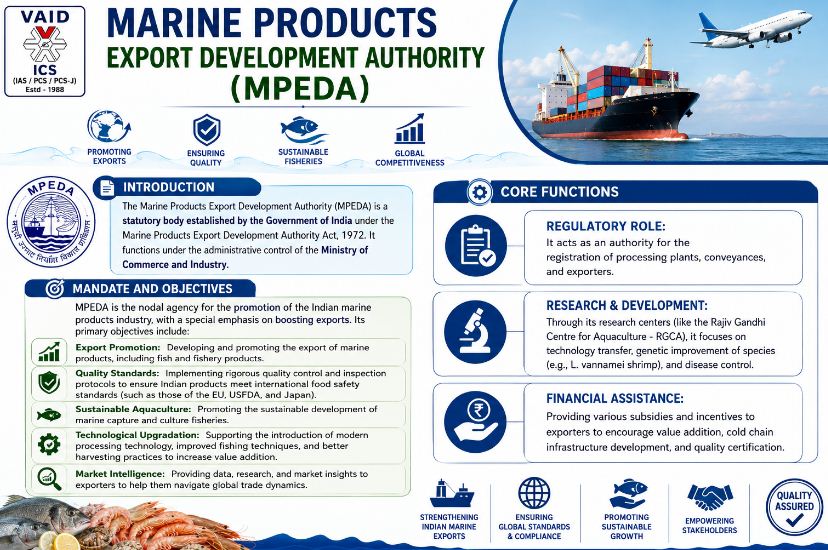
The Marine Products Export Development Authority (MPEDA) is a statutory body established by the Government of India under the Marine Products Export Development Authority Act, 1972. It functions under the administrative control of the Ministry of Commerce and Industry.
Mandate and Objectives:
MPEDA is the nodal agency for the promotion of the Indian marine products industry, with a special emphasis on boosting exports. Its primary objectives include:
-
Export Promotion: Developing and promoting the export of marine products, including fish and fishery products.
-
Quality Standards: Implementing rigorous quality control and inspection protocols to ensure Indian products meet international food safety standards (such as those of the EU, USFDA, and Japan).
-
Sustainable Aquaculture: Promoting the sustainable development of marine capture and culture fisheries.
-
Technological Upgradation: Supporting the introduction of modern processing technology, improved fishing techniques, and better harvesting practices to increase value addition.
-
Market Intelligence: Providing data, research, and market insights to exporters to help them navigate global trade dynamics.
Core Functions:
-
Regulatory Role: It acts as an authority for the registration of processing plants, conveyances, and exporters.
-
Research & Development: Through its research centers (like the Rajiv Gandhi Centre for Aquaculture – RGCA), it focuses on technology transfer, genetic improvement of species (e.g., L. vannamei shrimp), and disease control.
-
Financial Assistance: Providing various subsidies and incentives to exporters to encourage value addition, cold chain infrastructure development, and quality certification.
Strategic Importance for the Blue Economy:
-
Foreign Exchange: It plays a pivotal role in strengthening India’s “Blue Economy” by acting as the primary catalyst for foreign exchange earnings from seafood.
-
Global Competitiveness: By establishing testing labs and providing training on sanitary and phytosanitary (SPS) measures, MPEDA ensures that Indian seafood remains competitive in high-value markets like the US, EU, and Japan.
-
Sustainable Growth: In recent years, it has pivoted toward eco-friendly practices, focusing on the certification of sustainable fisheries and preventing illegal, unreported, and unregulated (IUU) fishing.
Governance Structure:
-
Composition: The authority is chaired by a Chairman (usually an IAS officer) and includes representatives from the central government, the parliament, and the marine products industry (fishermen, processors, and exporters).
-
Headquarters: Kochi, Kerala.
समुद्री उत्पाद निर्यात विकास प्राधिकरण (MPEDA):
परिचय:
समुद्री उत्पाद निर्यात विकास प्राधिकरण (MPEDA) भारत सरकार के वाणिज्य और उद्योग मंत्रालय के प्रशासनिक नियंत्रण के तहत 1972 के समुद्री उत्पाद निर्यात विकास प्राधिकरण अधिनियम के अंतर्गत स्थापित एक सांविधिक निकाय (Statutory Body) है।
उद्देश्य और कार्यक्षेत्र:
MPEDA भारतीय समुद्री उत्पाद उद्योग को बढ़ावा देने और विशेष रूप से निर्यात में वृद्धि करने वाली नोडल एजेंसी है। इसके प्राथमिक उद्देश्यों में शामिल हैं:
-
निर्यात संवर्धन: मछली और मत्स्य उत्पादों सहित समुद्री उत्पादों के निर्यात को विकसित और प्रोत्साहित करना।
-
गुणवत्ता मानक: अंतरराष्ट्रीय खाद्य सुरक्षा मानकों (जैसे EU, USFDA और जापान के मानक) को पूरा करने के लिए सख्त गुणवत्ता नियंत्रण और निरीक्षण प्रोटोकॉल लागू करना।
-
सतत जलीय कृषि (Sustainable Aquaculture): समुद्री कैप्चर और कल्चर मत्स्य पालन के सतत विकास को बढ़ावा देना।
-
तकनीकी उन्नयन: मूल्य संवर्धन (value addition) बढ़ाने के लिए आधुनिक प्रसंस्करण तकनीक और बेहतर कटाई प्रथाओं की शुरुआत करना।
-
बाजार खुफिया (Market Intelligence): वैश्विक व्यापार गतिशीलता को समझने के लिए निर्यातकों को डेटा, शोध और बाजार अंतर्दृष्टि प्रदान करना।
मुख्य कार्य:
-
विनियामक भूमिका: यह प्रसंस्करण संयंत्रों और निर्यातकों के पंजीकरण के लिए एक प्राधिकरण के रूप में कार्य करता है।
-
अनुसंधान एवं विकास (R&D): अपने शोध केंद्रों (जैसे राजीव गांधी सेंटर फॉर एक्वाकल्चर – RGCA) के माध्यम से, यह प्रौद्योगिकी हस्तांतरण, प्रजातियों के आनुवंशिक सुधार और रोग नियंत्रण पर ध्यान केंद्रित करता है।
-
वित्तीय सहायता: मूल्य संवर्धन, कोल्ड चेन बुनियादी ढांचे के विकास और गुणवत्ता प्रमाणन को प्रोत्साहित करने के लिए निर्यातकों को विभिन्न सब्सिडी और प्रोत्साहन प्रदान करना।
ब्लू इकोनॉमी के लिए रणनीतिक महत्व:
-
विदेशी मुद्रा: यह समुद्री भोजन से प्राप्त विदेशी मुद्रा अर्जन के लिए प्राथमिक उत्प्रेरक के रूप में कार्य करके भारत की “ब्लू इकोनॉमी” को मजबूत करता है।
-
वैश्विक प्रतिस्पर्धा: परीक्षण प्रयोगशालाओं की स्थापना और स्वच्छता और पादप स्वच्छता (SPS) उपायों पर प्रशिक्षण प्रदान करके, MPEDA यह सुनिश्चित करता है कि भारतीय समुद्री भोजन अमेरिका, यूरोपीय संघ और जापान जैसे उच्च-मूल्य वाले बाजारों में प्रतिस्पर्धी बना रहे।
-
सतत विकास: हाल के वर्षों में, यह अवैध, असूचित और अनियमित (IUU) मछली पकड़ने को रोकने और टिकाऊ मत्स्य पालन के प्रमाणन पर ध्यान केंद्रित कर रहा है।
संरचना और मुख्यालय:
-
संरचना: प्राधिकरण की अध्यक्षता एक अध्यक्ष (आमतौर पर एक आईएएस अधिकारी) द्वारा की जाती है और इसमें केंद्र सरकार, संसद और समुद्री उत्पाद उद्योग (मछुआरे, प्रोसेसर और निर्यातक) के प्रतिनिधि शामिल होते हैं।
-
मुख्यालय: कोच्चि, केरल।

May 19, 2026
October 17, 2025
October 16, 2025
October 6, 2025

