July 22, 2026
India’s foreign Policy : 22 July 2026
What C. Raja Mohan’s Article Argues?
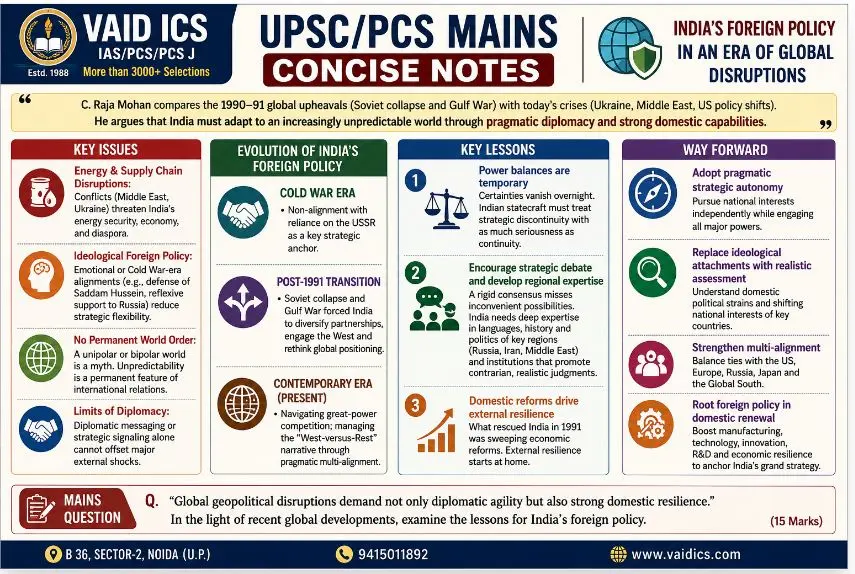
This editorial by strategic affairs expert C. Raja Mohan draws a parallel between the global disruptions of 1990–91 (the collapse of the Soviet Union and the Gulf War) and the contemporary geopolitical upheavals (ongoing conflicts in Ukraine, volatility in the Middle East following escalations involving Iran, and shifting US policies).
The author argues that while historical contexts change, the core challenge remains familiar: India must adapt to sudden, systemic disruptions of long-held international certainties.
Key Issues Highlighted?
-
Disruption of Energy and Supply Chains: Contemporary conflicts (e.g., in the Middle East and Ukraine) mirror the 1990–91 oil price shocks, straining India’s balance of payments, energy security, and diaspora safety.
-
Dogmatic Foreign Policy Thinking: India’s foreign policy establishment has historically suffered from rigid emotional attachments or ideological consensus—such as the uncritical defense of Saddam Hussein or reflexive sentimental solidarity with Russia (personalized around Vladimir Putin) driven by Cold War nostalgia.
-
The Illusion of Permanent Balance: A unipolar or predictably bipolar world order is a myth; unpredictability is a permanent feature of international relations.
-
The Limits of Pure Diplomacy: External systemic shocks cannot be managed through mere diplomatic messaging or strategic signaling alone.
India’s Foreign Policy: Key Features & Shifts:
| Era / Transition | Core Characteristics & Approach |
| Cold War Era | Bipolar stability centered heavily around the Soviet Union as a primary anchor, alongside non-alignment principles. |
| 1991 Transition | Shaken by the collapse of the USSR and the Gulf War, India was forced to diversify international partnerships, engage the West, and rethink its global positioning. |
| Contemporary Era (Today) | Navigating complex great-power competition, managing the “West-versus-Rest” narrative by pragmatically dealing within the West, balancing relationships with the US, Europe, Russia, and regional powers. |
The Three Foreign Policy Lessons for India:
The article outlines three central takeaways for managing global disruptions:
-
No Balance of Power is Permanent: Certainties vanish overnight. Indian statecraft must treat strategic discontinuity with as much seriousness as continuity.
-
Debate is a Strategic Asset: A foreign policy community locked into a rigid consensus misses inconvenient possibilities. India requires deep regional expertise (in languages, history, and internal domestic politics of places like Russia, Iran, and the Middle East) and institutions that encourage contrarian, realistic judgments.
-
Internal Reforms are the Ultimate Safeguard: What rescued India after the 1991 balance-of-payments crisis wasn’t just clever diplomatic footwork, but sweeping domestic economic reforms. External resilience starts at home.
The Way Forward & Balanced Approach:
-
Empathetic Realism over Reflexive Ideology: Instead of projecting emotional solidarity onto foreign regimes (like post-revolutionary Iran or modern Russia), India must cultivate a deep, clear-eyed understanding of their domestic political strains and shifting national interests.
-
Pragmatic Strategic Autonomy: India must transcend the false binary of choosing between strategic autonomy and partnering with Western democracies, emulating successful models of multi-alignment.
-
Rooting Foreign Policy in Domestic Renewal: Just as economic liberalization saved India in 1991, tackling technological disruptions, boosting domestic research, design, and manufacturing capabilities will anchor India’s grand strategy today.
Article Based Mains Qn:
Global disruptions and systemic shocks resemble the geopolitical turbulence of 1990–91. In this context, examine the key lessons India’s foreign policy must draw from 1991 to navigate contemporary international uncertainties.” (15 Marks, 250 Words)
रणनीतिक मामलों के विशेषज्ञ सी. राजा मोहन का यह आलेख 1990-91 के वैश्विक उथल-पुथल (सोवियत संघ के पतन और खाड़ी युद्ध) और समकालीन भू-राजनीतिक संकटों (रूस-यूक्रेन युद्ध, मध्य पूर्व में ईरान से जुड़ा तनाव और बदलती अमेरिकी नीतियां) के बीच एक स्पष्ट समानता खींचता है।
लेखक का तर्क है कि ऐतिहासिक संदर्भ भले ही बदल गए हों, लेकिन मूल चुनौती वही बनी हुई है: भारत को अंतरराष्ट्रीय निश्चितताओं के अचानक और प्रणालीगत विघटन (disruptions) के अनुकूल ढलना होगा।
मुख्य मुद्दे:
-
ऊर्जा और आपूर्ति श्रृंखला का बाधित होना: समकालीन संघर्ष 1990-91 के तेल मूल्य के झटकों की याद दिलाते हैं, जो भारत के भुगतान संतुलन, ऊर्जा सुरक्षा और प्रवासियों की सुरक्षा को खतरे में डालते हैं।
-
कट्टर विदेश नीति की सोच: भारत के विदेश नीति तंत्र में ऐतिहासिक रूप से एक कठोर वैचारिक सहमति या भावनात्मक झुकाव रहा है- जैसे सद्दाम हुसैन का बिना शर्त बचाव करना या शीत युद्ध के पुराने नॉस्टैल्जिया के कारण रूस (व्लादिमीर पुतिन के इर्द-गिर्द केंद्रित) के प्रति भावनात्मक एकजुटता दिखाना।
-
स्थिर शक्ति संतुलन का भ्रम: एक ध्रुवीय या अनुमानित रूप से द्विध्रुवीय विश्व व्यवस्था एक मिथक है; अनिश्चितता अंतरराष्ट्रीय राजनीति की एक स्थायी विशेषता है।
-
केवल कूटनीति की सीमाएं: बाहरी प्रणालीगत झटकों को केवल कूटनीतिक संदेशों या रणनीतिक बयानबाजी से नहीं संभाला जा सकता है।
भारत की विदेश नीति: मुख्य विशेषताएं और बदलाव:
| काल / संक्रमण | मुख्य विशेषताएं और दृष्टिकोण |
| शीत युद्ध का दौर | गुटनिरपेक्षता के सिद्धांतों के साथ-साथ सोवियत संघ पर मुख्य रणनीतिक सहारे के रूप में भारी निर्भरता। |
| 1991 का संक्रमण | सोवियत संघ के पतन और खाड़ी युद्ध से हिल चुके भारत को अपने अंतरराष्ट्रीय साझेदारियों में विविधता लाने, पश्चिम के साथ जुड़ने और अपनी वैश्विक स्थिति पर पुनर्विचार करने के लिए मजबूर होना पड़ा। |
| समकालीन दौर (आज) | महान शक्तियों की प्रतिस्पर्धा के बीच संतुलन साधना, पश्चिमी देशों के साथ व्यावहारिक रूप से जुड़ते हुए ‘पश्चिम बनाम अन्य’ की बहस से निपटना, और अमेरिका, यूरोप, रूस तथा क्षेत्रीय ताकतों के साथ संबंधों को संतुलित करना। |
भारत के लिए तीन विदेश नीति सबक:
लेख आलेख में वैश्विक विघटन से निपटने के लिए तीन केंद्रीय सबक बताए गए हैं:
-
शक्ति का संतुलन स्थायी नहीं होता: निश्चितताएं रातों-रात गायब हो जाती हैं। भारतीय राजनैतिक व्यवस्था को निरंतरता की तरह ही रणनीतिक अस्थिरता (discontinuity) को भी उतनी ही गंभीरता से लेना चाहिए।
-
बहस एक रणनीतिक संपत्ति है: एक ऐसा विदेश नीति समुदाय जो किसी कठोर आम सहमति में जकड़ा हुआ हो, वह आने वाली असहज वास्तविकताओं को नहीं देख पाता है। भारत को गहरी क्षेत्रीय विशेषज्ञता (रूस, ईरान और मध्य पूर्व की भाषाओं, इतिहास और घरेलू राजनीति में) और ऐसी संस्थाओं की आवश्यकता है जो विपरीत और यथार्थवादी निर्णयों को प्रोत्साहित करें।
-
आंतरिक सुधार ही अंतिम सुरक्षा कवच हैं: 1991 के भुगतान संतुलन संकट के बाद भारत को केवल चतुर कूटनीतिक पैंतरेबाज़ी ने नहीं बचाया, बल्कि व्यापक घरेलू आर्थिक सुधारों ने बचाया। बाहरी लचीलापन घर से शुरू होता है।
आगे की राह और संतुलित दृष्टिकोण:
-
प्रतिक्रियावादी विचारधारा के बजाय सहानुभूतिपूर्ण यथार्थवाद: विदेशी सत्तों (जैसे उत्तर-क्रांतिकारी ईरान या आधुनिक रूस) के प्रति भावनात्मक एकजुटता दिखाने के बजाय, भारत को उनके घरेलू राजनीतिक तनावों और बदलते राष्ट्रीय हितों की गहरी और स्पष्ट समझ विकसित करनी चाहिए।
-
व्यावहारिक रणनीतिक स्वायत्तता: भारत को रणनीतिक स्वायत्तता और पश्चिमी लोकतंत्रों के साथ साझेदारी के बीच झूठे विकल्प को पार करना चाहिए, और बहु-संरेखण (multi-alignment) के सफल मॉडलों का अनुकरण करना चाहिए।
-
घरेलू पुनरुत्थान पर विदेश नीति का आधारित होना: जिस प्रकार 1991 में आर्थिक उदारीकरण ने भारत को बचाया था, उसी तरह आज तकनीकी व्यवधानों से निपटना, घरेलू अनुसंधान, डिजाइन और विनिर्माण क्षमताओं को बढ़ावा देना भारत की वृहद रणनीति को मजबूत करेगा।

May 19, 2026
October 17, 2025
October 16, 2025
October 6, 2025

