March 18, 2026
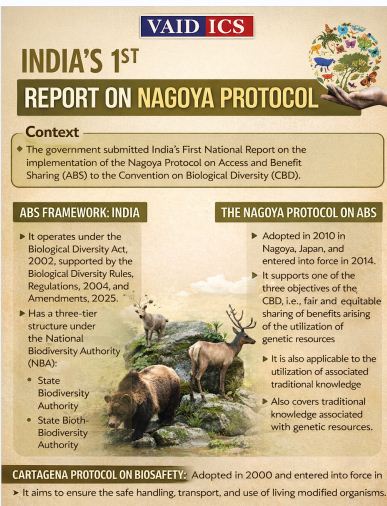
INDIA’S First National Report (NR1) on the Nagoya Protocol
WHY IN NEWS?
-
Official Submission: India officially submitted its First National Report (NR1) to the Secretariat of the Convention on Biological Diversity (CBD) on February 27, 2026.
-
Compliance: This fulfills India’s obligation under Article 29 of the Nagoya Protocol, which requires member nations to monitor and report on their progress.
-
Strategic Alignment: The report documents India’s shift toward a more transparent, digital-first biodiversity regime, specifically supporting Target 13 of the updated National Biodiversity Strategy and Action Plan (NBSAP).
II. KEY POINTS OF THE REPORT:
1. Legal & Institutional Framework
India has modernized its legal “armor” to protect biological resources:
-
Updated Laws: Implementation is now guided by the Biological Diversity Rules, 2024 and the new ABS Regulations, 2025.
-
Three-Tier Governance: * National: National Biodiversity Authority (NBA).
-
State: State Biodiversity Boards (SBBs).
-
Local: 2,76,653 Biodiversity Management Committees (BMCs) established at the village/local level.
-
2. Global Leadership in Transparency (IRCCs):
-
The 60% Milestone: India has published 3,556 Internationally Recognized Certificates of Compliance (IRCCs).
-
World Leader: This accounts for over 60% of the total IRCCs published globally, proving that India has the most transparent “Access and Benefit Sharing” (ABS) system in the world.
3. Economic Impact & Benefit Sharing:
The report highlights how biodiversity is being converted into financial support for local communities:
-
Funds Mobilized: ₹216.31 crore (approx. $28 million) was collected through NBA approvals.
-
Direct Disbursement: ₹139.69 crore has already been paid out to “benefit claimers” (local tribes, farmers, and BMCs) who are the traditional guardians of these resources.
-
Non-Monetary Gains: 395 approvals included technology transfers and collaborative research instead of just cash payments.
4. Statistics of Approvals (2017–2025)
-
Total ABS Approvals: 12,830.
-
Commercial Use: Nearly 7,000 approvals were granted specifically for the commercial utilization of biological resources by Indian and foreign entities.
-
Foreign Resources: India also started strictly monitoring foreign bio-resources being used within India (41 declarations received under Form 10).
5. Capacity Building
-
Massive Outreach: Over 2.56 lakh individuals have been trained through 3,700+ workshops to understand how to protect local “Traditional Knowledge” (TK) from bio-piracy.

October 17, 2025
October 16, 2025
October 6, 2025
September 24, 2025

