May 19, 2026
India’s Escalating Import Burden and Trade Deficit (April 2026)
Why in News?
India’s merchandise trade deficit widened to $28.4 billion in April 2026. According to an analysis by HDFC Bank, this expansion was primarily driven by import growth significantly outpacing the recovery in exports.
Comparative Matrix of the Trade Deficit:
- April 2026: $28.4 billion
- April 2025 (Year-on-Year – YoY): $27 billion
- March 2026 (Month-on-Month – MoM): $20.7 billion
Primary Drivers of the Import Rebound:
Following a temporary contraction in March 2026 due to a brief lull in gold and crude oil purchases, India’s import bill rebounded sharply in April, registering a 10% YoY increase. The core drivers include:
- Exponential Surge in Gold Imports: Gold imports nearly doubled compared to March 2026, marking a massive 82% annual increase.
- Rising Core Imports: Increased domestic industrial demand led to higher inflows of non-oil, non-gold “core” items, particularly electronics and manufacturing raw materials.
- Elevated Crude Oil Prices: The Indian crude basket remained structurally high at $114 per barrel, driving the total oil import bill up to $18.6 billion (compared to the $13 billion average witnessed in Q4 of FY26).
Geopolitical Disruptions & The Value vs. Volume Paradox:
- Strait of Hormuz Crisis: Due to severe geopolitical disruptions and the subsequent closure of the strategic Strait of Hormuz chokepoint, India’s actual oil import volumes plummeted by 47% YoY.
- The Paradox: Despite importing nearly half the physical volume of crude oil due to supply chain blockades, the inflated global price ($114/barrel) meant India still paid a disproportionately high total fiscal amount ($18.6 billion), severely straining the trade balance.
India’s Energy Security and Buffer Resilience:
According to statements by the Union Minister for Petroleum and Natural Gas, India maintains a strategic cushion to withstand short-term global supply shocks:
- Crude Oil & LNG: 60 days of emergency forward cover reserves.
- LPG: 45 days of buffer stock.
Fiscal Risk Warning: Due to the combination of global supply chain disruptions and domestic price insulation, state-run Oil Marketing Companies (OMCs) are absorbing massive under-recoveries, losing an estimated ₹1,000 crore per day. This poses a direct threat to the country’s fiscal deficit targets.
Analytical Points for UPSC Mains:
- Impact on Current Account Deficit (CAD): A structurally widening merchandise trade deficit exerts direct depreciating pressure on the Indian Rupee (INR) and threatens to breach sustainable CAD thresholds (typically healthy below 2.5% of GDP).
- Vulnerability of Supply Chokepoints: The 47% drop in volume due to the Strait of Hormuz disruption highlights India’s high geographical vulnerability regarding energy security, emphasizing the need to fast-track alternative transit routes (like the IMEC or North-South Transport Corridor).
- Strategic Petroleum Reserves (SPR): This volatile macro-environment reinforces the immediate necessity to expand Phase-II of India’s SPR program (adding commercial-cum-strategic storage at Chandikhol and Padur) to insulation the economy from prolonged external shocks.
Way Forward:
- Aggressive Energy Sourcing Diversification: India must accelerate crude sourcing from non-Middle Eastern geographies (such as increasing term-contracts with Russia, African nations, and Latin America) to bypass geopolitical vulnerabilities in the Persian Gulf.
- Curbing Non-Essential Imports (Gold): To tackle the 82% surge in gold imports, the government needs to financialize idle gold assets and make paper-gold instruments like Sovereign Gold Bonds (SGBs) more attractive to retail investors, thereby reducing physical import demand.
- Strengthening Domestic Supply Chains: High-value core imports like electronics must be substituted by rapidly scaling up domestic manufacturing through the Production Linked Incentive (PLI) schemes and enhancing local component ecosystems.
Conclusion:
The trade data for April 2026 indicates that while India’s internal economic growth remains robust, its macroeconomic stability is heavily tied to external commodity price shocks and geopolitical friction. To achieve long-term resilience, the state must balance its immediate fiscal responses (supporting OMCs) with long-term structural reforms, focusing on aggressive export promotion, alternative energy transition, and deep-cut import substitution.
यहाँ अप्रैल 2026 के व्यापार आंकड़ों के आधार पर भारतीय अर्थव्यवस्था (GS Paper III – भारतीय अर्थव्यवस्था एवं विदेशी व्यापार) के दृष्टिकोण से उपयुक्त मानक, प्रशासनिक और व्यवस्थित अंग्रेजी नोट्स का हूबहू हिंदी संस्करण दिया गया है:
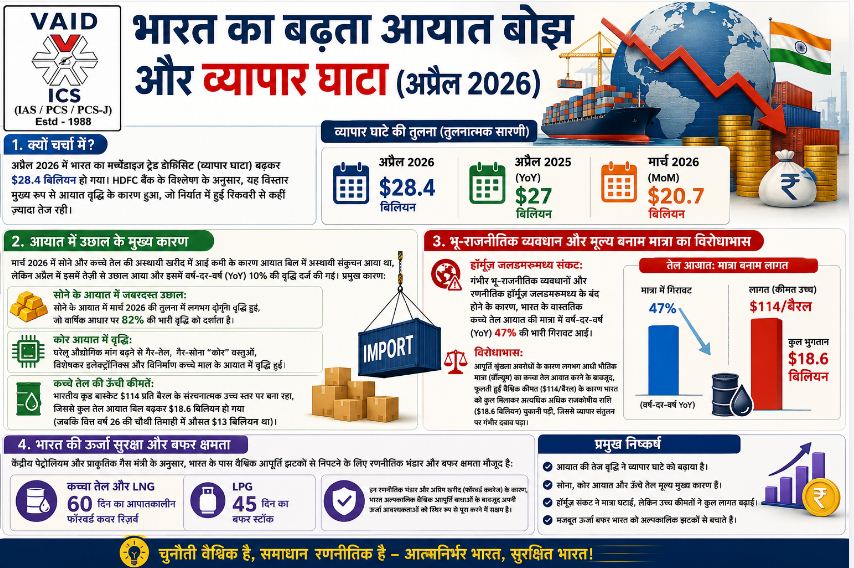
भारत का बढ़ता आयात बोझ और व्यापार घाटा (अप्रैल 2026)
चर्चा में क्यों?
अप्रैल 2026 में भारत का वस्तु व्यापार घाटा (Merchandise Trade Deficit) बढ़कर 28.4 बिलियन डॉलर हो गया है। HDFC बैंक के एक विश्लेषण के अनुसार, इस घाटे में विस्तार का मुख्य कारण आयात वृद्धि दर का निर्यात में सुधार की तुलना में काफी अधिक होना है।
व्यापार घाटे का तुलनात्मक मैट्रिक्स (तुलना):
-
अप्रैल 2026: $28.4 बिलियन
-
अप्रैल 2025 (वार्षिक आधार पर – YoY): $27 बिलियन
-
मार्च 2026 (मासिक आधार पर – MoM): $20.7 बिलियन
आयात बिल में उछाल के प्राथमिक कारक (Drivers of Import Rebound):
मार्च 2026 में सोने और कच्चे तेल की खरीद में आई अस्थायी मंदी के बाद, अप्रैल में भारत का आयात बिल तेजी से बढ़ा और इसमें 10% की वार्षिक (YoY) वृद्धि दर्ज की गई। इसके मुख्य कारक निम्नलिखित हैं:
-
स्वर्ण आयात में अप्रत्याशित वृद्धि: सोने का आयात मार्च 2026 की तुलना में लगभग दोगुना हो गया, जो कि 82% की भारी वार्षिक वृद्धि को दर्शाता है।
-
कोर आयात में बढ़ोतरी (Higher Core Imports): घरेलू औद्योगिक मांग में मजबूती के कारण गैर-तेल और गैर-सोना “कोर” वस्तुओं, विशेष रूप से इलेक्ट्रॉनिक्स और विनिर्माण क्षेत्र के कच्चे माल के आयात में भारी वृद्धि हुई।
-
कच्चे तेल की ऊंची कीमतें: भारतीय क्रूड बास्केट की कीमत 114 डॉलर प्रति बैरल के उच्च स्तर पर बनी रही। इसके कारण कुल तेल आयात बिल बढ़कर $18.6 बिलियन तक पहुंच गया (जबकि वित्तीय वर्ष 2026 की चौथी तिमाही में यह औसत $13 बिलियन था)।
भू-राजनीतिक व्यवधान और ‘मूल्य बनाम मात्रा का विरोधाभास’:
-
हॉर्मुज़ जलडमरूमध्ये (Strait of Hormuz) संकट: इस रणनीतिक जलमार्ग के बंद होने और उससे जुड़े गंभीर भू-राजनीतिक व्यवधानों के कारण भारत के वास्तविक तेल आयात की मात्रा (Volume) में वार्षिक आधार पर 47% की भारी गिरावट आई।
-
मूल्य बनाम मात्रा का विरोधाभास (Value vs Volume Paradox): आपूर्ति श्रृंखला में गतिरोध के कारण आयात होने वाले तेल की भौतिक मात्रा लगभग आधी रह जाने के बावजूद, वैश्विक स्तर पर कच्चे तेल की ऊंची कीमतों ($114/बैरल) के कारण भारत को कुल मिलाकर एक बहुत बड़ी वित्तीय राशि ($18.6 बिलियन) चुकानी पड़ी, जिसने व्यापार संतुलन को गंभीर रूप से प्रभावित किया।
भारत की ऊर्जा सुरक्षा और बफर क्षमता (Energy Security Matrix):
केंद्रीय पेट्रोलियम एवं प्राकृतिक गैस मंत्री के बयानों के अनुसार, किसी भी गंभीर वैश्विक आपूर्ति संकट या झटके से निपटने के लिए भारत के पास वर्तमान में निम्नलिखित आपातकालीन बफर स्टॉक (रणनीतिक भंडार) मौजूद हैं:
-
कच्चा तेल और एलएनजी (Crude Oil & LNG): 60 दिनों का अग्रिम आपातकालीन सुरक्षा कवर।
-
एलपीजी (LPG): 45 दिनों का बफर स्टॉक।
राजकोषीय जोखिम की चेतावनी (Fiscal Risk): वैश्विक आपूर्ति श्रृंखला में व्यवधान और घरेलू स्तर पर कीमतों को नियंत्रित रखने (जनता को महंगे तेल से बचाने) के कारण, सरकारी तेल विपणन कंपनियों (OMCs) को वर्तमान में अनुमानित ₹1,000 करोड़ रुपये प्रति दिन का भारी नुकसान (Under-recoveries) उठाना पड़ रहा है। यह स्थिति देश के राजकोषीय घाटे (Fiscal Deficit) के लक्ष्यों के लिए एक सीधा खतरा है।
यूपीएससी मुख्य परीक्षा के लिए विश्लेषणात्मक बिंदु (Mains Analytical Points):
-
चालू खाता घाटे (CAD) पर प्रभाव: वस्तु व्यापार घाटे (Merchandise Trade Deficit) का लगातार चौड़ा होना सीधे तौर पर भारतीय रुपये (INR) की विनिमय दर पर अवमूल्यन (Depreciation) का दबाव बनाता है और यह भारत के चालू खाता घाटे को उस सीमा से बाहर ले जाने की धमकी देता है जिसे टिकाऊ (सस्टेनेबल) माना जाता है (आमतौर पर सकल घरेलू उत्पाद के 2.5% से नीचे सुरक्षित माना जाता है)।
-
आपूर्ति चोक-पॉइंट्स की संवेदनशीलता: हॉर्मुज़ जलडमरूमध्ये में व्यवधान के कारण तेल की मात्रा में 47% की गिरावट भारत की ऊर्जा सुरक्षा के भौगोलिक जोखिमों को उजागर करती है। यह स्थिति भारत को वैकल्पिक पारगमन मार्गों (जैसे भारत-मध्य पूर्व-यूरोप आर्थिक गलियारा – IMEC या उत्तर-दक्षिण परिवहन गलियारा – INSTOR) को तेजी से विकसित करने की आवश्यकता पर बल देती है।
-
रणनीतिक पेट्रोलियम भंडार (SPR) की अनिवार्यता: यह अस्थिर व्यापक आर्थिक माहौल (Macro-environment) भारत के रणनीतिक पेट्रोलियम भंडारों के चरण-II (पादुर और चंडीखोल में अतिरिक्त वाणिज्यिक-सह-रणनीतिक भंडारण क्षमता) के निर्माण को गति देने की तात्कालिकता को पुख्ता करता है, ताकि दीर्घकालिक बाहरी झटकों से अर्थव्यवस्था को बचाया जा सके।
आगे की राह (Way Forward):
-
ऊर्जा स्रोतों का आक्रामक विविधीकरण: फारस की खाड़ी (Persian Gulf) में भू-राजनीतिक संवेदनशीलता को देखते हुए भारत को गैर-मध्य पूर्वी भौगोलिक क्षेत्रों से कच्चे तेल के आयात को तेजी से बढ़ाना चाहिए (जैसे रूस, अफ्रीकी देशों और लैटिन अमेरिका के साथ दीर्घकालिक अनुबंधों का विस्तार करना)।
-
गैर-आवश्यक आयात (सोने) पर नियंत्रण: सोने की भौतिक मांग को कम करने के लिए सरकार को वित्तीय साधनों, जैसे सॉवरेन गोल्ड बॉन्ड (SGB) को खुदरा निवेशकों के लिए और अधिक आकर्षक बनाना होगा, जिससे निवेश के रूप में सोने के भौतिक आयात पर निर्भरता कम हो सके।
-
घरेलू विनिर्माण व आयात प्रतिस्थापन: इलेक्ट्रॉनिक्स जैसे उच्च-मूल्य वाले कोर आयात को कम करने के लिए घरेलू प्रोडक्शन लिंक्ड इंसेंटिव (PLI) योजनाओं को और अधिक मजबूती से लागू करना होगा और स्थानीय कंपोनेंट इकोसिस्टम को बढ़ावा देकर ‘मेक इन इंडिया’ मूल्य श्रृंखला को मजबूत करना होगा।
निष्कर्ष (Conclusion)
अप्रैल 2026 के व्यापार आंकड़े यह स्पष्ट करते हैं कि भारत की आंतरिक आर्थिक वृद्धि मजबूत होने के बावजूद, इसकी व्यापक आर्थिक स्थिरता (Macroeconomic Stability) वैश्विक भू-राजनीति और कमोडिटी की कीमतों के झटकों से गहराई से जुड़ी हुई है। दीर्घकालिक आर्थिक सुदृढ़ता प्राप्त करने के लिए, सरकार को कंपनियों (OMCs) को वित्तीय सहायता देने जैसे तात्कालिक कदमों के साथ-साथ आक्रामक निर्यात प्रोत्साहन, वैकल्पिक ऊर्जा संक्रमण और गहरे आयात प्रतिस्थापन जैसे दीर्घकालिक संरचनात्मक सुधारों में संतुलन बनाना होगा।

May 19, 2026
October 17, 2025
October 16, 2025
October 6, 2025

