July 3, 2026
Indian Navy’s Anti-Piracy Operations
Why in News?
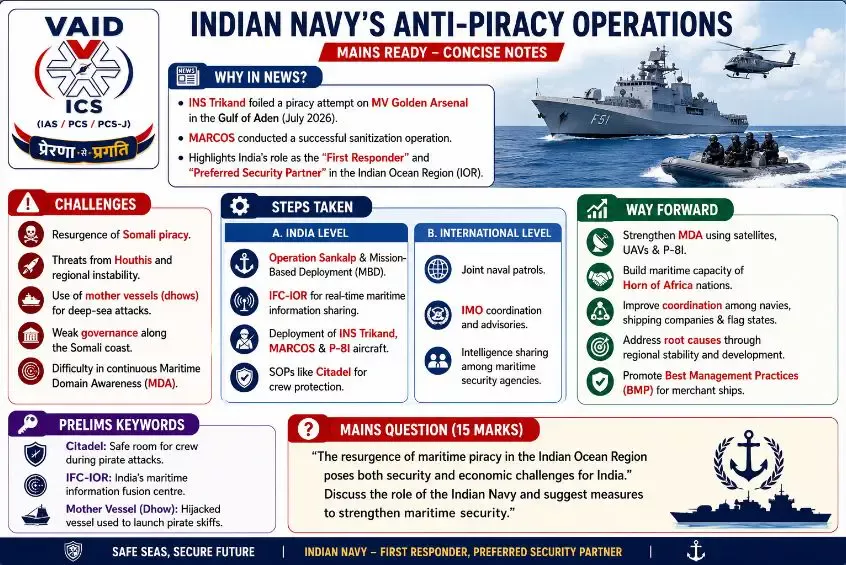
- Event: The Indian Navy successfully thwarted a piracy attempt on the bulk carrier MV Golden Arsenal in the Gulf of Aden (July 2026).
- Key Action: INS Trikand (a mission-deployed stealth frigate) intercepted the vessel, and Marine Commandos (MARCOS) conducted a sanitization operation.
- Strategic Role: This incident underscores the Indian Navy’s role as the “First Responder” and “Preferred Security Partner” in the Indian Ocean Region (IOR), amidst a documented resurgence of Somali piracy in 2026.
2. Key Issues & Challenges:
- Resurgence of Somali Piracy: After years of dormancy, maritime networks in the Western Indian Ocean and Horn of Africa are reactivating, moving from episodic incidents to systemic threats.
- Regional Instability: The Gulf of Aden and Red Sea corridors are volatile due to overlapping threats, including Houthi militia activity (drones/missiles) and rival pirate group clashes.
- Asymmetric Tactics: Pirates are increasingly using dhows as “mother vessels” to stage attacks far from the coast, increasing the operational radius.
- Infrastructure & Governance Gaps: Persistent lack of governance on the Somali coast allows piracy networks to adapt, preserve logistics, and leverage local power brokers.
- Maritime Domain Awareness (MDA): Maintaining continuous surveillance over a vast maritime area against low-visibility, small-skiff attacks remains resource-intensive.
3. Steps Taken:
A. India Level:
- Mission-Based Deployment (MBD): Continuous presence of warships in critical choke points (e.g., Gulf of Aden) under Operation Sankalp.
- Information Fusion Centre – Indian Ocean Region (IFC-IOR): Acts as the central node for maritime situational awareness, coordinating inputs between merchant vessels and naval assets.
- Specialized Response: Deployment of elite MARCOS units and long-range surveillance assets like the P-8I Maritime Patrol Aircraft.
- Standard Operating Procedures (SOPs): Encouraging merchant vessels to utilize the “Citadel” (a fortified safe room) to ensure crew safety during boardings.
B. International Level:
- Coalition Naval Efforts: Coordinated patrols by various international navies to deter piracy and armed robbery.
- Regulatory Framework: The International Maritime Organization (IMO) consistently issues urgent appeals for coordinated intervention and the release of hijacked crews.
- Collaboration: Sharing of real-time intelligence via international maritime security platforms to track suspicious skiffs and mother vessels.
4. Way Forward: Strategic Imperatives
- Strengthened MDA: Enhancing the integration of space-based and aerial surveillance (UAVs/P-8I) with real-time merchant reporting via IFC-IOR.
- Capacity Building: Assisting regional littoral states in the Horn of Africa to develop their own coast guards and improve governance to deny pirates safe havens on land.
- Institutional Coordination: Strengthening the nexus between private shipping companies, flag states, and naval forces to improve the speed of reporting and response.
- Addressing Root Causes: Engaging in diplomatic and socio-economic support to stabilize coastal communities, as naval deterrence alone is insufficient to eradicate piracy permanently.
- Standardizing Security Protocols: Promoting universal adoption of “Best Management Practices” (BMP) among merchant vessels to harden targets against boarding.
Key Terminology for Prelims
- Citadel: A self-contained, fortified safe room on a merchant ship designed to withstand forced entry, providing crew security during pirate attacks.
- IFC-IOR: India’s initiative to enhance maritime safety through regional cooperation by fusing maritime data.
- Mother Vessel (Dhow): Larger vessels hijacked by pirates and used as a staging base to launch smaller, faster skiffs into deep-sea shipping lanes.
भारतीय नौसेना का समुद्री डकैती-रोधी अभियान:
समाचार में क्यों?
- घटना: भारतीय नौसेना ने जुलाई 2026 में अदन की खाड़ी (Gulf of Aden) में मालवाहक जहाज MV गोल्डन आर्सेनल पर समुद्री डकैती के प्रयास को सफलतापूर्वक विफल कर दिया।
- प्रमुख कार्रवाई: INS त्रिकंद (मिशन-तैनात स्टील्थ फ्रिगेट) को तैनात किया गया, और मार्कोस (MARCOS) कमांडो ने जहाज को सुरक्षित करने के लिए सैनिटाइजेशन ऑपरेशन चलाया।
- रणनीतिक महत्व: यह घटना हिंद महासागर क्षेत्र (IOR) में भारतीय नौसेना की “प्रथम प्रतिक्रियाकर्ता” (First Responder) और “पसंदीदा सुरक्षा भागीदार” (Preferred Security Partner) की भूमिका को रेखांकित करती है, विशेषकर 2026 में सोमाली समुद्री डकैती के बढ़ते खतरों के बीच।
प्रमुख मुद्दे और चुनौतियां:
- सोमाली डकैती का पुनरुत्थान: वर्षों की निष्क्रियता के बाद, पश्चिमी हिंद महासागर और हॉर्न ऑफ अफ्रीका में समुद्री डकैती के नेटवर्क फिर से सक्रिय हो रहे हैं।
- क्षेत्रीय अस्थिरता: अदन की खाड़ी और लाल सागर के गलियारे हौथी मिलिशिया (ड्रोन/मिसाइल हमले) और प्रतिद्वंद्वी समुद्री डाकू समूहों के कारण अत्यधिक अस्थिर हैं।
- असममित रणनीति (Asymmetric Tactics): समुद्री डाकू अब तट से दूर हमले करने के लिए ‘मदर वेसल्स’ (डौ/Dhows) का उपयोग कर रहे हैं।
- शासन का अभाव: सोमाली तट पर शासन की निरंतर कमी समुद्री डाकू नेटवर्क को सुरक्षित ठिकाने और रसद प्रदान करती है।
- समुद्री डोमेन जागरूकता (MDA): विशाल समुद्री क्षेत्र में छोटे, कम दृश्यता वाले जहाजों पर नजर रखना एक संसाधन-गहन चुनौती है।
किए गए उपाय:
अ. भारत स्तर पर:
- मिशन-आधारित तैनाती (MBD): ऑपरेशन संकल्प के तहत अदन की खाड़ी जैसे महत्वपूर्ण समुद्री मार्गों पर युद्धपोतों की निरंतर उपस्थिति।
- IFC-IOR (सूचना संलयन केंद्र – हिंद महासागर क्षेत्र): यह समुद्री सुरक्षा के लिए एक केंद्रीय नोड है, जो व्यापारिक जहाजों और नौसेना के बीच खुफिया जानकारी साझा करता है।
- विशिष्ट प्रतिक्रिया: कुलीन मार्कोस इकाइयों की तैनाती और P-8I समुद्री गश्ती विमान जैसे लंबी दूरी के निगरानी संपत्तियों का उपयोग।
- मानक संचालन प्रक्रिया (SOPs): समुद्री डकैती के दौरान चालक दल की सुरक्षा सुनिश्चित करने के लिए जहाजों में “सिटाडेल” (Citadel) (एक सुरक्षित कमरा) के उपयोग को बढ़ावा देना।
ब. अंतर्राष्ट्रीय स्तर पर:
- गठबंधन नौसैनिक प्रयास: डकैती को रोकने के लिए विभिन्न देशों की नौसेनाओं द्वारा समन्वित गश्त।
- नियामक ढांचा: अंतर्राष्ट्रीय समुद्री संगठन (IMO) द्वारा हस्तक्षेप और चालक दल की रिहाई के लिए निरंतर अपील।
- सहयोग: संदिग्ध जहाजों को ट्रैक करने के लिए अंतर्राष्ट्रीय समुद्री सुरक्षा प्लेटफार्मों के माध्यम से वास्तविक समय में खुफिया जानकारी का आदान-प्रदान।
आगे की राह (Way Forward):
- मजबूत MDA: अंतरिक्ष-आधारित और हवाई निगरानी (UAVs/P-8I) के साथ IFC-IOR के माध्यम से रसद और सूचना एकीकरण को बढ़ाना।
- क्षमता निर्माण: हॉर्न ऑफ अफ्रीका के देशों को अपने तटीय सुरक्षा बलों को विकसित करने में सहायता करना।
- संस्थागत समन्वय: निजी शिपिंग कंपनियों, ध्वज राज्यों और नौसेना बलों के बीच संबंधों को मजबूत करना ताकि प्रतिक्रिया की गति में सुधार हो सके।
- मूल कारणों का समाधान: तटीय समुदायों को राजनयिक और सामाजिक-आर्थिक सहायता प्रदान करना ताकि उन्हें डकैती से दूर किया जा सके।
- सुरक्षा प्रोटोकॉल का मानकीकरण: व्यापारी जहाजों के बीच ‘सर्वोत्तम प्रबंधन प्रथाओं’ (BMP) को अपनाने को बढ़ावा देना।
परीक्षा के लिए महत्वपूर्ण शब्दावली:
- सिटाडेल (Citadel): व्यापारी जहाज पर बना एक सुरक्षित कमरा, जिसे डकैती के दौरान चालक दल की सुरक्षा के लिए मजबूत बनाया जाता है।
- IFC-IOR: समुद्री डेटा को एकीकृत करके क्षेत्रीय सहयोग के माध्यम से सुरक्षा बढ़ाने के लिए भारत की पहल।
- मदर वेसल (डौ): बड़े जहाजों का अपहरण कर उन्हें छोटे और तेज गति वाले जहाजों को समुद्र के गहरे मार्गों में भेजने के लिए एक बेस के रूप में उपयोग करना।

Citizenship (Amendment) Rules, 2026
May 19, 2026
Gist of daily Article /The Hindu 17oct 2025
October 17, 2025
Daily Gist of the Hindu/Indian Express : 16 Oct 2025
October 16, 2025
Daily Gist of The Hindu/Indian Express: 6 Oct 2025
October 6, 2025

