September 16, 2026
India–WTO: Shift in Plurilateral Agreements/भारत–WTO: बहुपक्षीय समझौतों के प्रति दृष्टिकोण में बदलाव
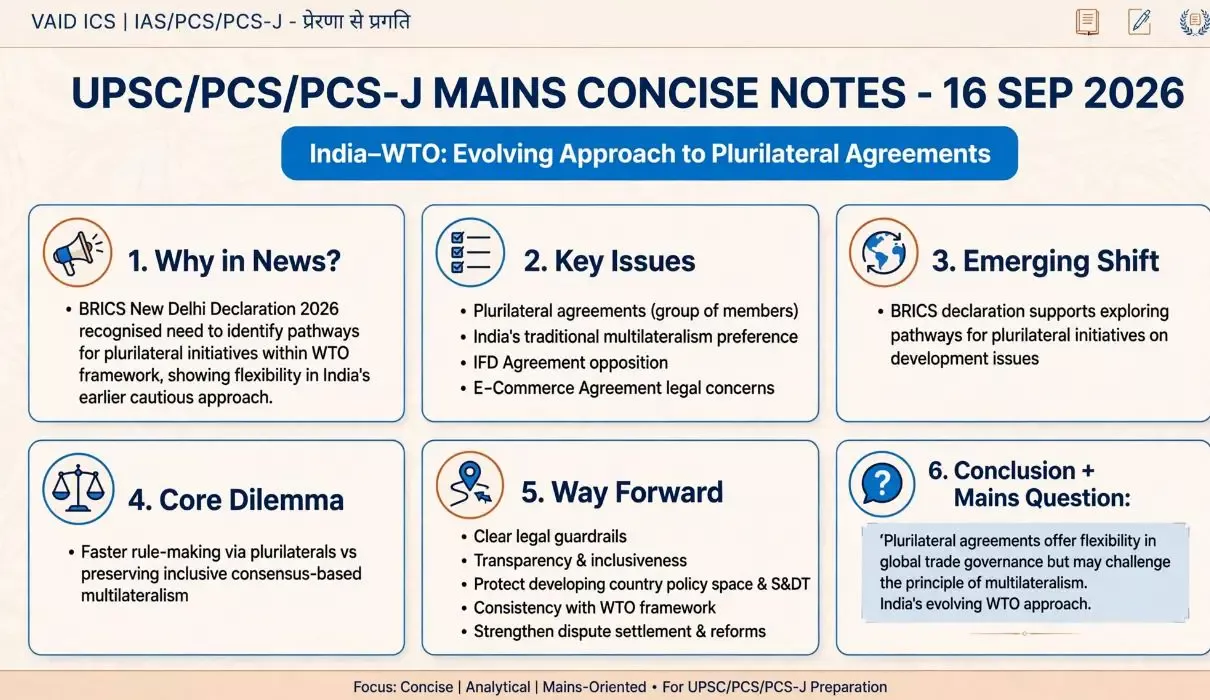
Why in News?
The 2026 BRICS New Delhi Declaration has indicated that BRICS members recognise the need to identify “pathways” for plurilateral initiatives within the WTO legal framework.
This is significant because India has traditionally preferred multilateral trade negotiations involving all WTO members and has raised concerns about plurilateral agreements.
What are Plurilateral Agreements?
Plurilateral agreements are trade agreements negotiated and implemented by a group of WTO members, rather than by all WTO members.
-
Multilateral: All WTO members participate.
-
Plurilateral: Only a group of willing/interested members participate.
-
Under WTO rules, incorporation of a plurilateral agreement into Annex 4 requires consensus among WTO members.
India’s Traditional Position:
India has argued that plurilateral agreements may:
-
Fragment the multilateral trading system.
-
Reduce the voice and negotiating space of developing countries.
-
Create systemic and legal concerns within the WTO.
-
Allow agreements to advance without adequate participation of all members.
-
Shift attention away from unresolved development-oriented issues.
At the WTO 14th Ministerial Conference (MC14), Cameroon, India advocated developing guardrails and legal safeguards before incorporating plurilateral agreements into the WTO framework.
Investment Facilitation for Development (IFD):
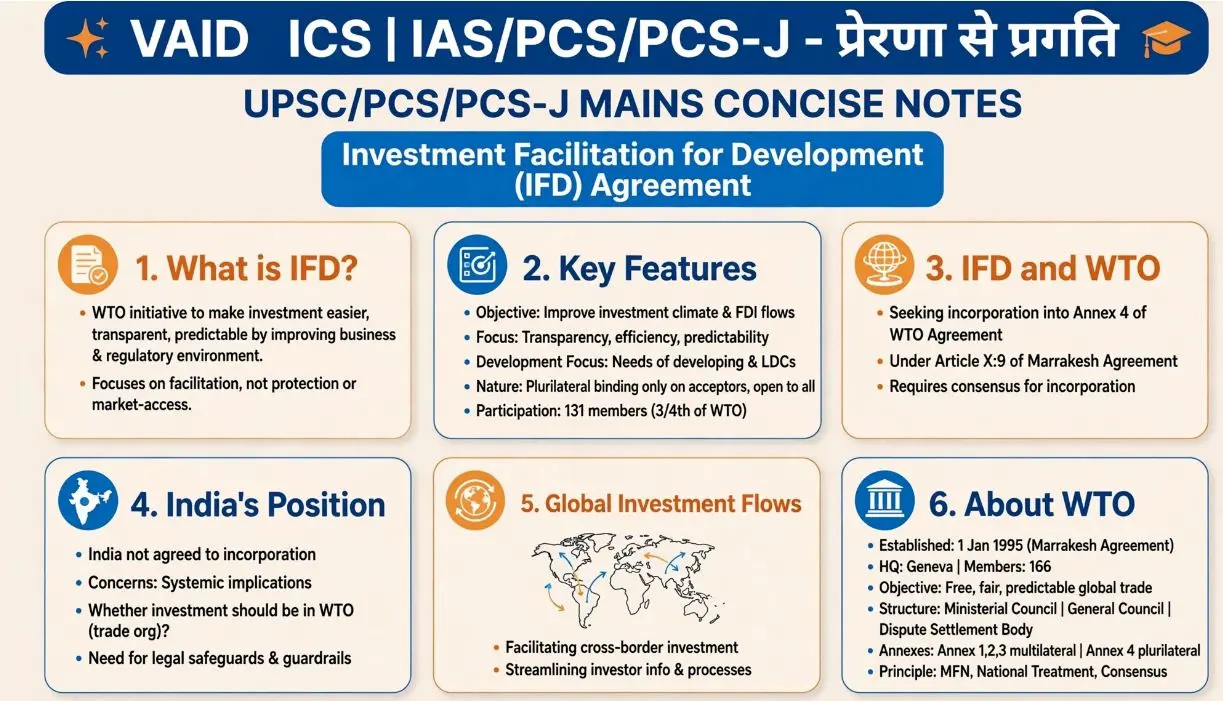
The Investment Facilitation for Development (IFD) initiative was launched at the WTO in 2017.
Objective:
To facilitate foreign direct investment (FDI) by improving transparency, administrative procedures and the investment environment.
India’s position:
-
India has opposed incorporation of the IFD agreement into the WTO rulebook.
-
It has argued that investment is not a core trade issue.
-
India has also raised concerns regarding the systemic implications of incorporating plurilateral agreements into the WTO framework.
Electronic Commerce Agreement:
India has also raised concerns over the proposed WTO Agreement on Electronic Commerce (ECA).
India questioned the legal basis for implementing the agreement through interim arrangements when consensus for its incorporation into the WTO legal framework had not been achieved.
According to the WTO Secretariat, 66 members covering around 70% of global trade have adopted an interim pathway for bringing the e-commerce agreement into force while discussions continue on its incorporation into the WTO framework.
What does the BRICS Declaration indicate?
The wording of the New Delhi Declaration suggests a potentially more open approach towards plurilateral initiatives.
However, this does not necessarily mean that India has abandoned its concerns regarding plurilateral agreements.
The emphasis is on:
-
Identifying appropriate pathways within the WTO legal framework.
-
Ensuring compatibility with the WTO system.
-
Exploring forward-looking rules.
-
Giving attention to development-oriented issues.
-
Continuing broader WTO reform.
Key Issue: Multilateralism vs Plurilateralism
The central debate is whether plurilateral agreements can:
Strengthen the WTO
→ by allowing willing members to negotiate new rules faster
OR
Fragment the WTO
→ by creating different sets of obligations for different groups of members.
For developing countries, the key concern is ensuring that plurilateral initiatives do not undermine special and differential treatment, policy space and development priorities.
Way Forward:
-
Establish clear legal safeguards for plurilateral agreements.
-
Maintain transparency and inclusiveness in negotiations.
-
Ensure that plurilateral initiatives remain consistent with the WTO framework.
-
Protect the policy space of developing countries.
-
Resolve outstanding issues through genuine multilateral negotiations wherever possible.
-
Reform the WTO dispute-settlement mechanism to restore confidence in the organisation.
Conclusion:
India’s position reflects the broader challenge of balancing WTO-wide multilateralism with the need for faster rule-making on emerging trade issues. A carefully designed framework can allow plurilateral initiatives while preserving the legitimacy, inclusiveness and development orientation of the WTO.
Mains Question:
“Plurilateral agreements can accelerate WTO rule-making but may also challenge the principle of multilateralism.” Discuss in the context of India’s evolving approach towards WTO reforms.
भारत–WTO: बहुपक्षीय समझौतों के प्रति दृष्टिकोण में बदलाव
चर्चा में क्यों?
2026 के BRICS नई दिल्ली घोषणापत्र में BRICS देशों ने WTO के कानूनी ढाँचे के भीतर बहुपक्षीय पहलों (Plurilateral Initiatives) के लिए उपयुक्त “मार्ग” (Pathways) तलाशने के महत्व को स्वीकार किया है।
यह महत्वपूर्ण है क्योंकि भारत परंपरागत रूप से सभी WTO सदस्यों की भागीदारी वाले बहुपक्षीय व्यापार वार्ताओं का समर्थन करता रहा है तथा सीमित सदस्यता वाले समझौतों को लेकर चिंताएँ व्यक्त करता रहा है।
बहुपक्षीय समझौते क्या हैं?
Plurilateral Agreements ऐसे व्यापार समझौते हैं, जिनमें WTO के सभी सदस्यों के बजाय इच्छुक या संबंधित सदस्यों का एक समूह भाग लेता है।
-
बहुपक्षीय (Multilateral): सभी WTO सदस्य भाग लेते हैं।
-
बहुपक्षीय-सीमित सदस्यता (Plurilateral): केवल इच्छुक/संबंधित देशों का समूह भाग लेता है।
-
WTO नियमों के अंतर्गत किसी बहुपक्षीय समझौते को Annex 4 में शामिल करने के लिए सदस्यों की सर्वसम्मति (Consensus) आवश्यक होती है।
भारत का पारंपरिक दृष्टिकोण:
भारत ने बहुपक्षीय समझौतों के संबंध में निम्नलिखित चिंताएँ व्यक्त की हैं:
-
बहुपक्षीय व्यापार प्रणाली के विखंडन का जोखिम।
-
विकासशील देशों की वार्ता-क्षमता एवं नीति-निर्माण की गुंजाइश में कमी।
-
WTO के भीतर कानूनी एवं संस्थागत संबंधी चिंताएँ।
-
सभी सदस्यों की पर्याप्त भागीदारी के बिना नए नियमों का निर्माण।
-
लंबित विकास-केंद्रित मुद्दों से ध्यान हटने की संभावना।
WTO के 14वें मंत्रिस्तरीय सम्मेलन (MC14), कैमरून में भारत ने बहुपक्षीय समझौतों को WTO व्यवस्था में शामिल करने से पहले सुरक्षात्मक प्रावधानों (Guardrails) और कानूनी सुरक्षा उपायों की आवश्यकता पर बल दिया था।
विकास के लिए निवेश सुविधा (IFD):
Investment Facilitation for Development (IFD) पहल WTO में 2017 में शुरू की गई थी।
उद्देश्य:
विदेशी प्रत्यक्ष निवेश (FDI) को सुगम बनाने के लिए पारदर्शिता, प्रशासनिक प्रक्रियाओं और निवेश वातावरण में सुधार करना।
भारत का दृष्टिकोण:
-
भारत ने IFD समझौते को WTO के नियम-पुस्तक में शामिल करने का विरोध किया है।
-
भारत का तर्क रहा है कि निवेश मूल व्यापार मुद्दा नहीं है।
-
भारत ने WTO व्यवस्था में बहुपक्षीय समझौतों को शामिल करने के व्यापक संस्थागत प्रभावों को लेकर भी चिंता व्यक्त की है।
इलेक्ट्रॉनिक वाणिज्य समझौता:
भारत ने प्रस्तावित WTO Agreement on Electronic Commerce (ECA) को लेकर भी प्रश्न उठाए हैं।
भारत ने यह प्रश्न किया कि जब WTO के कानूनी ढाँचे में समझौते को शामिल करने पर सर्वसम्मति नहीं बनी, तब इसे अंतरिम व्यवस्था (Interim Arrangements) के माध्यम से लागू करने का कानूनी आधार क्या है।
WTO सचिवालय के अनुसार, 66 सदस्य, जो लगभग 70% वैश्विक व्यापार का प्रतिनिधित्व करते हैं, ई-कॉमर्स समझौते को लागू करने के लिए अंतरिम व्यवस्था अपनाने की दिशा में आगे बढ़े हैं।
BRICS घोषणापत्र क्या संकेत देता है?
नई दिल्ली घोषणापत्र की भाषा बहुपक्षीय पहलों के प्रति भारत के दृष्टिकोण में कुछ लचीलेपन का संकेत देती है।
हालाँकि, इसका अर्थ यह आवश्यक रूप से नहीं है कि भारत ने बहुपक्षीय समझौतों से संबंधित अपनी सभी चिंताओं को त्याग दिया है।
घोषणापत्र में मुख्य रूप से जोर दिया गया है:
-
WTO के कानूनी ढाँचे के भीतर उपयुक्त मार्ग तलाशने पर।
-
WTO व्यवस्था के साथ संगतता सुनिश्चित करने पर।
-
भविष्य उन्मुख नियमों के निर्माण पर।
-
विकासोन्मुख मुद्दों पर ध्यान देने पर।
-
व्यापक WTO सुधार को आगे बढ़ाने पर।
प्रमुख मुद्दा: बहुपक्षीयता बनाम सीमित-सदस्यीय पहल
मुख्य बहस यह है कि क्या बहुपक्षीय समझौते:
WTO को मजबूत कर सकते हैं
→ इच्छुक देशों को नए मुद्दों पर तेजी से नियम बनाने की अनुमति देकर।
या
WTO को विभाजित कर सकते हैं
→ विभिन्न देशों के समूहों के लिए अलग-अलग दायित्वों की व्यवस्था बनाकर।
विकासशील देशों के लिए प्रमुख चिंता यह सुनिश्चित करना है कि ऐसी पहलें विशेष एवं विभेदक व्यवहार, नीतिगत गुंजाइश और विकास संबंधी प्राथमिकताओं को कमजोर न करें।
आगे की राह:
-
बहुपक्षीय समझौतों के लिए स्पष्ट कानूनी सुरक्षा उपाय विकसित किए जाएँ।
-
वार्ताओं में पारदर्शिता एवं समावेशिता सुनिश्चित की जाए।
-
बहुपक्षीय पहलें WTO के मौजूदा ढाँचे के अनुरूप हों।
-
विकासशील देशों की नीतिगत गुंजाइश सुरक्षित रखी जाए।
-
जहाँ संभव हो, महत्वपूर्ण मुद्दों का समाधान वास्तविक बहुपक्षीय वार्ताओं के माध्यम से किया जाए।
-
WTO के विवाद निपटान तंत्र में सुधार कर संगठन में विश्वास बहाल किया जाए।
निष्कर्ष:
भारत का दृष्टिकोण WTO में व्यापक बहुपक्षीयता और उभरते व्यापारिक मुद्दों पर तेजी से नियम निर्माण के बीच संतुलन की आवश्यकता को दर्शाता है। एक सुव्यवस्थित एवं समावेशी ढाँचा बहुपक्षीय पहलों को अनुमति देते हुए WTO की वैधता, समावेशिता और विकासोन्मुख स्वरूप को बनाए रख सकता है।
मुख्य परीक्षा प्रश्न:
“बहुपक्षीय समझौते WTO में नियम निर्माण को गति दे सकते हैं, किंतु वे बहुपक्षीयता के सिद्धांत के लिए चुनौती भी उत्पन्न कर सकते हैं।” भारत के WTO सुधारों के प्रति बदलते दृष्टिकोण के संदर्भ में चर्चा कीजिए।

May 19, 2026
October 17, 2025
October 16, 2025
October 6, 2025

