June 15, 2026
India water crisis: way ahead
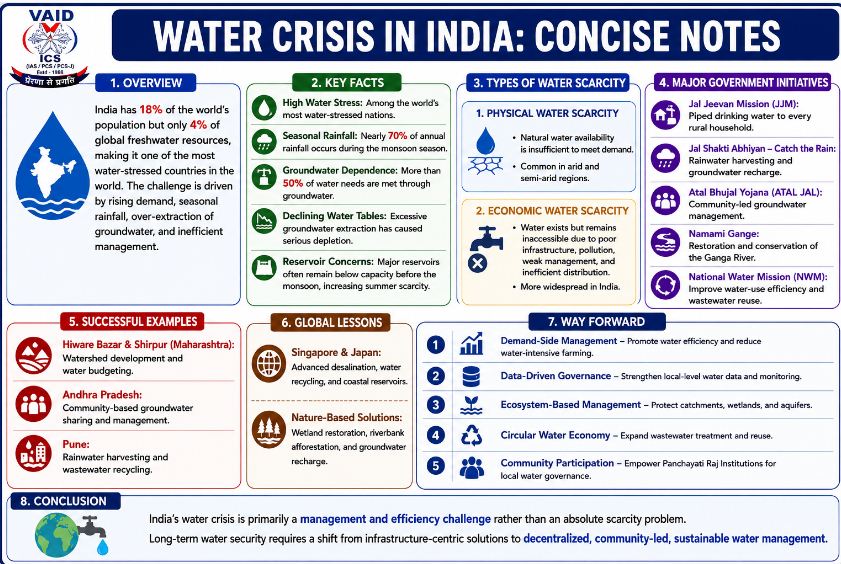
India is facing a severe water challenge, characterized by high demand, seasonal availability, and management inefficiencies. Although India is home to approximately 18 percent of the world’s population, it possesses only about 4 percent of the world’s freshwater resources.
Key Facts on Water Availability :
-
High Water Stress: India is recognized as one of the world’s most water-stressed nations.
-
Seasonal Imbalance: Nearly 70 percent of India’s annual rainfall occurs in just three months (the monsoon season), making storage and management critical.
-
Depleting Reservoirs: Data from the Central Water Commission (CWC) indicates that major reservoirs often operate well below capacity, particularly before the monsoon, heightening the risk of summer shortages.
-
Groundwater Dependency: India is the world’s largest user of groundwater, which accounts for more than 50 percent of the country’s water supply. Excessive extraction has led to an alarming decline in water tables across many regions.
Types of Water Crisis :
The crisis in India is dual-natured:
-
Physical Water Scarcity: This occurs when regions do not have enough water to meet demand because the natural supply is insufficient (e.g., arid and semi-arid regions).
-
Economic Water Scarcity: This is a more pervasive issue in India. It occurs when water exists, but there is a lack of investment in infrastructure, poor management, inefficient distribution, or polluted sources, preventing access.
Major Government Initiatives :
The Indian government has shifted toward a more integrated approach to water management:
-
Jal Jeevan Mission (JJM): Aims to provide safe and functional piped drinking water to every rural household.
-
Jal Shakti Abhiyan (Catch the Rain): A nationwide campaign focusing on rainwater harvesting, recharging aquifers, and rejuvenating traditional water bodies.
-
Atal Bhujal Yojana (ATAL JAL): A community-led groundwater management program targeting seven states with the most critically stressed groundwater levels.
-
Namami Gange: A flagship program dedicated to cleaning and restoring the ecological health of the Ganges River through sewage treatment, afforestation, and public awareness.
-
National Water Mission (NWM): Focuses on increasing water-use efficiency (by 20 percent by 2030) and promoting the reuse of wastewater.
Examples of Successful Management :
Several local and state-level successes demonstrate the effectiveness of decentralized, community-led management:
-
Maharashtra (Hiware Bazar & Shirpur Pattern): Famous for transforming drought-prone villages into water-surplus areas through watershed development, check dams, and community-based water budgeting.
-
Andhra Pradesh: Projects like the Andhra Pradesh Drought Adaptation Initiative have shown how communities can pool and share groundwater to survive dry spells.
-
Pune: The city has successfully implemented widespread rainwater harvesting and wastewater recycling initiatives to reduce demand on freshwater sources.
Global Perspectives :
-
Lessons from Abroad: Many arid countries, such as Singapore and Japan, have pioneered coastal reservoir projects and advanced desalination and water reuse technologies, offering a model for India’s urban centers.
-
Nature-Based Solutions: Globally, there is a shift toward “nature-based solutions,” such as restoring wetlands and reforesting riverbanks, which naturally improve water quality and recharge groundwater, offering more sustainable alternatives to purely hard-engineered infrastructure.
The Way Forward :
Moving toward long-term water security requires a shift in mindset and strategy:
-
Demand-Side Management: Moving beyond just building more dams (supply augmentation) to focusing on efficiency, rational pricing, and reducing water-intensive agricultural practices.
-
Data-Driven Governance: Strengthening comprehensive, accessible, and granular water data at the district and village levels to enable informed planning.
-
Ecosystem-Based Adaptation: Integrating land-use planning with water management, such as protecting catchments and reviving natural aquifers.
-
Circular Water Economy: Implementing “Zero Liquid Discharge” technologies in industries and scaling up the treatment and reuse of municipal wastewater for non-potable uses.
-
Community Stewardship: Empowering Panchayati Raj Institutions (local village councils) to lead water security planning, ensuring that solutions are context-specific and maintained by the local population.
Key Takeaway : India’s water challenge is largely an issue of management, infrastructure, and efficiency. Securing water for the future requires transitioning from an infrastructure-only approach to a service-oriented, decentralized, and community-led model.
भारत जल की गंभीर चुनौती का सामना कर रहा है, जो उच्च मांग, मौसमी उपलब्धता और कुप्रबंधन द्वारा चिह्नित है। हालांकि भारत में विश्व की लगभग 18 प्रतिशत जनसंख्या रहती है, लेकिन यहाँ विश्व के केवल 4 प्रतिशत ताजे जल (Freshwater) संसाधन उपलब्ध हैं।
जल उपलब्धता के प्रमुख तथ्य :
-
उच्च जल तनाव (High Stress): भारत को दुनिया के सबसे अधिक जल-तनाव वाले देशों में से एक माना जाता है।
-
मौसमी असंतुलन (Seasonal Imbalance): भारत की लगभग 70 प्रतिशत वार्षिक वर्षा केवल तीन महीनों (मानसून सीजन) में होती है, जिससे जल भंडारण और प्रबंधन अत्यंत महत्वपूर्ण हो जाता है।
-
घटते जलाशय (Depleting Reservoirs): केंद्रीय जल आयोग (CWC) का डेटा बताता है कि बड़े जलाशय अक्सर अपनी क्षमता से बहुत नीचे काम करते हैं, विशेष रूप से मानसून से पहले, जिससे गर्मियों में जल की कमी का जोखिम बढ़ जाता है।
-
भूजल पर निर्भरता (Groundwater Dependency): भारत दुनिया में भूजल का सबसे बड़ा उपयोग करने वाला देश है, जो देश की 50 प्रतिशत से अधिक जल आपूर्ति के लिए जिम्मेदार है। अत्यधिक दोहन के कारण कई क्षेत्रों में भूजल स्तर में खतरनाक गिरावट आई है।
जल संकट के प्रकार :
भारत में जल संकट दो तरह का है:
-
भौतिक जल अभाव (Physical Water Scarcity): यह तब होता है जब क्षेत्रों में मांग को पूरा करने के लिए पर्याप्त जल नहीं होता क्योंकि प्राकृतिक आपूर्ति अपर्याप्त है (उदाहरण के लिए: शुष्क और अर्ध-शुष्क क्षेत्र)।
-
आर्थिक जल अभाव (Economic Water Scarcity): यह भारत में अधिक व्यापक समस्या है। यह तब होता है जब जल उपलब्ध तो है, लेकिन बुनियादी ढांचे में निवेश की कमी, कुप्रबंधन, अक्षम वितरण या प्रदूषित जल स्रोतों के कारण लोगों तक पहुंच नहीं हो पाती।
प्रमुख सरकारी पहल :
भारत सरकार ने जल प्रबंधन के प्रति एकीकृत दृष्टिकोण अपनाया है:
-
जल जीवन मिशन (Jal Jeevan Mission): इसका उद्देश्य प्रत्येक ग्रामीण परिवार को सुरक्षित और कार्यात्मक नल का जल प्रदान करना है।
-
जल शक्ति अभियान (Jal Shakti Abhiyan): यह वर्षा जल संचयन, जलभृतों (Aquifers) को रिचार्ज करने और पारंपरिक जल निकायों को पुनर्जीवित करने पर केंद्रित एक राष्ट्रव्यापी अभियान है।
-
अटल भूजल योजना (Atal Bhujal Yojana): यह सात राज्यों में भूजल प्रबंधन के लिए एक सामुदायिक नेतृत्व वाला कार्यक्रम है, जहाँ भूजल स्तर सबसे अधिक तनावग्रस्त है।
-
नमामि गंगे (Namami Gange): यह गंगा नदी के पारिस्थितिक स्वास्थ्य को सीवेज उपचार, वनीकरण और जन जागरूकता के माध्यम से साफ और पुनर्स्थापित करने का एक प्रमुख कार्यक्रम है।
-
राष्ट्रीय जल मिशन (National Water Mission): इसका ध्यान जल-उपयोग दक्षता बढ़ाने (2030 तक 20 प्रतिशत) और अपशिष्ट जल के पुन: उपयोग को बढ़ावा देने पर है।
सफल प्रबंधन के उदाहरण :
कई स्थानीय और राज्य-स्तरीय सफलताएं विकेंद्रीकृत, सामुदायिक नेतृत्व वाले प्रबंधन की प्रभावशीलता को दर्शाती हैं:
-
महाराष्ट्र (हिवरे बाजार और शिरपुर पैटर्न): जलप्रपात विकास, चेक डैम और सामुदायिक आधारित जल बजट के माध्यम से सूखे वाले गांवों को जल-अधिशेष क्षेत्रों में बदलने के लिए प्रसिद्ध है।
-
आंध्र प्रदेश: आंध्र प्रदेश सूखा अनुकूलन पहल जैसी परियोजनाओं ने दिखाया है कि कैसे समुदाय सूखे के समय जीवित रहने के लिए भूजल को इकट्ठा और साझा कर सकते हैं।
-
पुणे: शहर ने ताजे पानी के स्रोतों पर मांग कम करने के लिए व्यापक वर्षा जल संचयन और अपशिष्ट जल पुनर्चक्रण पहल को सफलतापूर्वक लागू किया है।
वैश्विक परिप्रेक्ष्य :
-
विदेशों से सीख: सिंगापुर और जापान जैसे कई शुष्क देशों ने तटीय जलाशय परियोजनाओं और उन्नत विलवणीकरण (Desalination) एवं जल पुन: उपयोग तकनीकों का मार्ग प्रशस्त किया है।
-
प्रकृति-आधारित समाधान (Nature-Based Solutions): विश्व स्तर पर आर्द्रभूमि (Wetlands) की बहाली और नदी के किनारों पर वृक्षारोपण जैसे समाधानों की ओर बदलाव हो रहा है, जो प्राकृतिक रूप से जल की गुणवत्ता में सुधार करते हैं और भूजल को रिचार्ज करते हैं।
आगे की राह :
दीर्घकालिक जल सुरक्षा की ओर बढ़ने के लिए मानसिकता और रणनीति में बदलाव की आवश्यकता है:
-
मांग-पक्ष प्रबंधन (Demand-Side Management): केवल अधिक बांध बनाने से आगे बढ़कर दक्षता, तर्कसंगत मूल्य निर्धारण और जल-गहन कृषि प्रथाओं को कम करने पर ध्यान केंद्रित करना।
-
डेटा-संचालित शासन (Data-Driven Governance): सूचित योजना को सक्षम करने के लिए जिला और ग्राम स्तर पर व्यापक और सटीक जल डेटा को मजबूत करना।
-
पारिस्थितिकी तंत्र-आधारित अनुकूलन (Ecosystem-Based Adaptation): जल प्रबंधन के साथ भूमि-उपयोग नियोजन को एकीकृत करना, जैसे कि जलग्रहण क्षेत्रों की रक्षा करना और प्राकृतिक जलभृतों को पुनर्जीवित करना।
-
चक्रीय जल अर्थव्यवस्था (Circular Water Economy): उद्योगों में “जीरो लिक्विड डिस्चार्ज” तकनीकों को लागू करना और नगरपालिका अपशिष्ट जल को उपचारित कर उसका गैर-पेय उपयोग बढ़ाना।
-
सामुदायिक प्रबंधन (Community Stewardship): जल सुरक्षा योजना का नेतृत्व करने के लिए पंचायती राज संस्थाओं को सशक्त बनाना, ताकि समाधान स्थानीय स्तर पर विशिष्ट हों और जनता द्वारा बनाए रखे जाएं।
निष्कर्ष (Key Takeaway): भारत की जल चुनौती मुख्य रूप से प्रबंधन, बुनियादी ढांचे और दक्षता की समस्या है। भविष्य के लिए जल सुरक्षित करने हेतु बुनियादी ढांचे के दृष्टिकोण से सेवा-उन्मुख, विकेंद्रीकृत और सामुदायिक-नेतृत्व वाले मॉडल की ओर बढ़ने की आवश्यकता है।

May 19, 2026
October 17, 2025
October 16, 2025
October 6, 2025

