June 2, 2026
India-Myanmar Bilateral Relations: Diplomatic & Security Engagement/भारत-म्यांमार संबंध: ऐतिहासिक और समकालीन विश्लेषण
Why in news ? Myanmar President U Min Aung Hlaing visited India (May 30 – June 3, 2026), marking his first visit since becoming President. The bilateral engagement focused on restoring regional stability, border security, and long-pending connectivity projects.
Key Discussion Points:
-
Security & Border Integrity:
- Non-Use of Territory: President Hlaing assured PM Modi that Myanmar’s territory will not be used for activities inimical to India’s security interests.
- Insurgent Groups: PM Modi specifically raised concerns regarding Indian insurgent groups operating near the 1,643-km India-Myanmar border. Myanmar has committed to taking “everything necessary” to address this threat.
-
Connectivity & Infrastructure:
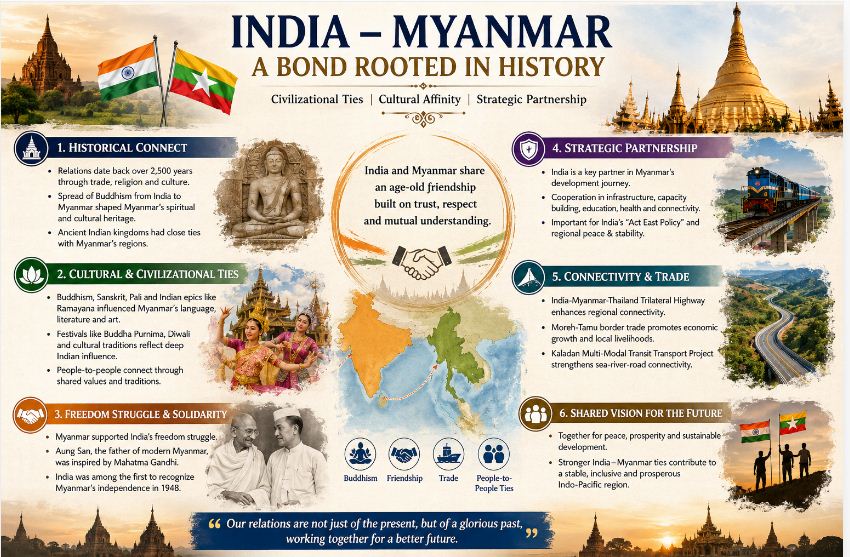
- Key Projects: The Kaladan Multimodal Transit Transport Project and the India-Myanmar-Thailand Trilateral Highway remain high priorities.
- Challenges: Both projects face significant delays due to the ongoing internal security situation and hostilities in the Rakhine state and areas where ethnic armed groups are active.
- Strategy: India continues to seek opportunities to progress work during lulls in fighting, with assurances from Myanmar for project security.
-
Humanitarian & Social Issues:
-
Cyber Scam Compounds: India has successfully repatriated over 2,400 citizens from illegal cyber scam centers in Myanmar. Efforts are ongoing to rescue the remaining ~150+ citizens.
-
Education: India will increase the number of Mekong Ganga ICCR scholarships for Myanmar students from 36 to 100, starting in 2026.
-
-
Political Dynamics:
- Internal Stability: India emphasized that Myanmar’s challenges must be solved by the people of Myanmar through a “Myanmar-led and Myanmar-owned” solution.
- Democratic Inclusion: PM Modi raised the issue of Nobel laureate Aung San Suu Kyi (in detention since 2021) within the context of the peace process, emphasizing the need for an inclusive dialogue involving all stakeholders.
- Diplomatic Stance: India’s engagement is not a commentary on Myanmar’s internal politics; India prioritizes sustained dialogue and regional stability over disengagement.
Strategic Dimensions:
-
Regional Security: Stability in Myanmar is considered essential for the internal security of India’s Northeast and the coherence of ASEAN as a regional bloc.
-
Defence Cooperation: Focus remains on training, capacity building, institution building, and UN peacekeeping cooperation.
India-Myanmar Historical Relations: A Longstanding Bond
The relationship between India and Myanmar is rooted in deep civilizational, cultural, and political ties that span millennia. As neighbors with a 1,643-km land border and a shared maritime boundary in the Bay of Bengal, the two nations have shared a history characterized by both ancient connections and modern geopolitical alignment.
Ancient and Cultural Roots:
-
Buddhist Influence: Myanmar (formerly Burma) was deeply influenced by the spread of Buddhism from India. The architectural and cultural landscape of Bagan contains numerous pagodas inspired by Indian styles, symbolizing the enduring spiritual connection between the two societies.
-
Shared Heritage: For centuries, both countries were part of the broader Indian Ocean trade network. Trade in spices, textiles, and precious gems fostered a constant movement of people, monks, and scholars.
Colonial Era:
-
Administrative Union: Under British rule, Burma was administered as a province of British India from 1824 until 1937. This period saw a significant influx of Indian traders, laborers, and professionals into Burma, creating a complex, intertwined socioeconomic structure.
-
Separation: In 1937, the British separated Burma from India. During World War II, both nations witnessed the rise of nationalist movements against British rule. The Indian National Army (INA), led by Subhash Chandra Bose, operated from Burmese soil, with its famous slogan “Dilli Chalo” resonating through the region.
Post-Independence:
-
Treaty of Friendship (1951): Following independence, India and Myanmar signed a Treaty of Friendship in 1951, which laid the foundation for stable diplomatic relations.
-
Democratic Solidarity: India was a vocal supporter of Myanmar’s democratic aspirations for decades. During the period of the military junta, India maintained a policy of “constructive engagement,” balancing its commitment to democratic values with its strategic interest in regional security and connectivity.
Key Dimensions of Modern Relations:
-
Strategic Geography: Myanmar acts as India’s “Gateway to the East.” It is a vital partner in India’s “Act East” Policy, serving as the only land bridge to Southeast Asia.
-
Security & Border Management: The porous nature of the border has historically necessitated close security cooperation to address insurgent groups operating in the Northeast.
-
Connectivity Projects: India has invested heavily in infrastructure to enhance connectivity, most notably through:
-
Kaladan Multimodal Transit Transport Project: Designed to link Kolkata to the Northeast through the Sittwe port in Myanmar.
-
India-Myanmar-Thailand (IMT) Trilateral Highway: A major project aiming to link Moreh (India) to Mae Sot (Thailand) via Myanmar.
-
Challenges and Evolution:
-
Internal Dynamics: The history of the relationship has been tested by Myanmar’s internal political volatility, including the 2021 military coup. India has consistently advocated for a “Myanmar-led and Myanmar-owned” solution, emphasizing the need for inclusive dialogue and the restoration of democratic processes.
-
Refugee & Humanitarian Issues: The ongoing internal crisis has led to humanitarian challenges, including the displacement of people, which has direct implications for India’s border states.
भारत-म्यांमार संबंध: ऐतिहासिक और समकालीन विश्लेषण
परिचय:
भारत और म्यांमार के संबंध सदियों पुराने हैं, जो सांस्कृतिक, धार्मिक और ऐतिहासिक संबंधों में गहराई से जड़े हुए हैं। 1,643 किलोमीटर की लंबी भूमि सीमा और बंगाल की खाड़ी में समुद्री सीमा साझा करने वाले ये दोनों देश न केवल पड़ोसी हैं, बल्कि ‘एक्ट ईस्ट नीति’ (Act East Policy) के तहत भारत के रणनीतिक साझेदार भी हैं।
ऐतिहासिक पृष्ठभूमि:
-
सांस्कृतिक और धार्मिक संबंध: म्यांमार में बौद्ध धर्म का प्रसार भारत से हुआ। प्राचीन काल से ही व्यापारिक और धार्मिक आदान-प्रदान के कारण दोनों देशों के बीच मजबूत सांस्कृतिक संबंध रहे।
-
औपनिवेशिक काल: 1824 से 1937 तक, बर्मा (म्यांमार का पूर्व नाम) ब्रिटिश भारत का एक प्रांत था। इस दौरान प्रशासनिक और सामाजिक स्तर पर दोनों क्षेत्रों का एकीकरण हुआ। 1937 में ब्रिटिश शासन ने बर्मा को भारत से अलग कर दिया।
-
स्वतंत्रता संग्राम: द्वितीय विश्व युद्ध के दौरान, नेताजी सुभाष चंद्र बोस के ‘भारतीय राष्ट्रीय सेना’ (INA) ने बर्मा की धरती का उपयोग ‘दिल्ली चलो’ अभियान के लिए किया था, जो दोनों देशों के साझा स्वतंत्रता संघर्ष का प्रतीक है।
समकालीन द्विपक्षीय संबंध के मुख्य आयाम:
1. रणनीतिक और सुरक्षा संबंध:
-
सीमा सुरक्षा: भारत के पूर्वोत्तर राज्यों की सुरक्षा म्यांमार के साथ स्थिरता पर निर्भर है। दोनों देशों ने यह सुनिश्चित करने का संकल्प लिया है कि उनकी धरती का उपयोग एक-दूसरे की सुरक्षा के विरुद्ध न हो।
-
विद्रोह विरोधी सहयोग: भारत म्यांमार के साथ मिलकर अपने सीमावर्ती क्षेत्रों में सक्रिय विद्रोही समूहों की गतिविधियों पर नियंत्रण रखने के लिए सहयोग करता है।
2. प्रमुख कनेक्टिविटी परियोजनाएं (Connectivity Projects):
-
कलादान मल्टीमॉडल ट्रांजिट ट्रांसपोर्ट प्रोजेक्ट: यह कोलकाता बंदरगाह को म्यांमार के सित्तवे बंदरगाह से जोड़कर भारत के पूर्वोत्तर राज्यों तक पहुँचने का एक वैकल्पिक मार्ग प्रदान करता है।
-
भारत-म्यांमार-थाईलैंड (IMT) त्रिपक्षीय राजमार्ग: यह परियोजना भारत को दक्षिण-पूर्व एशिया से जोड़ने के लिए अत्यंत महत्वपूर्ण है।
3. आर्थिक और विकास सहयोग:
-
क्षमता निर्माण: भारत म्यांमार में रक्षा प्रशिक्षण, क्षमता निर्माण और शिक्षा (मेकोंग गंगा छात्रवृत्ति) के माध्यम से मानवीय सहायता प्रदान कर रहा है।
-
मानवीय प्रयास: हाल के वर्षों में, भारत ने म्यांमार में फंसे अपने नागरिकों को साइबर स्कैम केंद्रों से सुरक्षित निकालने का सफल अभियान चलाया है।
चुनौतियाँ:
-
राजनीतिक अस्थिरता: 2021 के तख्तापलट के बाद म्यांमार की आंतरिक स्थिति और वहां चल रहा लोकतंत्र समर्थक आंदोलन भारत के लिए कूटनीतिक संतुलन की चुनौती पेश करता है।
-
परियोजनाओं में देरी: सुरक्षा स्थितियों और जातीय संघर्षों के कारण बुनियादी ढांचा परियोजनाओं में बार-बार बाधाएं आ रही हैं।
-
शरणार्थी संकट: आंतरिक हिंसा के कारण विस्थापन और सीमा पार मानवीय चुनौतियां भारत के सीमावर्ती राज्यों के लिए सुरक्षा चिंताएं पैदा करती हैं।
भारत का दृष्टिकोण:
भारत “म्यांमार के नेतृत्व वाले और म्यांमार के स्वामित्व वाले” समाधान में विश्वास करता है। भारत की नीति ‘सतत जुड़ाव’ (Sustained Engagement) की रही है, जिसमें वह लोकतंत्र, समावेशी वार्ता और क्षेत्रीय स्थिरता पर जोर देता है। भारत का मानना है कि disengagement (जुड़ाव तोड़ना) इसका समाधान नहीं है।
निष्कर्ष:
म्यांमार भारत के लिए ‘एक्ट ईस्ट नीति’ का प्रवेश द्वार है। एक स्थिर और समृद्ध म्यांमार न केवल पूर्वोत्तर भारत की सुरक्षा के लिए, बल्कि पूरे दक्षिण-पूर्व एशियाई क्षेत्र की अखंडता (ASEAN) के लिए महत्वपूर्ण है।

May 19, 2026
October 17, 2025
October 16, 2025
October 6, 2025

