September 4, 2025
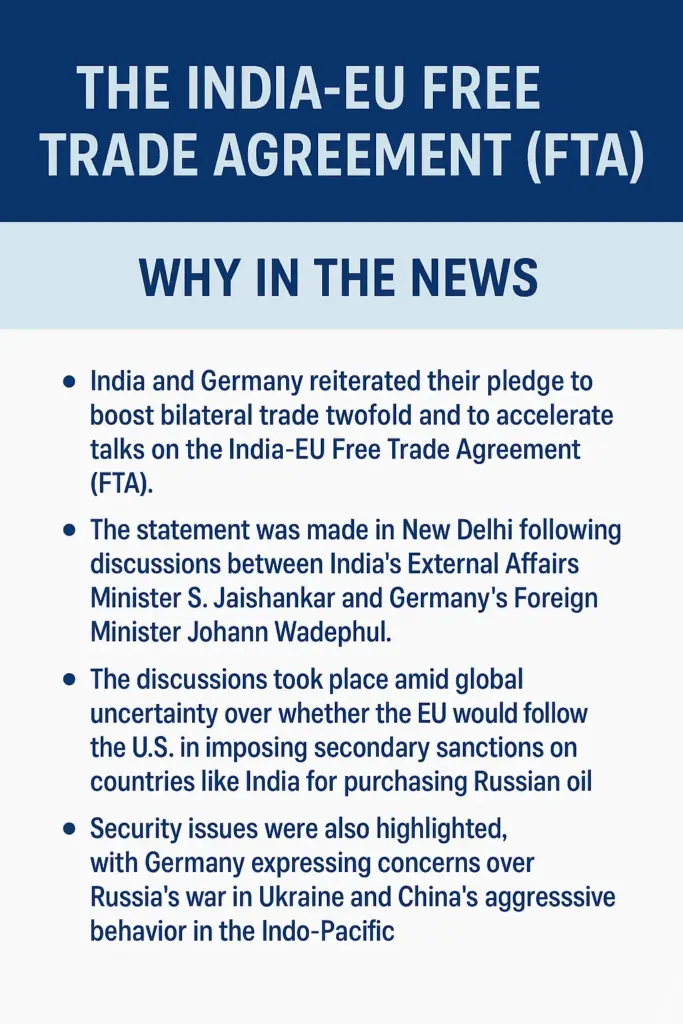
The India-EU Free Trade Agreement (FTA)
Why in the News
India and Germany reiterated their pledge to boost bilateral trade twofold and to accelerate talks on the India-EU Free Trade Agreement (FTA).
- The statement was made in New Delhi following discussions between India’s External Affairs Minister S. Jaishankar and Germany’s Foreign Minister Johann Wadephul.
- The discussions took place amid global uncertainty over whether the EU would follow the U.S. in imposing secondary sanctions on countries like India for purchasing Russian oil.
- The two leaders also discussed the twin challenges of economic volatility and political uncertainty, including the impact of U.S. tariffs and sanctions on global trade.
- Security issues were also highlighted, with Germany expressing concerns over Russia’s war in Ukraine and China’s aggressive behavior in the Indo-Pacific.
Key Points: The India-EU Free Trade Agreement (FTA)
- India and Germany agreed to fast-track FTA talks, with negotiators expected to meet more frequently, possibly every month, to meet the year-end deadline set by PM Modi and EU President Ursula von der Leyen.
- The FTA is intended to bring stability to the global economy, with Mr. Jaishankar describing it as an essential anchor in times of uncertainty.
- Sticking points in the negotiations include:
- Agricultural market access, especially for food and dairy products.
- Potential EU sanctions similar to the U.S. secondary sanctions targeting countries buying Russian oil.
- Germany expressed backing for tougher measures on Russian oil trade but stopped short of explicitly endorsing punitive tariffs on India.
- Recent EU sanctions have already targeted Nayara Energy, a joint venture involving Russian oil giant Rosneft and Indian firms.
- Germany emphasized that sanctions should be used as a means to push Russia towards peace talks with Ukraine.
- Germany also voiced concerns over China’s growing aggression in the Indo-Pacific, linking European and Indo-Pacific security.
- India emphasized the need for a multi-polar world and strategic autonomy, advocating for intensive consultations and cooperation instead of unilateral sanctions.
India-Germany Relations:
Strong Economic Partnership:
- Germany is India’s largest trading partner in the EU, with bilateral trade crossing $30 billion in 2023-24.
- Focus areas include green energy, digital technology, automobile manufacturing, and defense cooperation.
Defense and Security Cooperation:
- Both nations share concerns over China’s actions in the Indo-Pacific and Russia’s war in Ukraine.
- Collaborative efforts are growing in areas such as naval security, cybersecurity, and the fight against terrorism.
FTA Importance:
- A successful India-EU FTA could boost trade, attract European investments, and diversify supply chains.
- It would help India gain market access in Europe while providing the EU an alternative manufacturing base to China.
Challenges:
- Differences over market access, especially in agriculture and dairy.
- Potential conflicts over secondary sanctions related to Russian oil imports.
- Balancing strategic autonomy with closer ties to the West amid the Russia-Ukraine war.

Gist of daily Article /The Hindu 17oct 2025
October 17, 2025
Daily Gist of the Hindu/Indian Express : 16 Oct 2025
October 16, 2025
Daily Gist of The Hindu/Indian Express: 6 Oct 2025
October 6, 2025
Daily Gist of Article /The Hindu /Indian Express: 24 Sep 2025
September 24, 2025

