October 15, 2026
India–ASEAN Defence and Technological Cooperation/भारत–आसियान रक्षा एवं प्रौद्योगिकी सहयोग:
Why in News?
Defence Minister Rajnath Singh called for deeper defence and technological cooperation between India and the Association of Southeast Asian Nations (ASEAN) at the maiden ASEAN–India Defence Think Tank Forum held in New Delhi. The initiative highlights India’s efforts to strengthen strategic partnerships and promote a free, open, inclusive and rules-based Indo-Pacific.
The year 2026 has been designated as the ASEAN–India Year of Maritime Cooperation, providing an opportunity to translate shared maritime interests into practical initiatives.
What is the ASEAN–India Defence Think Tank Forum?
-
Venue: Manohar Parrikar Institute for Defence Studies and Analyses (MP-IDSA), New Delhi.
-
Purpose: To strengthen strategic dialogue, defence policy coordination and technological collaboration between India and ASEAN.
-
Major areas of cooperation: Joint research and development, co-production of defence equipment, maritime security, maritime domain awareness and underwater surveillance.
-
Strategic significance: Think tanks can help policymakers identify common security challenges, develop policy options and build mutual understanding.
What is ASEAN?
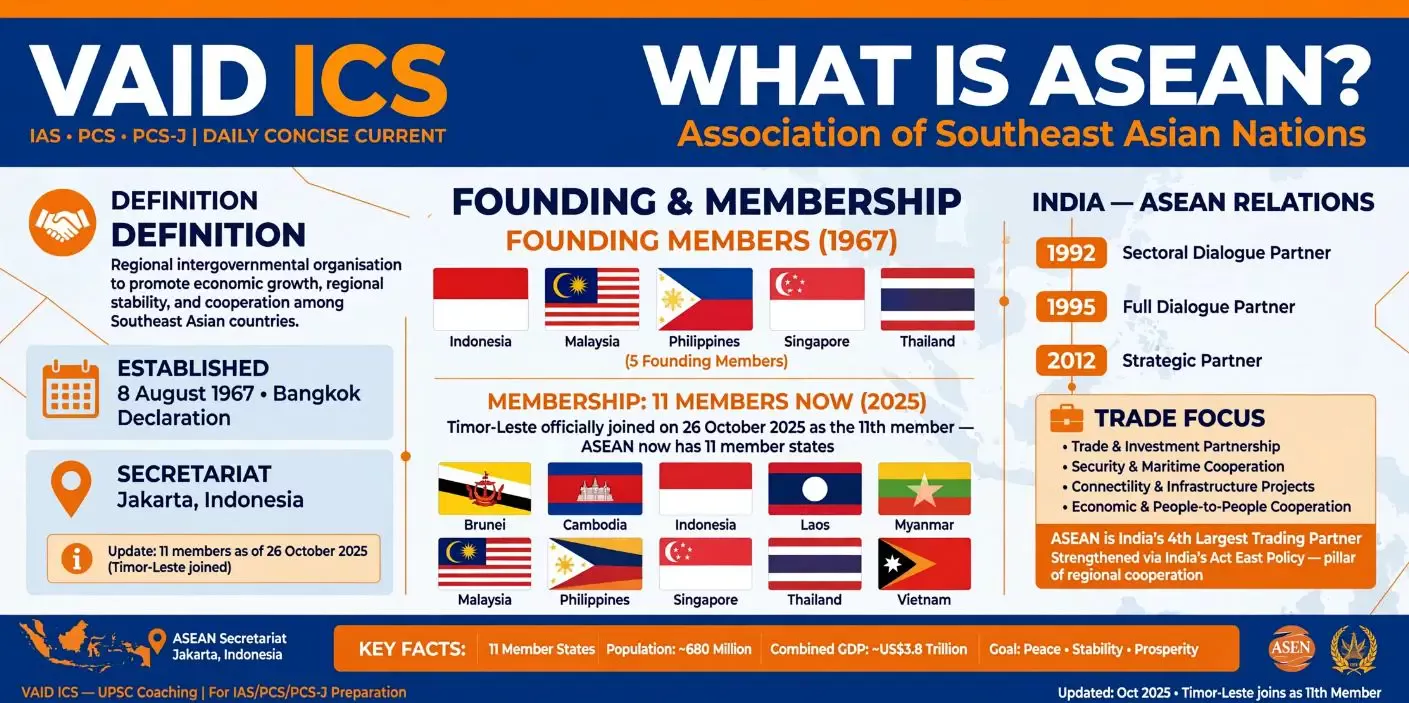
Association of Southeast Asian Nations (ASEAN) is a regional intergovernmental organisation established to promote economic growth, regional stability and cooperation among Southeast Asian countries.
-
Established: 8 August 1967, through the Bangkok Declaration.
-
Founding members: Indonesia, Malaysia, the Philippines, Singapore and Thailand.
-
Secretariat: Jakarta, Indonesia.
-
Membership: ASEAN has 11 members following Timor-Leste’s admission in 2025. Older material describing ASEAN as a ten-member organisation may therefore be outdated.
-
India–ASEAN relations: India became a Sectoral Dialogue Partner in 1992, a full Dialogue Partner in 1995 and a Strategic Partner in 2012.
Why is ASEAN important to India?
-
Geostrategic importance: ASEAN occupies a crucial position between the Indian and Pacific Oceans and near important maritime trade routes.
-
Economic importance: It is a major partner in trade, investment, supply chains and regional connectivity.
-
Security cooperation: ASEAN-led platforms provide channels for dialogue on maritime security, terrorism, transnational crime and regional stability.
-
Regional balance: Strong ties with ASEAN support India’s engagement with the wider Indo-Pacific and its strategic autonomy.
How does India’s Indo-Pacific vision relate to ASEAN?
India’s Indo-Pacific vision seeks a region where all countries, irrespective of their size, can make independent choices, protect their national interests and pursue development peacefully. It emphasises cooperation rather than the dominance of any single power.
Its principal elements are:
-
Freedom of navigation and overflight in accordance with international law.
-
Respect for sovereignty and territorial integrity.
-
Peaceful settlement of disputes.
-
An open, inclusive and rules-based regional order.
-
ASEAN centrality, recognising ASEAN’s role in shaping regional institutions and dialogue.
-
Strategic autonomy, allowing countries to pursue independent foreign-policy choices.
-
Cooperation against conventional and non-traditional threats, including piracy, trafficking, cyber threats and illegal fishing.
Why is ASEAN central to India’s Indo-Pacific strategy?
ASEAN centrality means that ASEAN-led institutions remain important platforms for regional dialogue, cooperation and confidence-building.
India’s engagement with ASEAN helps it connect its eastern neighbourhood with the wider Indo-Pacific. It also allows India to cooperate with countries that may have different strategic interests without requiring them to join competing geopolitical blocs.
What are India’s major policy frameworks?
1. Act East Policy:
-
Introduced: 2014, building upon the earlier Look East Policy launched in 1991.
-
Objective: Strengthen India’s economic, strategic, political and cultural relations with Southeast Asia and the wider Indo-Pacific.
-
ASEAN’s role: ASEAN remains central to India’s engagement with Southeast Asia.
-
Major dimensions: Trade, connectivity, defence cooperation, investment, cultural exchanges and people-to-people contacts.
-
Strategic significance: Supports India’s regional integration, connectivity with its northeastern states and engagement with the Indo-Pacific.
2. SAGAR:
Full form: Security and Growth for All in the Region.
-
Articulated: 2015.
-
Core focus: Maritime security, regional prosperity and cooperation in the Indian Ocean Region.
-
Major dimensions: Capacity-building, disaster response, maritime cooperation, sustainable development and respect for international maritime law.
-
Relevance to ASEAN: Promotes cooperation among maritime nations to protect sea routes and address common security challenges.
3. MAHASAGAR
Full form: Mutual and Holistic Advancement for Security and Growth Across Regions.
-
Articulated: 2025.
-
Broad objective: Expand India’s approach to maritime security and regional development through wider international cooperation.
-
Major dimensions: Security partnerships, economic cooperation, capacity-building, technology and sustainable development.
-
Relevance: Provides a broader framework for India’s engagement with maritime partners across the Indo-Pacific and the Global South.
Key distinction: SAGAR emphasises Security and Growth for All in the Region, while MAHASAGAR reflects a broader approach to mutual and holistic advancement across regions. Both support cooperation rather than isolation.
What are the major areas of India–ASEAN defence cooperation?
1. Joint research and development:
India and ASEAN countries can develop a joint research agenda in areas such as:
-
Artificial Intelligence (AI) and defence applications.
-
Cybersecurity and cyber defence.
-
Counter-drone technologies.
-
Maritime surveillance and underwater awareness.
-
Space-based systems and satellite-enabled security.
-
Disaster response technologies.
Joint research can reduce duplication, improve interoperability and help partner countries respond to emerging security challenges.
2. Co-production of defence equipment:
Co-production involves partner countries jointly manufacturing defence equipment, sharing selected technologies and developing industrial capabilities.
Potential areas include:
-
Drones and counter-drone systems.
-
Radars and surveillance equipment.
-
Helicopters and related systems.
-
Communications and cyber-defence equipment.
-
Maritime surveillance systems.
For India, such cooperation can support defence indigenisation, exports, economies of scale and stronger industrial partnerships. For ASEAN partners, it can offer opportunities for capacity-building and diversification of defence suppliers.
Important distinction: Co-production does not automatically mean complete technology transfer. The extent of technology sharing depends on agreements, export controls, intellectual-property arrangements and each country’s security requirements.
3. Maritime domain awareness (MDA):
Maritime Domain Awareness is the effective understanding of activities, developments and potential threats in the maritime environment.
It involves collecting, analysing and sharing information from sources such as:
-
Coastal radar networks.
-
Automatic Identification System (AIS) data.
-
Satellites and remote-sensing systems.
-
Naval and coast guard patrols.
-
Maritime information-sharing centres.
-
Unmanned aerial and underwater systems.
Why is MDA important?
It can help identify suspicious vessel movements, monitor illegal fishing, detect maritime trafficking and improve responses to security incidents.
4. Interoperability
Interoperability is the ability of the armed forces and security agencies of different countries to work together effectively.
It requires compatible procedures, communications, training and coordination.
It can be improved through:
-
Joint naval exercises.
-
Information-sharing arrangements.
-
Common operating procedures.
-
Joint search-and-rescue exercises.
-
Humanitarian assistance and disaster relief (HADR) operations.
-
Cooperation between navies and coast guards.
Interoperability is particularly important when several countries must respond rapidly to a maritime emergency.
5. Underwater cooperation
Underwater awareness is becoming increasingly important because threats can arise from submarines, underwater drones, suspicious seabed activity and risks to undersea infrastructure.
Cooperation may include:
-
Sharing relevant maritime information.
-
Improving surveillance capabilities.
-
Protecting undersea communication cables and critical infrastructure.
-
Developing underwater detection technologies.
-
Strengthening coordination in submarine-related safety and security.
Such cooperation must be consistent with international law and the respective countries’ security arrangements.
Why is maritime security crucial for India and ASEAN?
India and Southeast Asia are connected through a continuous maritime space linking the Indian Ocean with the western Pacific. Sea routes carry energy supplies, manufactured goods, food, raw materials and other essential commodities.
Major concerns include:
-
Piracy and armed robbery at sea.
-
Illegal, unreported and unregulated fishing (IUU fishing).
-
Human, arms and drug trafficking.
-
Disruption of maritime trade routes.
-
Threats to ports and critical maritime infrastructure.
-
Natural disasters and maritime accidents.
-
Strategic competition and grey-zone activities.
Greater maritime cooperation can strengthen early warning, improve emergency response and help preserve a stable, rules-based maritime order.
What is the ASEAN–India Year of Maritime Cooperation 2026?
The designation of 2026 as the ASEAN–India Year of Maritime Cooperation creates an opportunity to convert shared strategic interests into concrete initiatives.
Priority areas include:
-
Maritime information-sharing and improved situational awareness.
-
Cooperation among navies and coast guards.
-
Joint responses to maritime emergencies.
-
Combating piracy, trafficking and illegal fishing.
-
Promoting maritime safety and sustainable ocean governance.
-
Exploring collaboration in maritime technology and capacity-building.
The initiative builds upon the wider India–ASEAN partnership and the ASEAN–India Joint Statement on Maritime Cooperation adopted in 2022.
What is the strategic significance for India?
1. Strengthening Act East Policy: Defence cooperation gives India’s engagement with ASEAN a stronger strategic and security dimension.
2. Supporting defence self-reliance: Joint research and manufacturing can strengthen India’s domestic defence industrial ecosystem while opening avenues for exports.
3. Protecting sea lanes: Better maritime awareness can help safeguard trade, energy supplies and essential shipping routes.
4. Building regional trust: Regular dialogue and joint exercises can reduce misunderstandings and strengthen confidence among regional partners.
5. Addressing emerging threats: AI, drones, cyberattacks and underwater systems require cooperation beyond conventional military capabilities.
6. Strengthening ASEAN centrality: Working through ASEAN-led mechanisms supports inclusive regionalism and avoids unnecessary competition between regional forums.
7. Enhancing India’s role in the Global South: Technology partnerships and capacity-building can help India position itself as a cooperative security partner.
What are the major challenges?
-
Different threat perceptions: ASEAN members do not always share identical assessments of regional security risks.
-
Strategic competition: Rivalries among major powers may complicate regional cooperation.
-
Technology gaps: Differences in defence capabilities, budgets and technical standards can limit joint projects.
-
Information-sharing concerns: Sensitive data requires secure systems and clear rules on access and use.
-
Dependence on external suppliers: Export restrictions and technology-transfer limitations may affect co-production.
-
Institutional complexity: Multiple regional forums can create overlapping priorities and coordination difficulties.
-
Uneven capacities: Smaller countries may need greater training, infrastructure and financial support to participate effectively.
What should be the way forward?
-
Institutionalise the Defence Think Tank Forum through regular meetings, joint research and policy recommendations.
-
Establish a joint India–ASEAN defence research agenda focused on maritime security, cyber threats, disaster response and emerging technologies.
-
Expand practical cooperation in naval exercises, coast guard coordination and HADR.
-
Develop secure mechanisms for maritime information-sharing while protecting sensitive data.
-
Encourage viable co-development and co-production projects, supported by clear intellectual-property and technology-sharing arrangements.
-
Promote training, maintenance support and capacity-building for ASEAN partners.
-
Use ASEAN-led mechanisms to maintain inclusiveness, ASEAN centrality and respect for strategic autonomy.
-
Measure progress through concrete outcomes, such as joint projects, training programmes, interoperable systems and improved emergency-response capacity.
भारत–आसियान रक्षा एवं प्रौद्योगिकी सहयोग:
चर्चा में क्यों?
रक्षा मंत्री राजनाथ सिंह ने नई दिल्ली में आयोजित प्रथम आसियान–भारत रक्षा थिंक टैंक फोरम (ASEAN–India Defence Think Tank Forum) में भारत और दक्षिण-पूर्व एशियाई राष्ट्रों के संगठन (ASEAN) के बीच रक्षा एवं प्रौद्योगिकी सहयोग को और गहरा करने की आवश्यकता पर बल दिया।
वर्ष 2026 को आसियान–भारत समुद्री सहयोग वर्ष (ASEAN–India Year of Maritime Cooperation) के रूप में नामित किया गया है। इसका उद्देश्य साझा समुद्री हितों को ठोस सहयोगात्मक पहलों में परिवर्तित करना है।
आसियान–भारत रक्षा थिंक टैंक फोरम क्या है?
-
आयोजन स्थल: मणोहर पर्रिकर रक्षा अध्ययन एवं विश्लेषण संस्थान (MP-IDSA), नई दिल्ली।
-
उद्देश्य: रक्षा नीति, सामरिक संवाद, प्रौद्योगिकी विकास और क्षेत्रीय सुरक्षा के क्षेत्र में भारत तथा आसियान देशों के बीच सहयोग को बढ़ावा देना।
-
प्रमुख सहयोग क्षेत्र: संयुक्त अनुसंधान एवं विकास, रक्षा उपकरणों का सह-उत्पादन, समुद्री सुरक्षा, समुद्री क्षेत्र जागरूकता तथा पानी के भीतर निगरानी।
-
महत्त्व: थिंक टैंक के माध्यम से साझा सुरक्षा चुनौतियों पर विचार-विमर्श, नीतिगत सुझावों का आदान-प्रदान तथा आपसी विश्वास का निर्माण किया जा सकता है।
आसियान क्या है?
आसियान (Association of Southeast Asian Nations) दक्षिण-पूर्व एशिया का एक क्षेत्रीय अंतर-सरकारी संगठन है, जिसका उद्देश्य आर्थिक विकास, राजनीतिक सहयोग, क्षेत्रीय स्थिरता तथा सुरक्षा को बढ़ावा देना है।
-
स्थापना: 8 अगस्त 1967।
-
संस्थापक सदस्य: इंडोनेशिया, मलेशिया, फिलीपींस, सिंगापुर और थाईलैंड।
-
मुख्यालय: जकार्ता, इंडोनेशिया।
-
सदस्यता: तिमोर-लेस्ते के प्रवेश के बाद आसियान में 11 सदस्य देश हैं।
-
भारत–आसियान संबंध: भारत 1992 में क्षेत्रीय संवाद भागीदार, 1995 में पूर्ण संवाद भागीदार तथा 2012 में सामरिक भागीदार बना।
भारत के लिए आसियान का महत्त्व?
-
भू-सामरिक महत्त्व: आसियान हिंद महासागर और प्रशांत महासागर को जोड़ने वाले महत्त्वपूर्ण समुद्री क्षेत्र में स्थित है।
-
आर्थिक महत्त्व: यह व्यापार, निवेश, आपूर्ति शृंखलाओं तथा क्षेत्रीय संपर्क का महत्त्वपूर्ण भागीदार है।
-
सुरक्षा सहयोग: आसियान-नेतृत्व वाले मंच समुद्री सुरक्षा, आतंकवाद, अंतरराष्ट्रीय अपराध और क्षेत्रीय स्थिरता पर संवाद के अवसर प्रदान करते हैं।
-
क्षेत्रीय संतुलन: आसियान के साथ मजबूत संबंध भारत की स्वतंत्र विदेश नीति तथा व्यापक हिंद-प्रशांत क्षेत्र में सक्रिय भूमिका को समर्थन देते हैं।
हिंद-प्रशांत क्षेत्र के संबंध में भारत का दृष्टिकोण क्या है?
भारत का हिंद-प्रशांत दृष्टिकोण ऐसे क्षेत्रीय व्यवस्था की परिकल्पना करता है, जहाँ सभी देशों को स्वतंत्र निर्णय लेने, अपने राष्ट्रीय हितों की रक्षा करने तथा शांतिपूर्ण विकास करने का अवसर प्राप्त हो।
इसके प्रमुख सिद्धांत निम्नलिखित हैं:
-
नौवहन एवं वायु-उड़ान की स्वतंत्रता: अंतरराष्ट्रीय कानून के अनुरूप समुद्री और हवाई मार्गों का उपयोग।
-
संप्रभुता एवं क्षेत्रीय अखंडता का सम्मान।
-
विवादों का शांतिपूर्ण समाधान।
-
खुली, समावेशी एवं नियम-आधारित क्षेत्रीय व्यवस्था।
-
आसियान की केंद्रीय भूमिका: क्षेत्रीय संवाद और सहयोग में आसियान-नेतृत्व वाले संस्थागत तंत्रों का महत्त्व।
-
सामरिक स्वायत्तता: प्रत्येक देश को अपनी विदेश नीति और सुरक्षा संबंधी निर्णय स्वतंत्र रूप से लेने का अधिकार।
-
सामूहिक सुरक्षा सहयोग: समुद्री डकैती, अवैध तस्करी, अवैध मत्स्यन और साइबर खतरों जैसी चुनौतियों का संयुक्त समाधान।
भारत की प्रमुख नीतियाँ एवं दृष्टिकोण
1. एक्ट ईस्ट नीति (Act East Policy)
-
प्रारंभ: 2014; यह 1991 की लुक ईस्ट नीति का विस्तारित स्वरूप है।
-
उद्देश्य: दक्षिण-पूर्व एशिया और व्यापक हिंद-प्रशांत क्षेत्र के साथ भारत के आर्थिक, सामरिक, राजनीतिक एवं सांस्कृतिक संबंधों को मजबूत करना।
-
आसियान की भूमिका: आसियान भारत की दक्षिण-पूर्व एशिया संबंधी नीति का केंद्रीय भाग है।
-
प्रमुख क्षेत्र: व्यापार, निवेश, संपर्क, रक्षा सहयोग तथा सांस्कृतिक आदान-प्रदान।
-
महत्त्व: यह भारत के पूर्वोत्तर क्षेत्र के संपर्क, क्षेत्रीय आर्थिक एकीकरण तथा हिंद-प्रशांत में भारत की भूमिका को मजबूत करती है।
2. सागर (SAGAR)
पूर्ण रूप: Security and Growth for All in the Region — क्षेत्र में सभी के लिए सुरक्षा एवं विकास।
-
प्रतिपादन: 2015।
-
मुख्य उद्देश्य: हिंद महासागर क्षेत्र में समुद्री सुरक्षा, क्षेत्रीय समृद्धि और सहयोग को बढ़ावा देना।
-
प्रमुख क्षेत्र: समुद्री सुरक्षा, क्षमता निर्माण, आपदा प्रबंधन, सतत विकास तथा अंतरराष्ट्रीय समुद्री कानून का सम्मान।
-
आसियान से संबंध: समुद्री देशों के बीच सहयोग बढ़ाकर व्यापारिक समुद्री मार्गों की सुरक्षा और साझा चुनौतियों के समाधान में सहायता करना।
3. महासागर (MAHASAGAR)
पूर्ण रूप: Mutual and Holistic Advancement for Security and Growth Across Regions — क्षेत्रों में सुरक्षा एवं विकास के लिए पारस्परिक और समग्र उन्नति।
-
प्रतिपादन: 2025।
-
मुख्य उद्देश्य: व्यापक क्षेत्रीय सहयोग के माध्यम से भारत की समुद्री सुरक्षा एवं विकास संबंधी दृष्टि का विस्तार करना।
-
प्रमुख क्षेत्र: सुरक्षा साझेदारी, आर्थिक सहयोग, क्षमता निर्माण, प्रौद्योगिकी तथा सतत विकास।
-
महत्त्व: यह हिंद-प्रशांत और वैश्विक दक्षिण के देशों के साथ भारत के व्यापक सहयोग को प्रोत्साहित करता है।
मुख्य अंतर: सागर हिंद महासागर क्षेत्र में सभी के लिए सुरक्षा एवं विकास पर केंद्रित है, जबकि महासागर व्यापक क्षेत्रों में सुरक्षा और विकास के लिए पारस्परिक एवं समग्र सहयोग की अवधारणा को आगे बढ़ाता है।
भारत–आसियान रक्षा सहयोग के प्रमुख क्षेत्र कौन-से हैं?
1. संयुक्त अनुसंधान एवं विकास
भारत और आसियान देश उभरती प्रौद्योगिकियों के क्षेत्र में संयुक्त अनुसंधान कर सकते हैं, जिनमें शामिल हैं:
-
कृत्रिम बुद्धिमत्ता (AI) और उसके रक्षा संबंधी अनुप्रयोग।
-
साइबर सुरक्षा एवं साइबर रक्षा।
-
ड्रोन-रोधी प्रौद्योगिकी।
-
समुद्री निगरानी एवं पानी के भीतर की गतिविधियों की जानकारी।
-
अंतरिक्ष-आधारित निगरानी प्रणालियाँ एवं उपग्रह प्रौद्योगिकी।
-
आपदा प्रबंधन संबंधी प्रौद्योगिकियाँ।
संयुक्त अनुसंधान से तकनीकी क्षमताओं में सुधार, संसाधनों का बेहतर उपयोग तथा उभरते सुरक्षा खतरों का प्रभावी समाधान संभव है।
2. रक्षा उपकरणों का सह-उत्पादन
सह-उत्पादन (Co-production) का अर्थ है दो या अधिक देशों द्वारा रक्षा उपकरणों के निर्माण में संयुक्त भागीदारी, तकनीकी सहयोग तथा औद्योगिक क्षमताओं का विकास।
इसके प्रमुख संभावित क्षेत्र हैं:
-
ड्रोन एवं ड्रोन-रोधी प्रणालियाँ।
-
रडार एवं निगरानी उपकरण।
-
हेलीकॉप्टर तथा संबंधित प्रणालियाँ।
-
संचार एवं साइबर रक्षा उपकरण।
-
समुद्री निगरानी प्रणालियाँ।
भारत के लिए महत्त्व:
-
रक्षा क्षेत्र में आत्मनिर्भरता को बढ़ावा।
-
स्वदेशी रक्षा उद्योग का विकास।
-
रक्षा निर्यात के नए अवसर।
-
तकनीकी क्षमताओं तथा विनिर्माण आधार का विस्तार।
-
साझेदार देशों के साथ दीर्घकालिक औद्योगिक संबंध।
हालाँकि, सह-उत्पादन का अर्थ स्वतः पूर्ण प्रौद्योगिकी हस्तांतरण नहीं है। यह संबंधित समझौतों, बौद्धिक संपदा अधिकारों, निर्यात नियंत्रण और सुरक्षा आवश्यकताओं पर निर्भर करता है।
3. समुद्री क्षेत्र जागरूकता (Maritime Domain Awareness—MDA)
समुद्री क्षेत्र जागरूकता का अर्थ समुद्री क्षेत्र में होने वाली गतिविधियों, घटनाओं और संभावित खतरों की प्रभावी जानकारी प्राप्त करना, उनका विश्लेषण करना तथा आवश्यक सूचनाओं का आदान-प्रदान करना है।
इसके प्रमुख साधन हैं:
-
तटीय रडार नेटवर्क।
-
पोतों की स्वचालित पहचान प्रणाली (AIS) से प्राप्त आँकड़े।
-
उपग्रह एवं सुदूर संवेदन प्रणालियाँ।
-
नौसेना और तटरक्षक बलों की गश्त।
-
समुद्री सूचना-साझाकरण केंद्र।
-
मानवरहित हवाई एवं पानी के भीतर कार्य करने वाली प्रणालियाँ।
महत्त्व: इससे संदिग्ध पोतों की पहचान, अवैध मत्स्यन की निगरानी, समुद्री तस्करी पर नियंत्रण तथा सुरक्षा संबंधी घटनाओं पर त्वरित प्रतिक्रिया में सहायता मिलती है।
4. अंतर-संचालनीयता (Interoperability)
अंतर-संचालनीयता विभिन्न देशों के सशस्त्र बलों एवं सुरक्षा एजेंसियों की एक साथ प्रभावी ढंग से कार्य करने की क्षमता है।
इसे निम्नलिखित माध्यमों से मजबूत किया जा सकता है:
-
संयुक्त नौसैनिक अभ्यास।
-
सूचना-साझाकरण व्यवस्था।
-
समान संचालन प्रक्रियाएँ।
-
संयुक्त खोज एवं बचाव अभियान।
-
मानवीय सहायता एवं आपदा राहत अभियान।
-
नौसेना और तटरक्षक बलों के बीच समन्वय।
इससे समुद्री आपात स्थितियों में विभिन्न देशों की एजेंसियों के बीच बेहतर तालमेल स्थापित होता है।
5. पानी के भीतर सुरक्षा एवं निगरानी
पानी के भीतर की गतिविधियों की निगरानी का महत्त्व बढ़ रहा है, क्योंकि पनडुब्बियों, मानवरहित जलमग्न प्रणालियों तथा समुद्र के नीचे स्थित महत्त्वपूर्ण बुनियादी ढाँचे से संबंधित सुरक्षा चुनौतियाँ उत्पन्न हो सकती हैं।
सहयोग के संभावित क्षेत्र हैं:
-
समुद्री सूचनाओं का आदान-प्रदान।
-
पानी के भीतर निगरानी क्षमताओं का विकास।
-
समुद्र के नीचे स्थित संचार केबलों और महत्त्वपूर्ण बुनियादी ढाँचे की सुरक्षा।
-
जलमग्न वस्तुओं का पता लगाने वाली प्रौद्योगिकियों का विकास।
-
समुद्री सुरक्षा और पनडुब्बी संबंधी जोखिमों पर समन्वय।
भारत और आसियान के लिए समुद्री सुरक्षा क्यों महत्त्वपूर्ण है?
भारत और दक्षिण-पूर्व एशिया एक साझा समुद्री क्षेत्र से जुड़े हैं, जो हिंद महासागर को पश्चिमी प्रशांत क्षेत्र से जोड़ता है। इस क्षेत्र के समुद्री मार्गों से ऊर्जा, खाद्य पदार्थ, औद्योगिक वस्तुएँ और अन्य आवश्यक सामग्री का परिवहन होता है।
प्रमुख चुनौतियाँ निम्नलिखित हैं:
-
समुद्री डकैती एवं समुद्र में सशस्त्र लूट।
-
अवैध, अनियमित एवं अनियंत्रित मत्स्यन (IUU Fishing)।
-
मानव, हथियार एवं मादक पदार्थों की तस्करी।
-
महत्त्वपूर्ण समुद्री व्यापार मार्गों में व्यवधान।
-
बंदरगाहों और समुद्री बुनियादी ढाँचे के लिए खतरे।
-
प्राकृतिक आपदाएँ एवं समुद्री दुर्घटनाएँ।
-
सामरिक प्रतिस्पर्धा एवं ग्रे-ज़ोन गतिविधियाँ।
समुद्री सहयोग से समय रहते खतरों की पहचान, आपातकालीन प्रतिक्रिया और नियम-आधारित समुद्री व्यवस्था को मजबूत किया जा सकता है।
आसियान–भारत समुद्री सहयोग वर्ष 2026 का महत्त्व क्या है?
वर्ष 2026 को आसियान–भारत समुद्री सहयोग वर्ष के रूप में नामित करने का उद्देश्य साझा समुद्री हितों को व्यावहारिक पहलों में बदलना है।
प्रमुख प्राथमिकताएँ हैं:
-
समुद्री सूचना-साझाकरण एवं निगरानी को मजबूत करना।
-
नौसेनाओं और तटरक्षक बलों के बीच सहयोग बढ़ाना।
-
समुद्री आपात स्थितियों में संयुक्त प्रतिक्रिया विकसित करना।
-
समुद्री डकैती, तस्करी और अवैध मत्स्यन का मुकाबला करना।
-
समुद्री सुरक्षा एवं महासागरीय संसाधनों के सतत प्रबंधन को प्रोत्साहित करना।
-
समुद्री प्रौद्योगिकी और क्षमता निर्माण में सहयोग बढ़ाना।
यह पहल भारत–आसियान संबंधों में समुद्री सहयोग को अधिक व्यावहारिक और परिणामोन्मुख बनाने का अवसर प्रदान करती है।
भारत के लिए सामरिक महत्त्व
एक्ट ईस्ट नीति को मजबूती: रक्षा सहयोग भारत की पूर्वोन्मुख नीति को आर्थिक संबंधों से आगे बढ़ाकर सुरक्षा और प्रौद्योगिकी तक विस्तारित करता है।
रक्षा आत्मनिर्भरता: संयुक्त अनुसंधान और सह-उत्पादन से घरेलू रक्षा उद्योग मजबूत हो सकता है तथा रक्षा निर्यात के अवसर बढ़ सकते हैं।
समुद्री व्यापार मार्गों की सुरक्षा: बेहतर निगरानी से व्यापार और ऊर्जा आपूर्ति की निरंतरता बनाए रखने में सहायता मिलती है।
क्षेत्रीय विश्वास निर्माण: नियमित संवाद और संयुक्त अभ्यास गलतफहमियों को कम करके पारस्परिक विश्वास बढ़ाते हैं।
उभरते खतरों का समाधान: कृत्रिम बुद्धिमत्ता, ड्रोन, साइबर हमलों तथा पानी के भीतर की गतिविधियों से संबंधित चुनौतियों के लिए तकनीकी सहयोग आवश्यक है।
आसियान की केंद्रीय भूमिका को समर्थन: आसियान-नेतृत्व वाले मंचों के माध्यम से सहयोग करने से समावेशी क्षेत्रीय व्यवस्था और सामरिक स्वायत्तता को बढ़ावा मिलता है।
वैश्विक दक्षिण के साथ संबंध: क्षमता निर्माण और प्रौद्योगिकी साझेदारी भारत को एक विश्वसनीय क्षेत्रीय सुरक्षा भागीदार के रूप में स्थापित करने में सहायता कर सकती है।
प्रमुख चुनौतियाँ
-
खतरों के संबंध में अलग-अलग धारणाएँ: आसियान के सभी सदस्य देशों की सुरक्षा प्राथमिकताएँ समान नहीं हैं।
-
महाशक्तियों के बीच प्रतिस्पर्धा: प्रमुख शक्तियों की सामरिक प्रतिद्वंद्विता क्षेत्रीय सहयोग को प्रभावित कर सकती है।
-
तकनीकी असमानता: रक्षा क्षमताओं, बजट और तकनीकी मानकों में अंतर संयुक्त परियोजनाओं को सीमित कर सकता है।
-
सूचना-साझाकरण संबंधी चिंताएँ: संवेदनशील आँकड़ों की सुरक्षा के लिए स्पष्ट नियम और सुरक्षित प्रणालियाँ आवश्यक हैं।
-
बाहरी आपूर्तिकर्ताओं पर निर्भरता: निर्यात प्रतिबंध तथा तकनीकी हस्तांतरण की सीमाएँ सह-उत्पादन को प्रभावित कर सकती हैं।
-
संस्थागत जटिलता: विभिन्न क्षेत्रीय मंचों के बीच प्राथमिकताओं का दोहराव समन्वय को कठिन बना सकता है।
-
क्षमता संबंधी असमानताएँ: कुछ देशों को प्रशिक्षण, बुनियादी ढाँचे और वित्तीय सहायता की अधिक आवश्यकता हो सकती है।
आगे की राह
-
रक्षा थिंक टैंक फोरम को नियमित संवाद, संयुक्त अनुसंधान और नीतिगत सुझावों के माध्यम से संस्थागत स्वरूप प्रदान किया जाए।
-
समुद्री सुरक्षा, साइबर खतरों, आपदा प्रबंधन और उभरती प्रौद्योगिकियों पर संयुक्त रक्षा अनुसंधान कार्यक्रम विकसित किए जाएँ।
-
नौसैनिक अभ्यास, तटरक्षक समन्वय तथा मानवीय सहायता एवं आपदा राहत अभियानों का विस्तार किया जाए।
-
संवेदनशील सूचनाओं की सुरक्षा सुनिश्चित करते हुए समुद्री सूचना-साझाकरण तंत्र मजबूत किया जाए।
-
बौद्धिक संपदा और तकनीकी हस्तांतरण के स्पष्ट नियमों के साथ सह-विकास एवं सह-उत्पादन परियोजनाओं को प्रोत्साहित किया जाए।
-
आसियान देशों के लिए प्रशिक्षण, रखरखाव सहायता तथा क्षमता निर्माण के अवसर बढ़ाए जाएँ।
-
क्षेत्रीय सहयोग में आसियान की केंद्रीय भूमिका, संप्रभुता के सम्मान और सामरिक स्वायत्तता को प्राथमिकता दी जाए।
-
सहयोग की सफलता का आकलन संयुक्त परियोजनाओं, प्रशिक्षण कार्यक्रमों, तकनीकी समन्वय और आपातकालीन प्रतिक्रिया में सुधार जैसे ठोस परिणामों के आधार पर किया जाए।
-

May 19, 2026
October 17, 2025
October 16, 2025
October 6, 2025

