March 28, 2026
Income-tax Act, 2025: New Tax Rule 2026
The transition from the 64-year-old Income-tax Act, 1961, to the Income-tax Act, 2025, and the aggressive regulation of Synthetically Generated Information (SGI) mark a shift towards a “Digital-First” legislative framework in India.
Economy: The Income-tax Act, 2025 :
The replacement of the 1961 Act is aimed at reducing litigation and simplifying the tax language for the common man.
Key Conceptual Shifts:
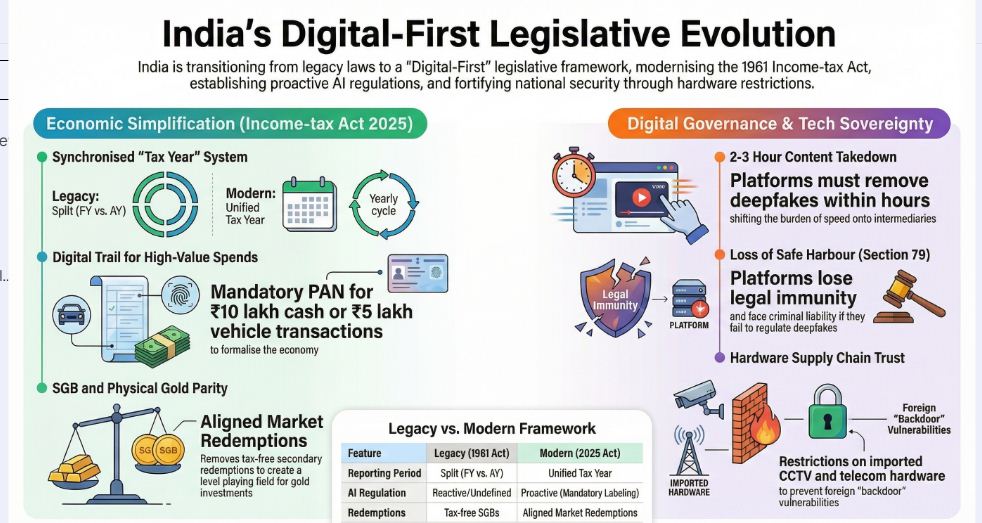
- Abolition of FY vs. AY: Historically, taxpayers struggled with the distinction between the year of earning (Financial Year) and the year of taxing (Assessment Year). The “Tax Year” system synchronizes these, making the process more intuitive.
- Digital Trail: Mandatory PAN for high-value transactions (₹10 lakh cash/₹5 lakh vehicle) is a move to formalize the economy and track the “big spenders” who may not be filing commensurate tax returns.
- Sovereign Gold Bonds (SGB): Removing the tax-free status on secondary market redemptions aligns SGBs with other capital market instruments, ensuring a level playing field for physical gold and digital gold.
Governance & Tech: IT Rules (AI & SGI Regulation) :
With the rise of deepfakes, the government has moved from “reactive” to “proactive” regulation.
Critical Provisions :
- The 3-Hour/2-Hour Takedown: This is a massive logistical challenge for intermediaries. It shifts the burden of speed onto platforms like X (formerly Twitter), Meta, and YouTube.
- Loss of Safe Harbour (Section 79): This is the “Nuclear Option.” Safe Harbour protects platforms from being sued for what users post. Losing this means a platform can be treated as the publisher of a deepfake, leading to criminal liability.
- Mandatory AI Labeling: This addresses the “Information Integrity” crisis. By labeling SGI, the government aims to prevent the weaponization of misinformation during elections or social unrest.
Internal Security: Digital & Telecom Security :
The restrictions on imported CCTV and telecom hardware are rooted in National Security.
- Supply Chain Trust: By restricting specific imported surveillance hardware, India is addressing “backdoor” vulnerabilities that could allow foreign state actors to spy on critical infrastructure.
- 2-Factor Authentication (2FA): As digital payments surge, 2FA becomes the primary defense against the rising tide of cyber-frauds and phishing.

Gist of daily Article /The Hindu 17oct 2025
October 17, 2025
Daily Gist of the Hindu/Indian Express : 16 Oct 2025
October 16, 2025
Daily Gist of The Hindu/Indian Express: 6 Oct 2025
October 6, 2025
Daily Gist of Article /The Hindu /Indian Express: 24 Sep 2025
September 24, 2025

