August 24, 2026
Human–Elephant Conflict and Elephant Corridors
Why in News?
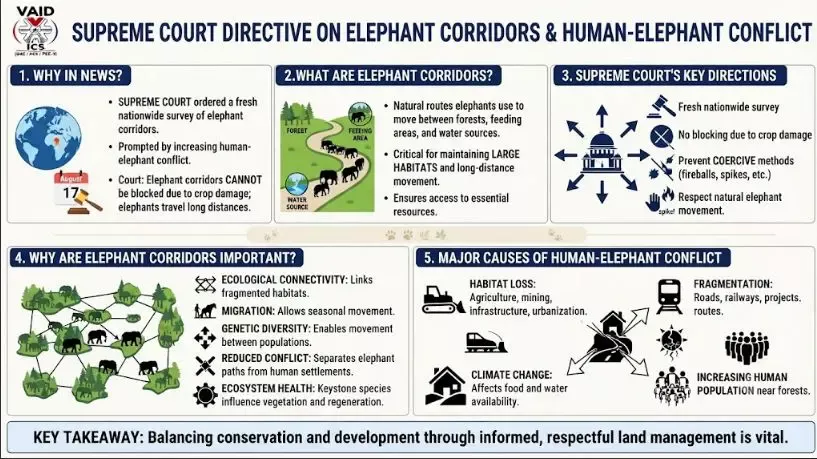
On 17 August, the Supreme Court directed the Union government to conduct a fresh nationwide survey of elephant corridors while hearing a case related to human–elephant conflict.
The Court observed that elephant corridors cannot be blocked merely because elephants cause crop damage, as elephant herds naturally travel long distances.
What are Elephant Corridors?
Elephant corridors are natural routes used by elephants to move between forests, feeding areas and water sources.
They are important because elephants require large habitats and regularly move over long distances in search of food, water and suitable habitat.
Supreme Court’s Key Directions:
-
Fresh survey of elephant corridors across the country.
-
Elephant corridors should not be blocked because of crop damage.
-
The Centre must indicate steps taken to prevent coercive methods used to drive elephants away.
-
The Court particularly raised concerns over methods such as fireballs, spikes and other harmful measures.
-
Management of human–elephant conflict should respect the natural movement of elephants.
Why are Elephant Corridors Important?
Ecological connectivity: Corridors connect fragmented forest habitats.
Migration: They allow elephants to move between different habitats according to seasonal requirements.
Genetic diversity: Movement between populations helps maintain genetic diversity.
Human–elephant conflict: Properly protected corridors can reduce encounters between elephants and human settlements.
Ecosystem health: Elephants are keystone species and influence vegetation, seed dispersal and forest regeneration.
Major Causes of Human–Elephant Conflict:
-
Habitat loss due to agriculture, mining, infrastructure and urbanisation.
-
Fragmentation of forests by roads, railways and other projects.
-
Encroachment into traditional elephant movement routes.
-
Crop cultivation near elephant habitats.
-
Increasing human population around forest areas.
-
Climate and environmental changes affecting food and water availability.
Problems with Coercive Methods:
Using fireballs, spikes and other harmful methods to divert elephants can:
-
Injure or distress animals.
-
Alter their natural movement.
-
Increase aggressive encounters.
-
Push elephants into new human settlements.
-
Ultimately worsen human–elephant conflict.
Way Forward:
Scientific mapping: Regularly update elephant-corridor maps using field surveys, GPS and remote sensing.
Protect corridors: Prevent permanent construction and fragmentation in critical movement routes.
Habitat restoration: Restore degraded forest patches connecting fragmented habitats.
Early-warning systems: Use sensors, mobile alerts and community-based monitoring to warn people about elephant movement.
Compensation: Ensure quick and adequate compensation for crop and property losses.
Community participation: Involve local communities in corridor protection and conflict-management programmes.
Wildlife-friendly infrastructure: Develop underpasses, overpasses and other appropriate measures at roads and railway crossings.
Mains Perspective:
The issue reflects the need to balance wildlife conservation with livelihood security. The solution is not to stop elephant movement but to protect ecological corridors, reduce habitat fragmentation and develop scientific, community-based conflict-management systems.
Possible Mains Question:
“Elephant corridors are essential for maintaining ecological connectivity and reducing human–elephant conflict. Discuss the challenges in protecting them and suggest a sustainable way forward.”
मानव–हाथी संघर्ष एवं हाथी गलियारे:
क्यों चर्चा में?
17 अगस्त को सर्वोच्च न्यायालय ने केंद्र सरकार को देशभर में हाथी गलियारों का नया सर्वेक्षण कराने का निर्देश दिया।
न्यायालय ने कहा कि फसल नुकसान के डर से हाथी गलियारों को अवरुद्ध नहीं किया जा सकता, क्योंकि हाथी स्वाभाविक रूप से लंबी दूरी तय करते हैं।
हाथी गलियारे क्या हैं?
हाथी गलियारे वे प्राकृतिक मार्ग हैं जिनका उपयोग हाथी वनों, भोजन क्षेत्रों और जल स्रोतों के बीच आने-जाने के लिए करते हैं।
हाथियों को भोजन, पानी और उपयुक्त आवास की तलाश में लंबी दूरी तक 이동 करना पड़ता है। इसलिए इन गलियारों का संरक्षण आवश्यक है।
सर्वोच्च न्यायालय के प्रमुख निर्देश:
-
देशभर में हाथी गलियारों का नया सर्वेक्षण किया जाए।
-
फसल नुकसान के आधार पर हाथी गलियारों को अवरुद्ध न किया जाए।
-
केंद्र सरकार बताए कि हाथियों को भगाने के लिए अपनाए जा रहे बलपूर्वक उपायों को रोकने के लिए क्या कदम उठाए गए हैं।
-
आग के गोले, नुकीली वस्तुएँ तथा अन्य हानिकारक तरीकों के प्रयोग पर रोक लगाने की दिशा में कदम उठाए जाएँ।
-
हाथियों के प्राकृतिक आवागमन को बनाए रखते हुए मानव–हाथी संघर्ष का समाधान किया जाए।
हाथी गलियारे क्यों महत्वपूर्ण हैं?
पारिस्थितिक संपर्क: अलग-अलग वन क्षेत्रों को आपस में जोड़ते हैं।
आवागमन: हाथियों को भोजन, पानी और उपयुक्त आवास के बीच जाने में मदद करते हैं।
आनुवंशिक विविधता: अलग-अलग हाथी आबादियों के बीच संपर्क बनाए रखते हैं।
मानव–हाथी संघर्ष में कमी: सुरक्षित गलियारे हाथियों को मानव बस्तियों से दूर प्राकृतिक मार्ग प्रदान कर सकते हैं।
पारिस्थितिकी तंत्र: हाथी एक कीस्टोन प्रजाति हैं और बीज प्रसार तथा वन पुनर्जनन में महत्वपूर्ण भूमिका निभाते हैं।
मानव–हाथी संघर्ष के प्रमुख कारण:
-
वनों का क्षरण और आवास का नुकसान
-
कृषि एवं अन्य गतिविधियों के लिए वन भूमि का उपयोग
-
वनों का विखंडन
-
सड़क, रेलवे और अन्य बुनियादी ढाँचे का विस्तार
-
हाथियों के पारंपरिक मार्गों पर अतिक्रमण
-
वन क्षेत्रों के आसपास बढ़ती मानव आबादी
-
भोजन एवं जल की उपलब्धता में बदलाव
-
जलवायु परिवर्तन एवं अन्य पर्यावरणीय दबाव
बलपूर्वक उपायों की समस्या:
हाथियों को भगाने के लिए आग के गोले, नुकीली वस्तुएँ और अन्य हिंसक तरीके अपनाने से:
-
हाथियों को चोट और तनाव हो सकता है।
-
उनका प्राकृतिक आवागमन प्रभावित होता है।
-
हाथी नए मानव क्षेत्रों की ओर जा सकते हैं।
-
मानव–हाथी संघर्ष और बढ़ सकता है।
-
समस्या का स्थायी समाधान नहीं होता।
आगे की राह:
वैज्ञानिक मानचित्रण: GPS, रिमोट सेंसिंग और जमीनी सर्वेक्षण से हाथी गलियारों की नियमित पहचान एवं निगरानी।
गलियारों का संरक्षण: महत्वपूर्ण गलियारों में अनियंत्रित निर्माण एवं भूमि उपयोग को रोकना।
आवास पुनर्स्थापन: खंडित वन क्षेत्रों को पुनः जोड़ना और खराब हो चुके आवासों को बहाल करना।
पूर्व चेतावनी प्रणाली: सेंसर, मोबाइल अलर्ट और स्थानीय निगरानी से हाथियों की आवाजाही की जानकारी देना।
त्वरित मुआवजा: फसल एवं संपत्ति के नुकसान के लिए समय पर उचित मुआवजा।
सामुदायिक भागीदारी: स्थानीय समुदायों को संरक्षण एवं संघर्ष प्रबंधन में शामिल करना।
वन्यजीव-अनुकूल बुनियादी ढाँचा: सड़क और रेलवे मार्गों पर उपयुक्त अंडरपास एवं ओवरपास विकसित करना।
मुख्य परीक्षा के लिए निष्कर्ष:
मानव–हाथी संघर्ष केवल वन्यजीव संरक्षण की समस्या नहीं बल्कि पारिस्थितिकी, आजीविका और विकास के बीच संतुलन का प्रश्न है। समाधान हाथियों के प्राकृतिक आवागमन को रोकना नहीं, बल्कि हाथी गलियारों का संरक्षण, आवास विखंडन में कमी और समुदाय-आधारित संघर्ष प्रबंधन है।
संभावित मुख्य परीक्षा प्रश्न
“हाथी गलियारे पारिस्थितिक संपर्क बनाए रखने तथा मानव–हाथी संघर्ष को कम करने में महत्वपूर्ण हैं। इनके संरक्षण की प्रमुख चुनौतियों की चर्चा करते हुए सतत समाधान सुझाइए।”

May 19, 2026
October 17, 2025
October 16, 2025
October 6, 2025

