May 20, 2026
Hop’ Experiment/’हॉप’ (Hop) प्रयोग क्या था?
What is the Core News?:
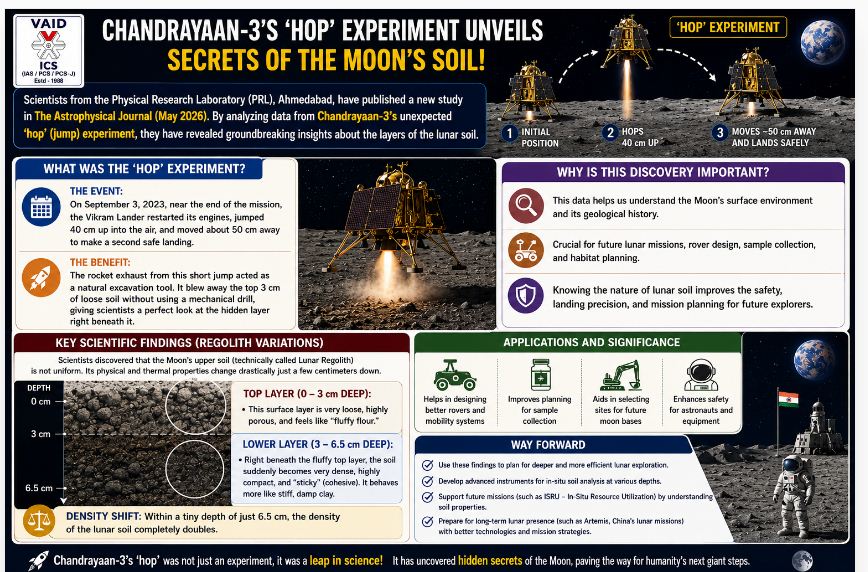
Scientists from the Physical Research Laboratory (PRL) in Ahmedabad have published a new study in The Astrophysical Journal (May 2026). By analyzing data from Chandrayaan-3’s unexpected ‘hop’ (jump) experiment, they have revealed groundbreaking insights about the layers of the lunar soil.
What was the ‘Hop’ Experiment?:
-
The Event: On September 3, 2023, near the end of the mission, the Vikram Lander restarted its engines, jumped 40 cm up into the air, and moved about 50 cm away to make a second safe landing.
-
The Benefit: The rocket exhaust from this short jump acted as a natural excavation tool. It blew away the top 3 cm of loose soil without using a mechanical drill, giving scientists a perfect look at the hidden layer right beneath it.
Key Scientific Findings (Regolith Variations):
Scientists discovered that the Moon’s upper soil (technically called Lunar Regolith) is not uniform. Its physical and thermal properties change drastically just a few centimeters down:
-
The Top Layer (0 to 3 cm deep): This surface layer is very loose, highly porous, and feels like “fluffy flour.”
-
The Lower Layer (3 to 6.5 cm deep): Right beneath the fluffy top layer, the soil suddenly becomes very dense, highly compact, and “sticky” (cohesive). It behaves more like stiff, damp clay.
-
Density Shift: Within a tiny depth of just 6.5 cm, the density of the lunar soil completely doubles.
Role of the ChaSTE Payload:
-
The Instrument: ChaSTE (Chandra’s Surface Thermophysical Experiment) is a thermal probe (a sharp rod with temperature sensors) designed to measure the temperature and thermal insulation properties of the lunar soil.
-
The Twilight Benefit: After the lander hopped, ChaSTE was kept active for 57 minutes during the lunar sunset (twilight). This revealed that the fluffy top layer acts like an extreme insulation blanket. It allows heat to escape instantly into the vacuum of space, cooling the surface rapidly while the dense layer underneath retains its heat.
Why this Discovery Matters for Future Missions:
-
Protecting Water-Ice: The fact that the top layer acts as an insulating blanket explains why solar heat cannot penetrate deep into the ground. This is the primary reason why water-ice particles remain safely preserved just inches beneath the surface in the Moon’s polar regions.
-
Building Moon Bases: When future human habitats or bases are constructed on the Moon, engineers can use this dense, compact lower layer to build underground shelters. This will protect astronauts from dangerous cosmic radiation and extreme temperature swings.
-
Sample Return Technology: The successful engine restart and hop proved that ISRO has the core technology required for future Sample Return Missions (like Chandrayaan-4), where a spacecraft must launch from the Moon’s surface to bring soil samples back to Earth.
हॉप’ (Hop) प्रयोग:
चर्चा में क्यों ?
अहमदाबाद की भौतिक अनुसंधान प्रयोगशाला (PRL) के वैज्ञानिकों ने ‘द एस्ट्रोफिजिकल जर्नल’ (मई 2026) में एक नया अध्ययन प्रकाशित किया है। इसमें चंद्रयान-3 के ‘हॉप’ (उछाल) प्रयोग के आंकड़ों का विश्लेषण करके चंद्रमा की सतह की मिट्टी की परतों के बारे में एक बड़ा खुलासा किया गया है।
‘हॉप’ (Hop) प्रयोग क्या था?:
-
घटना: 3 सितंबर 2023 को, मिशन के अंत में विक्रम लैंडर ने अपने इंजनों को दोबारा चालू किया और हवा में 40 सेमी ऊपर उछलकर अपनी जगह से लगभग 50 सेमी दूर जाकर सुरक्षित लैंडिंग की।
-
फायदा: इस छलांग के दौरान रॉकेट के धुएं और दबाव ने एक प्राकृतिक उपकरण की तरह काम किया। इसने सतह की ऊपरी 3 सेमी की ढीली परत (मिट्टी) को बिना किसी ड्रिल के उड़ा दिया, जिससे वैज्ञानिकों को उसके ठीक नीचे की छिपी हुई परत का अध्ययन करने का मौका मिल गया।
वैज्ञानिकों को क्या पता चला? (मुख्य निष्कर्ष):
वैज्ञानिकों के अनुसार, चंद्रमा की ऊपरी सतह (जिसे रेगोलिथ / Regolith कहा जाता है) एक जैसी (Uniform) नहीं है। इसमें मात्र कुछ ही सेंटीमीटर की गहराई पर बहुत बड़े बदलाव देखे गए हैं:
-
ऊपरी परत (0 से 3 सेमी गहराई): यह सतह बहुत ही हल्की, बेहद छिद्रपूर्ण (porous) और “आटे जैसी” मुलायम या फुसफुसी है।
-
नीचे की परत (3 से 6.5 सेमी गहराई): ऊपरी मुलायम परत के ठीक नीचे की मिट्टी अचानक बहुत घनी, ठोस और अत्यधिक चिपचिपी (cohesive) हो जाती है। यह किसी “गीली या सख्त मिट्टी” की तरह व्यवहार करती है।
-
घनत्व में बदलाव: मात्र 6.5 सेमी की गहराई के भीतर ही चंद्रमा की मिट्टी का घनत्व (Density) सीधे दोगुना हो जाता है।
चास्टे (ChaSTE) पेलोड की भूमिका:
-
उपकरण: ‘चास्टे’ (Chandra’s Surface Thermophysical Experiment) एक थर्मल प्रोब (तापमान मापने वाली छड़) है, जिसे थर्मल इन्सुलेशन और तापमान प्रोफाइल मापने के लिए डिजाइन किया गया था।
-
ट्विलाइट (सांझ) का फायदा: हॉप प्रयोग के बाद, इस उपकरण को चंद्रमा पर शाम ढलने (twilight) के दौरान 57 मिनट तक सक्रिय रखा गया। इससे यह पता चला कि चंद्रमा की ऊपरी मुलायम परत एक थर्मल ब्लैंकेट (इन्सुलेटिंग कंबल) की तरह काम करती है। यह अंतरिक्ष के निर्वात (vacuum) में गर्मी को तुरंत बाहर जाने देती है, जिससे ऊपर की सतह बहुत तेजी से ठंडी होती है, जबकि नीचे की ठोस परत में तापमान का अंतर बना रहता है।
इस खोज का भविष्य के मिशनों के लिए महत्व:
-
पानी और बर्फ की सुरक्षा: मिट्टी की ऊपरी परत का ‘थर्मल ब्लैंकेट’ की तरह काम करना यह समझाता है कि सूर्य की गर्मी गहराई तक क्यों नहीं पहुँच पाती। यही कारण है कि चंद्रमा के ध्रुवीय क्षेत्रों में सतह के ठीक नीचे पानी और बर्फ के कण (Water-Ice) सुरक्षित बचे हुए हैं।
-
मानव आवास का निर्माण: भविष्य में जब चंद्रमा पर मानव बस्तियाँ या बेस बनाए जाएंगे, तो इस घनी और ठोस निचली परत का उपयोग अंतरिक्ष यात्रियों को खतरनाक ब्रह्मांडीय विकिरण (Cosmic Radiation) और तापमान के उतार-चढ़ाव से बचाने के लिए बंकर या शेल्टर बनाने में किया जा सकेगा।
-
सैंपल रिटर्न मिशन: इंजनों को दोबारा चालू करके हवा में उछलने की इस तकनीक ने साबित कर दिया कि इसरो (ISRO) भविष्य के मिशनों (जैसे चंद्रयान-4) में चंद्रमा की सतह से चट्टानों के नमूने लेकर वापस पृथ्वी पर लौटने या मानव को वापस लाने की क्षमता रखता है।

May 19, 2026
October 17, 2025
October 16, 2025
October 6, 2025

