February 23, 2026
History of Women’s Reservation in India
History of Women’s Reservation in India
From the 1970s to the 106th Constitutional Amendment Act (2023):
Constitutional & Legal Foundation:
The demand for women’s reservation is rooted in the principle of Substantive Equality. While the Constitution guarantees equality, representation remained low, leading to the use of specific articles to justify reservation:
- Article 14: Right to Equality.
- Article 15(3): Empowers the State to make special provisions for women and children.
- Article 16: Equality of opportunity in public employment.
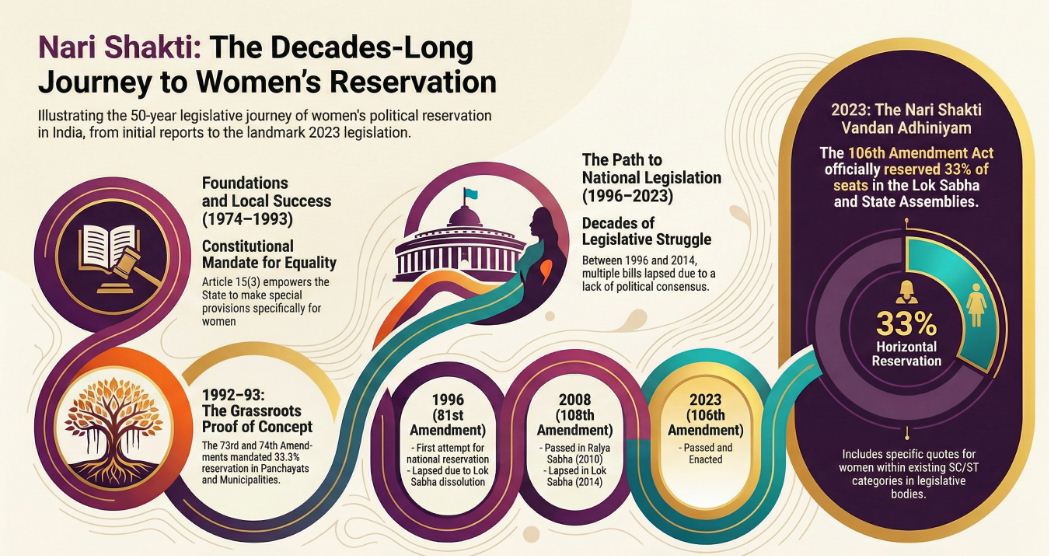
The Evolution: Pre-1990s to Local Governance:
The journey began with identifying the gap in representation and testing the waters at the grassroots level.
- 1974 (CSWI Report): The Towards Equality report by the Committee on the Status of Women in India highlighted the declining political representation of women.
- 1988 (National Perspective Plan): Recommended 30% reservation for women in all elective bodies.
- 1992–93 (The Turning Point): The 73rd and 74th Amendments mandated 3% reservation for women in Panchayats and Municipalities. This served as a “proof of concept” for national-level reservation.
The Legislative Struggle (1996 – 2014):
For nearly three decades, the Bill faced a cycle of introduction and lapse.
| Attempt | Bill/Year | Key Outcome |
| First Attempt | 81st Amendment Bill (1996) | Introduced by H.D. Deve Gowda; lapsed due to Lok Sabha dissolution. |
| Repeated Tries | 1998, 1999, 2002, 2003 | Failed to gain consensus due to demands for an “OBC Sub-quota”. |
| Major Milestone | 108th Amendment Bill (2008) | Passed in the Rajya Sabha (2010), but never cleared the Lok Sabha. Lapsed in 2014. |
The Breakthrough: Nari Shakti Vandan Adhiniyam (2023):
In September 2023, the long-standing demand finally saw legislative success.
Key Details:
- Official Name: The Constitution (106th Amendment) Act, 2023.
- Target: 33% reservation in Lok Sabha, State Legislative Assemblies, and the Delhi Assembly.
- SC/ST Provision: Includes horizontal reservation for women within existing SC/ST quotas.
Implementation Timeline:
Unlike other bills, this is not immediate. It is tied to two factors:
- The Census: Must be conducted first (post-2023).
- Delimitation: The “redrawing of boundaries” for constituencies must happen based on the new census data.
- Duration: The reservation is valid for 15 years, after which Parliament may extend it.
Critical Analysis:
Arguments In Favor
- Breaking the “Glass Ceiling”: Moves beyond symbolic representation to actual legislative power.
- Policy Shift: Studies from Panchayats show women leaders often prioritize health, education, and water.
- Correcting Historical Imbalance: Addresses the fact that women make up nearly 50% of the population but only ~14% of Parliament.
Concerns & Challenges:
- The “Proxy” Risk: Concern over Pati-Panchayat (husbands ruling on behalf of elected wives) shifting to the Parliamentary level.
- OBC Exclusion: Critics argue that without a specific sub-quota for OBC women, the benefits may only reach elite classes.
- The Delay: Linking it to the Census and Delimitation means it might not be implemented until the 2029 General Elections.
Conclusion:
The journey of women’s reservation in the Lok Sabha spans nearly three decades of debate and political struggle. With the passage of the 106th Constitutional Amendment Act, 2023, India has taken a historic step toward gender-inclusive democracy, though actual implementation awaits delimitation.

October 17, 2025
October 16, 2025
October 6, 2025
September 24, 2025

