June 11, 2026
Hindu Kush Himalaya (HKH) Monsoon Outlook 2026:
Why in News?
The HKH Monsoon Outlook 2026, published by ICIMOD and China’s Institute of Atmospheric Physics, forecasts below-normal rainfall and above-normal temperatures for the upcoming season, largely driven by El Niño patterns. This creates a dual crisis: the potential for agricultural drought coupled with heightened risks of sudden, extreme weather disasters.
Key Points:
-
Water Buffer Depletion: Decreased winter snowfall combined with rising summer temperatures has significantly reduced the region’s seasonal water buffer, threatening water security for downstream populations.
-
Paradoxical Risk: Despite a “drier” forecast, the region remains at extreme risk. Intense, concentrated rainfall events can still trigger catastrophic landslides and flash floods, as the soil and terrain become unstable.
-
Climate Linkages: The report establishes a clear link between El Niño cycles, warming sea surface temperatures in the Indian Ocean, and the erratic behavior of the monsoon, which remains the lifeline for South Asian agriculture.
About Hindu Kush Himalaya (HKH):
-
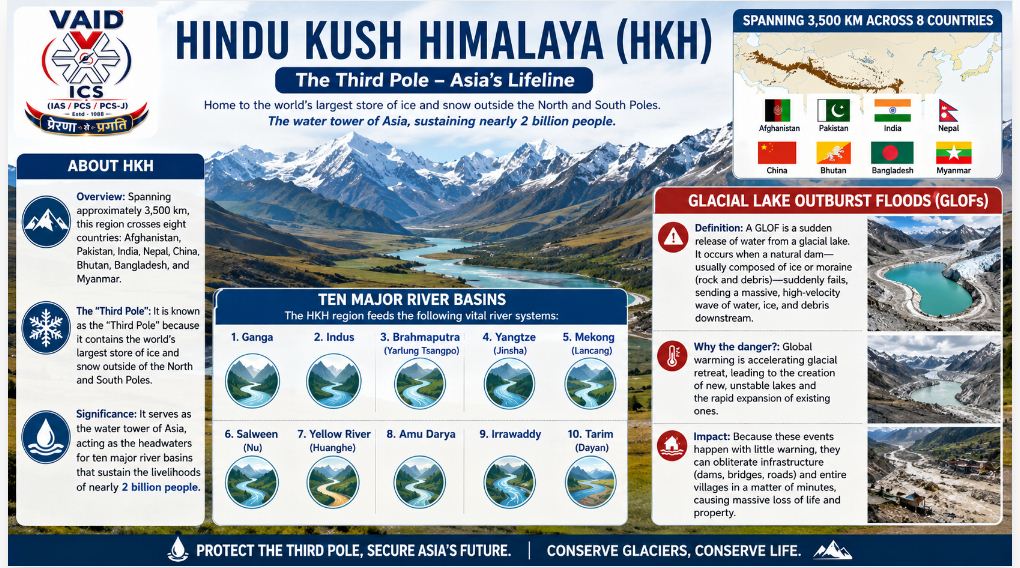
Overview: Spanning approximately 3,500 km, this region crosses eight countries: Afghanistan, Pakistan, India, Nepal, China, Bhutan, Bangladesh, and Myanmar.
-
The “Third Pole”: It is known as the “Third Pole” because it contains the world’s largest store of ice and snow outside of the North and South Poles.
-
Significance: It serves as the water tower of Asia, acting as the headwaters for ten major river basins that sustain the livelihoods of nearly 2 billion people.
Ten Major River Basins:
The HKH region feeds the following vital river systems:
-
Ganga
-
Indus
-
Brahmaputra (Yarlung Tsangpo)
-
Yangtze (Jinsha)
-
Mekong (Lancang)
-
Salween (Nu)
-
Yellow River (Huanghe)
-
Amu Darya
-
Irrawaddy
-
Tarim (Dayan)
Glacial Lake Outburst Floods (GLOFs):
-
Definition: A GLOF is a sudden release of water from a glacial lake. It occurs when a natural dam—usually composed of ice or moraine (rock and debris)—suddenly fails, sending a massive, high-velocity wave of water, ice, and debris downstream.
-
Why the danger?: Global warming is accelerating glacial retreat, leading to the creation of new, unstable lakes and the rapid expansion of existing ones.
-
Impact: Because these events happen with little warning, they can obliterate infrastructure (dams, bridges, roads) and entire villages in a matter of minutes, causing massive loss of life and property.
हिंदू कुश हिमालय (HKH) मानसून आउटलुक 2026:
चर्चा में क्यों है (Why in News):
ICIMOD (इंटरनेशनल सेंटर फॉर इंटीग्रेटेड माउंटेन डेवलपमेंट) और चीन के इंस्टीट्यूट ऑफ एटमॉस्फेरिक फिजिक्स द्वारा जारी ‘HKH मानसून आउटलुक 2026’ में अल नीनो (El Niño) के प्रभाव के कारण इस क्षेत्र में सामान्य से कम बारिश और सामान्य से अधिक तापमान की भविष्यवाणी की गई है। यह स्थिति न केवल सूखे का खतरा बढ़ाती है, बल्कि क्षेत्र की जल सुरक्षा और आपदा प्रबंधन के लिए एक बड़ी चुनौती बन गई है।
मुख्य बिंदु (Key Points):
-
जल सुरक्षा पर संकट: सर्दियों में बर्फबारी कम होने और गर्मियों में तापमान बढ़ने से क्षेत्र का ‘प्राकृतिक जल बफर’ (seasonal water buffer) कम हो गया है।
-
विरोधाभासी खतरा: यद्यपि कुल मिलाकर मानसून कमजोर रहने की संभावना है, लेकिन इसका अर्थ यह नहीं है कि आपदा का खतरा कम है। तीव्र और अचानक वर्षा (intense rainfall events) से भूस्खलन (landslides) और अचानक बाढ़ (flash floods) का खतरा बना हुआ है।
-
जलवायु का प्रभाव: अल नीनो की वापसी के कारण हिंद महासागर के तापमान के साथ मिलकर मानसून के पैटर्न में बदलाव आ रहा है, जो दक्षिण एशियाई कृषि और अर्थव्यवस्था के लिए चिंताजनक है।
हिंदू कुश हिमालय (HKH) के बारे में:
-
परिचय: यह क्षेत्र लगभग 3,500 किमी के दायरे में फैला है, जो 8 देशों (अफगानिस्तान, पाकिस्तान, भारत, नेपाल, चीन, भूटान, बांग्लादेश और म्यांमार) को जोड़ता है।
-
तीसरा ध्रुव (Third Pole): इसे ‘दुनिया का तीसरा ध्रुव’ कहा जाता है क्योंकि ध्रुवीय क्षेत्रों के बाहर यहाँ दुनिया का सबसे बड़ा बर्फ और ग्लेशियर भंडार स्थित है।
-
महत्व: यह एशिया की दस प्रमुख नदी प्रणालियों का उद्गम स्थल है और लगभग 2 अरब लोगों की खाद्य, जल और ऊर्जा सुरक्षा सुनिश्चित करता है।
दस प्रमुख नदी बेसिन (Major River Basins):
HKH क्षेत्र निम्नलिखित दस नदियों को जल प्रदान करता है:
-
गंगा (Ganga)
-
सिंधु (Indus)
-
ब्रह्मपुत्र (Brahmaputra/Yarlung Tsangpo)
-
यांग्त्ज़ी (Yangtze/Jinsha)
-
मेकांग (Mekong/Lancang)
-
सलवीन (Salween/Nu)
-
पीली नदी (Yellow River/Huanghe)
-
अमू दरिया (Amu Darya)
-
इरावदी (Irrawaddy)
-
तारिम (Tarim/Dayan)
ग्लेशियल लेक आउटबर्स्ट फ्लड्स (GLOFs):
-
क्या है?: GLOF ग्लेशियर के पिघलने से बनी झील के अचानक फूटने की घटना है। जब ग्लेशियर के किनारे या सामने बने प्राकृतिक अवरोध (मोरेन/मलबे के बांध) टूट जाते हैं, तो झील का पानी और मलबा अचानक नीचे की ओर बहने लगता है।
-
खतरा क्यों?: जलवायु परिवर्तन के कारण तापमान में वृद्धि हो रही है, जिससे ग्लेशियर तेजी से पिघल रहे हैं और नई झीलें बन रही हैं या मौजूदा झीलें और बड़ी हो रही हैं।
-
प्रभाव: यह घटना बहुत कम समय में भारी तबाही लाती है, जो निचले इलाकों में बुनियादी ढांचे (बांधों, घरों, सड़कों) को नष्ट कर देती है और जीवन के लिए बड़ा खतरा पैदा करती है।

May 19, 2026
October 17, 2025
October 16, 2025
October 6, 2025

