January 27, 2026
GS 1 -SOCIAL ISSUES-URBANISATION -CONCISE NOTES
Definition: Increase in proportion of population living in urban areas due to migration, natural growth, and reclassification of settlements.
UN Definition: Urbanisation occurs when >50% population resides in towns/cities.
India Context: As per UN World Urbanisation Prospects (2023), ~36% of India’s population is urban; projected to reach ~50% by 2047.
India has 2nd largest urban population globally (after China).
Smart Cities Mission: 100 cities under implementation, ~80% projects completed by 2025.
- Statutory Towns: All administrative units that have been defined by statute as urban, like Municipal Corporation, Municipality, Cantonment Board, Notified Town Area Committee, Town Panchayat, Nagar Palikas etc.
- Census Towns: Administrative units satisfying the following three criteria simultaneously:
-
- A minimum population of 5000;
- At least 75 percent of the male working population engaged in the non-agricultural sector;
- A density of population of at least 400 persons per square km.
Types of Urban Settlements:
- Based on Function
- Functional Classification of Towns: Besides being central or nodal points, many towns and cities have specific roles.
- Some are known for particular activities, products, or services they specialize in.
- However, each town typically fulfills multiple functions.
- Based on their primary or specialized functions, Indian cities and towns can be broadly categorized as follows:
| Functional Classification | Characteristics | Examples |
| Administrative Towns | Serve As Administrative Headquarters. | Chandigarh, New Delhi, Bhopal |
| Industrial Towns | Driven By Industrial Activities. | Mumbai, Salem, Coimbatore |
| Transport Cities | Primarily Engaged In Export And Import Activities | Kandla, Kochchi, Agra |
| Commercial Towns | Specialize In Trade And Commerce. | Kolkata, Saharanpur, Satna |
| Mining Towns | Developed In Mineral-Rich Areas. | Raniganj, Jharia, Digboi |
| Garrison Cantonment Towns | Emerged As Garrison Towns. | Ambala, Jalandhar, Mhow |
| Educational Towns | Started As Educational Centers. | Roorki, Varanasi, Aligarh |
| Religious and Cultural Towns | Came To Prominence Due To Their Religious/Cultural Significance. | Varanasi, Mathura, Amritsar |
| Tourist Towns | Emerged As Tourist Destinations. | Nainital, Mussoorie, Shimla |
- B. Based on Population:
- Based on population, urban settlements can be classified into the following categories.
- City: A city is typically considered a large urban area, but there are no precise criteria to distinguish it from a smaller town.
- It’s a concentrated settlement with diverse functions and usually features a central business district.
- Metropolitan City: Metropolitan Cities are those cities that have a Population in between one million to five million.
The number of metropolitan cities increased from 12 in 1981 to 53 in 2011.
Megacity: A megacity is a very large city, and it can be a single metropolitan area.
Population: More than 5 million population are in metropolitan cities.
Megacities: Cities with a population of 5 million and above.
Megalopolis: When a large city sprawls and brings into its fold smaller adjacent towns and cities.
Population: more than 5 million.
Conurbation: It is formed by the coalescence of urban settlements that were separated by open space in the past.
The coalescence usually occurs through ribbon development along the main inter-urban transport routes.
Causes of Urbanisation:
Economic: Industrialisation, IT hubs, service sector growth.
Social: Better education, healthcare, lifestyle aspirations.
Political/Policy: Smart Cities, PMAY‑Urban, AMRUT.
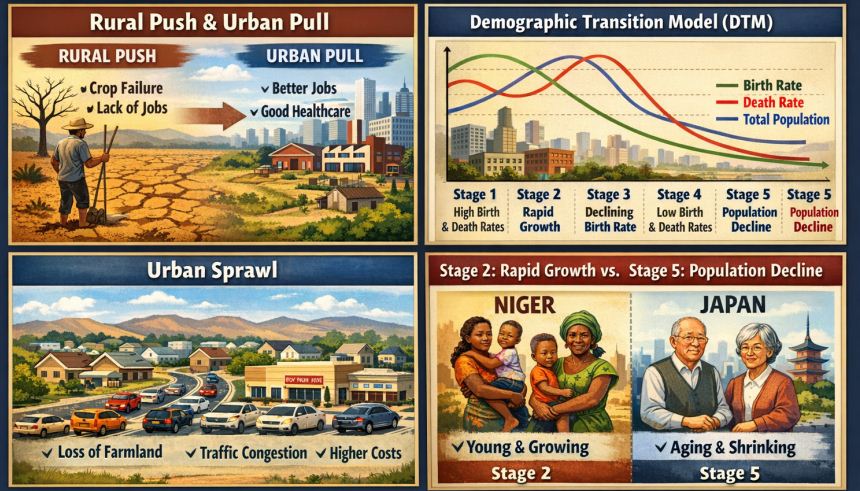
Demographic: Rural push (agrarian distress) + urban pull (jobs).
Infrastructure: Metro rail, highways, airports.
Keywords: Rural Push vs Urban Pull, Demographic Transition, Urban Sprawl.
| Rural Push & Urban Pull:
This describes the dual forces that drive migration from the countryside to the city.
Example: A farmer in a village moves because a drought destroyed his livelihood (Push), and he heads to Mumbai because he heard there are steady factory jobs available (Pull). Demographic Transition Model (DTM): This model explains how a country’s population structure changes as it develops from an agrarian society to an industrial one. It typically follows five stages based on birth and death rates.
Example: Niger is currently in Stage 2 (rapid growth), while Japan is in Stage 5 (shrinking, aging population). Urban Sprawl: Urban sprawl is the rapid, often poorly planned expansion of a city into the surrounding rural areas. It is characterized by low-density housing and a heavy reliance on cars.
Example: The expansion of Phoenix, Arizona, where the city limits have stretched miles into the desert with vast suburban neighborhoods and shopping centers. |
Issues & Challenges:
Housing: Slums, informal settlements, affordability crisis.
Transport: Congestion, pollution, poor last‑mile connectivity.
Waste Management: Landfills, segregation failure.
Flooding & Climate Risks: Encroachment on wetlands, poor drainage.
Livability: Air pollution, water scarcity, inequality.
Governance: Weak Urban Local Bodies (ULBs), fiscal stress.
Government Schemes & Policies:
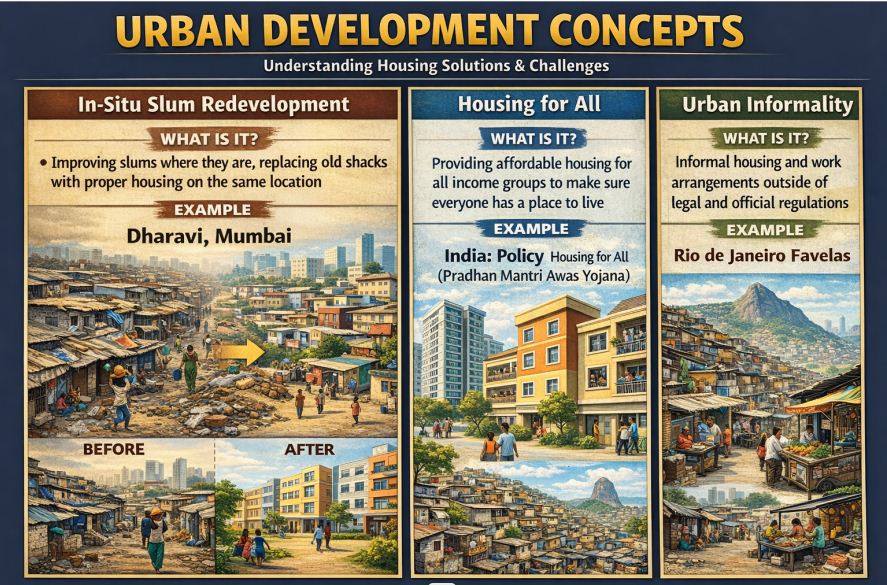
Housing: PMAY‑Urban, Dharavi Redevelopment Project.
Transport: Metro Rail, PM Gati Shakti, National Electric Bus Programme.
Waste: Swachh Bharat Mission‑Urban 2.0, Plastic Waste Rules 2022.
Flooding/Resilience: AMRUT 2.0, NDMA guidelines.
Livability: Smart Cities Mission, National Urban Policy Framework.
Governance: 15th Finance Commission grants, e‑Governance initiatives.
Recent Changes & Reforms:
Shift to sustainability: Circular economy, waste‑to‑energy plants.
Digital governance: GIS mapping, online grievance redressal.
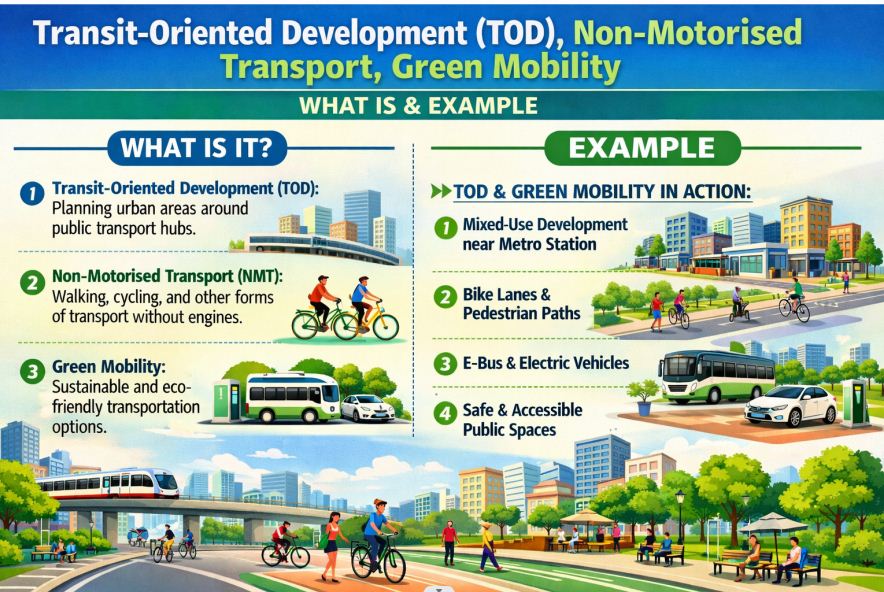
Green transport: EV buses, TOD (Transit‑Oriented Development).
Participatory planning: Kerala’s model of local governance.
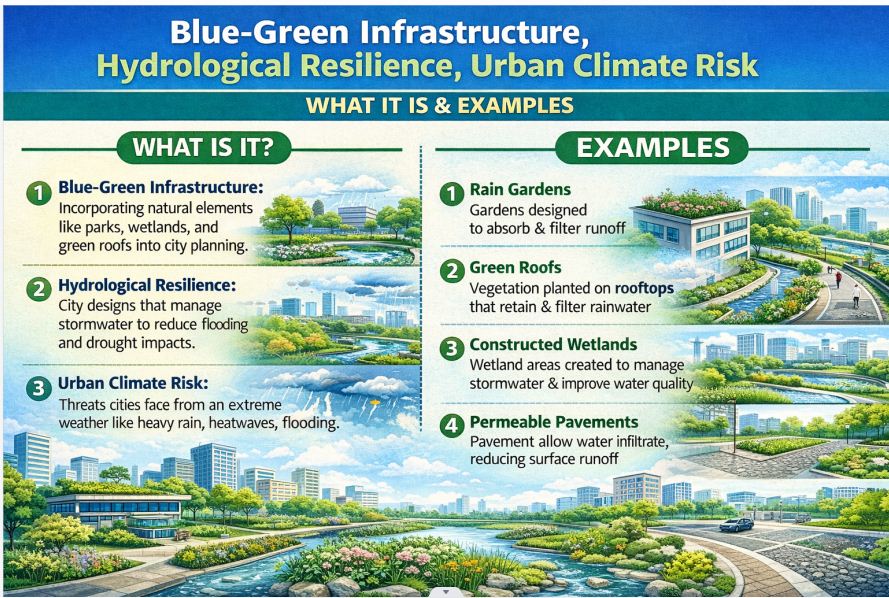
Urban resilience: Blue‑green infrastructure for flood control.
Housing & Slums:
Concept: Housing shortage → proliferation of slums (≈65 million people live in slums, Census 2011).
Challenges:
- Land scarcity, high rents, informal settlements.
- Poor sanitation, health hazards, lack of tenure security.
- Rising demand due to migration.
Schemes/Policies:
- PMAY‑Urban: Affordable housing for all.
- Dharavi Redevelopment Project (Mumbai, 2023).
- Smart Cities Mission: Integrated housing + infrastructure.
Examples: Delhi’s JJ clusters, Mumbai’s Dharavi, Lucknow’s slum rehabilitation under PMAY.
Keywords: Insitu Slum Redevelopment, Housing for All, Urban Informality.
Way Forward:
- Promote in‑situ slum redevelopment with community participation.
- Strengthen rental housing policy for migrants.
- Integrate health, sanitation, and livelihood in housing schemes.
- Encourage PPP models for affordable housing.
- Use GIS mapping for slum identification and planning.
Urban Transport:
Concept: Efficient mobility is backbone of urban economy.
Challenges:
- Congestion, pollution, poor last‑mile connectivity.
- Dependence on private vehicles.
- Weak integration of modes.
Schemes/Policies:
- Metro Rail Projects: Lucknow, Kanpur, Pune.
- PM Gati Shakti for integrated planning.
- National Electric Bus Programme (2023).
- Examples: Delhi Metro Phase IV, Bengaluru suburban rail, Lucknow Metro.
Keywords: TransitOriented Development (TOD), NonMotorised Transport, Green Mobility.
Way Forward:
- Expand mass rapid transit systems (metro, BRTS).
- Promote non‑motorised transport (cycling, walking).
- Incentivise electric mobility and shared transport.
- Integrate multi‑modal transport hubs under PM Gati Shakti.
- Adopt Transit‑Oriented Development (TOD) for compact cities.
Solid Waste Management:
Concept: Urban India generates ~160,000 tonnes/day of solid waste.
Challenges:
- Landfills overflowing, poor segregation.
- Informal sector excluded.
- Plastic & biomedical waste rising.
Schemes/Policies:
- Swachh Bharat Mission‑Urban 2.0 (2021).
- Plastic Waste Management Rules 2022.
- Waste to Energy plants.
Examples: Indore ranked cleanest city (Swachh Survekshan 2023), Ghazipur landfill crisis (Delhi).
Keywords: Circular Economy, Waste to Energy, Segregation at Source.
Way Forward:
- Ensure segregation at source with citizen awareness.
- Strengthen waste‑to‑energy plants and composting.
- Formalise and integrate informal waste pickers.
- Promote extended producer responsibility (EPR) for plastics.
- Adopt circular economy principles in urban planning.
Urban Flooding:
Concept: Flooding due to poor drainage, climate change, encroachment.
Challenges:
- Loss of wetlands, concretisation.
- Inadequate stormwater systems.
- Climate extremes (heavy rainfall).
Schemes/Policies:
- AMRUT 2.0 for stormwater drainage.
- NDMA Guidelines on Urban Flooding.
- National Disaster Risk Reduction Framework.
Examples: Bengaluru floods (2022), Chennai floods (2023), Mumbai deluge (2005 legacy).
Keywords: Blue Green Infrastructure, Hydrological Resilience, Urban Climate Risk.
Way forward:
- Restore wetlands and natural drainage channels.
- Build blue‑green infrastructure (parks, lakes, permeable pavements).
- Upgrade stormwater drainage systems under AMRUT.
- Integrate climate‑resilient urban planning.
- Strengthen early warning systems and disaster preparedness.
Urban Sprawl & Livability:
Concept: Unplanned expansion of cities into peri‑urban areas.
Challenges:
- Loss of agricultural land, ecological stress.
- Rising commute times, fragmented governance.
- Livability issues: air pollution, water scarcity, housing affordability.
Schemes/Policies:
- Smart Cities Mission.
- National Urban Policy Framework (NUPF).
- Ease of Living Index (MoHUA).
Examples: NCR expansion into Haryana & UP, Delhi AQI crisis, Mumbai housing affordability index.
Keywords: Compact City Model, Sustainable Urbanism, Ease of Living.
Way forward:
- Adopt compact city model to reduce sprawl.
- Promote satellite towns with planned infrastructure.
- Enforce land‑use zoning and master plans.
- Improve air quality monitoring and green cover.
- Enhance Ease of Living Index with citizen feedback.
Role of Urban Local Bodies (ULBs) & Governance:
Concept: ULBs are the “third tier” of governance under 74th Constitutional Amendment.
Challenges:
- Fiscal stress, weak autonomy.
- Staff shortages, political interference.
- Limited capacity for planning & execution.
Schemes/Policies:
- 15th Finance Commission grants.
- eGovernance initiatives (online grievance redressal, GIS mapping).
- Capacity building under AMRUT.
Examples: Kerala’s participatory planning model, Indore’s PPP in waste management.
Keywords: Decentralised Governance, Urban Commons, Participatory Planning.
Way Forward:
- Empower ULBs with financial autonomy and capacity building.
- Implement e‑governance and digital platforms for transparency.
- Encourage participatory planning with citizen involvement.
- Strengthen municipal cadre and training institutes.
- Ensure convergence of schemes (Smart Cities, AMRUT, SBM) at local level.
United Nations Human Settlement Programme (UN-Habitat):
- The United Nations Human Settlements Programme, commonly known as UN-Habitat, is the UN agency responsible for promoting sustainable urban development and adequate shelter for all. Established in 1977 after the Habitat I Conference (1976), it operates from its headquarters in Nairobi, Kenya. Its mandate is derived from several UN General Assembly resolutions and from the Habitat Agenda adopted during Habitat II (1996). Today, UN-Habitat works in over 70 countries and leads global efforts to reduce slums, promote safe housing, enhance urban resilience and support innovative urban planning. It also guides member states in implementing the New Urban Agenda.
- Major Historical Milestones of United Nations Human Settlement Programme (UN-Habitat) are:
- 1976– Habitat I Conference in Vancouver focuses on housing shortages, rising slums and sustainable urban planning.
- 1977– UN General Assembly establishes the United Nations Centre for Human Settlements (Habitat).
- 1996- Habitat II in Istanbul adopts the Habitat Agenda, emphasising two goals: adequate shelter for all and sustainable human settlements.
- 2001– Creation of the World Urban Forum to address global urbanisation challenges.
- 2002– Habitat Centre transformed into the United Nations Human Settlements Programme (UN-Habitat) via UNGA Resolution 56/206.
- 2015- UN-Habitat mandated to support Sustainable Development Goal 11: Sustainable Cities and Communities.
- 2016– New Urban Agenda adopted at Habitat III in Quito, strengthening UN-Habitat’s role.
- 2019– First UN-Habitat Assembly convened in Nairobi.
United Nations Human Settlement Programme (UN-Habitat) Initiatives:
World Urban Forum (WUF): Created in 2001, WUF is the world’s leading conference on sustainable urbanisation. Held biennially, it serves as a global platform for governments, experts and civil society to exchange solutions for urban challenges.
World Urban Campaign (WUC): The WUC promotes the New Urban Agenda through global advocacy. It involves governments, NGOs, private sector institutions and research bodies to promote affordable housing, sustainable mobility and inclusive planning.
World Habitat Day: Celebrated on the first Monday of October every year, it encourages global reflection on the right to adequate shelter and collective responsibility for human habitat.
UN-Habitat Scroll of Honour Award: Established in 1989, this prestigious award recognizes outstanding contributions to urban development and poverty reduction.
UN Advisory Committee of Local Authorities (UNACLA): Established in 2000, UNACLA strengthens collaboration between the UN system and local authorities worldwide.
World Cities Report 2024: Cities and Climate Action:
UN-Habitat released “World Cities Report 2024: Cities and Climate Action”
It noted that cities are both victims of climate change and its worst offenders (Generating Green House Gases), although disproportionately exposed to impacts of climate change.
Key-findings of Report:
- Exposed to climate change: More than 2 billion people currently living in cities could be exposed to an additional temperature increase of at least 5 °C by 2040.
- Funding gap: Cities need an estimated $4.5-5.4 trillion per year to build and maintain climate-resilient systems.
- Current financing stands at just $831 billion.
Shrinking Green space: With average share in urban areas worldwide falling from 20% in 1990 to 14 % in 2020.
- Impact on Vulnerable People: Some climate interventions have inadvertently worsened conditions for vulnerable communities.
- g., “green gentrification,” where initiatives like park creation displace low-income households or drive up property values.
Recommendations:
- Revenue raising based on enabling conditions e.g. through debt, creating PPPs, and establishing instruments to mobilize climate finance.
- Integrating climate action into urban planning and Supporting bottom-up(Locally-led) climate adaptation efforts for effectively building resilience.
- Strengthening social protection programmes, adopting nature-based solutions that address climate shocks.
शहरीकरण (Urbanisation) क्या है?
परिभाषा: प्रवास, प्राकृतिक विकास और बस्तियों के पुनवर्गीकरण के कारण शहरी क्षेत्रों में रहने वाली जनसंख्या के अनुपात में वृद्धि।
संयुक्त राष्ट्र (UN) की परिभाषा: शहरीकरण तब होता है जब 50% से अधिक जनसंख्या कस्बों/शहरों में निवास करती है।
भारत का संदर्भ: संयुक्त राष्ट्र विश्व शहरीकरण संभावना (2023) के अनुसार, भारत की लगभग 36% जनसंख्या शहरी है; 2047 तक इसके लगभग 50% तक पहुँचने का अनुमान है।
- भारत की शहरी आबादी विश्व में दूसरी सबसे बड़ी है (चीन के बाद)।
- स्मार्ट सिटी मिशन: 100 शहरों में कार्यान्वयन जारी है, 2025 तक लगभग 80% परियोजनाएं पूरी होने की उम्मीद है।
शहरी बस्तियों का वर्गीकरण:
- वैधानिक शहर (Statutory Towns): वे सभी प्रशासनिक इकाइयाँ जिन्हें कानून द्वारा शहरी घोषित किया गया है, जैसे नगर निगम, नगरपालिका, छावनी बोर्ड, अधिसूचित टाउन एरिया कमेटी, नगर पंचायत, नगर पालिका आदि।
- जनगणना शहर (Census Towns): वे प्रशासनिक इकाइयाँ जो एक साथ निम्नलिखित तीन मानदंडों को पूरा करती हैं:
- न्यूनतम 5000 की जनसंख्या;
- कम से कम 75 प्रतिशत पुरुष कार्यशील जनसंख्या गैर-कृषि क्षेत्र में लगी हो;
- जनसंख्या का घनत्व कम से कम 400 व्यक्ति प्रति वर्ग किमी हो।
शहरी बस्तियों के प्रकार:
A. कार्यों के आधार पर (Functional Classification)
शहरों की अपनी विशिष्ट भूमिकाएँ होती हैं। उनकी प्राथमिक विशेषज्ञता के आधार पर भारतीय शहरों को इस प्रकार वर्गीकृत किया जा सकता है:
| कार्यात्मक वर्गीकरण | विशेषताएँ | उदाहरण |
| प्रशासनिक शहर | प्रशासनिक मुख्यालय के रूप में सेवा देना। | चंडीगढ़, नई दिल्ली, भोपाल |
| औद्योगिक शहर | औद्योगिक गतिविधियों द्वारा संचालित। | मुंबई, सेलम, कोयंबटूर |
| परिवहन शहर | मुख्य रूप से आयात और निर्यात गतिविधियों में संलग्न। | कांडला, कोच्चि, आगरा |
| वाणिज्यिक शहर | व्यापार और वाणिज्य में विशेषज्ञता। | कोलकाता, सहारनपुर, सतना |
| खनन शहर | खनिज समृद्ध क्षेत्रों में विकसित। | रानीगंज, झरिया, डिगबोई |
| छावनी शहर | गैरीसन (सैन्य) कस्बों के रूप में उभरे। | अंबाला, जालंधर, महू |
| शैक्षिक शहर | शैक्षिक केंद्रों के रूप में शुरू हुए। | रुड़की, वाराणसी, अलीगढ़ |
| धार्मिक और सांस्कृतिक | धार्मिक/सांस्कृतिक महत्व के कारण प्रसिद्ध हुए। | वाराणसी, मथुरा, अमृतसर |
| पर्यटन शहर | पर्यटन स्थलों के रूप में उभरे। | नैनीताल, मसूरी, शिमला |
B. जनसंख्या के आधार पर:
- शहर (City): आम तौर पर एक बड़ा शहरी क्षेत्र, जिसमें कार्यों की विविधता और एक केंद्रीय व्यावसायिक जिला (CBD) होता है।
- महानगर (Metropolitan City): वे शहर जिनकी जनसंख्या 10 लाख से 50 लाख (1 से 5 मिलियन) के बीच होती है। 1981 में इनकी संख्या 12 थी जो 2011 में बढ़कर 53 हो गई।
- मेगासिटी (Megacity): 50 लाख से अधिक जनसंख्या वाले शहर।
- मेगालोपोलिस (Megalopolis): जब एक बड़ा शहर फैलता है और अपने साथ सटे छोटे कस्बों और शहरों को भी शामिल कर लेता है (जनसंख्या 50 लाख से अधिक)।
- सननगर (Conurbation): यह अलग-अलग शहरी बस्तियों के आपस में मिल जाने से बनता है। यह आमतौर पर मुख्य अंतर-शहरी परिवहन मार्गों के किनारे विकास के कारण होता है।
शहरीकरण के कारण:
- आर्थिक: औद्योगीकरण, आईटी हब, सेवा क्षेत्र की वृद्धि।
- सामाजिक: बेहतर शिक्षा, स्वास्थ्य देखभाल, जीवन शैली की आकांक्षाएं।
- राजनीतिक/नीति: स्मार्ट सिटी, PMAY अर्बन, AMRUT योजना।
- जनसांख्यिकीय: ग्रामीण पुश (कृषि संकट) + शहरी पुल (रोजगार)।
- बुनियादी ढांचा: मेट्रो रेल, राजमार्ग, हवाई अड्डे।
- मुख्य शब्द: ग्रामीण पुश बनाम शहरी पुल, जनसांख्यिकीय संक्रमण, शहरी फैलाव (अर्बन स्प्रॉल)।
ग्रामीण पुश और शहरी पुल (Rural Push & Urban Pull):
- ग्रामीण पुश कारक: नकारात्मक स्थितियाँ जो लोगों को घर छोड़ने पर मजबूर करती हैं (जैसे फसल की बर्बादी, नौकरियों की कमी, सूखा या संघर्ष)।
- शहरी पुल कारक: सकारात्मक आकर्षण जो लोगों को शहरों की ओर खींचते हैं (जैसे बेहतर वेतन वाली नौकरियां, उन्नत स्वास्थ्य सेवा और शैक्षिक अवसर)।
- उदाहरण: एक किसान गाँव छोड़ता है क्योंकि सूखे ने उसकी आजीविका नष्ट कर दी (पुश), और वह मुंबई जाता है क्योंकि उसे पता चलता है कि वहाँ कारखाने में स्थायी नौकरियां उपलब्ध हैं (पुल)।
जनसांख्यिकीय संक्रमण मॉडल (Demographic Transition Model – DTM):
यह मॉडल बताता है कि कैसे एक समाज कृषि से औद्योगिक की ओर बढ़ता है:
- चरण 1: उच्च जन्म और मृत्यु दर (स्थिर जनसंख्या)।
- चरण 2: बेहतर चिकित्सा से मृत्यु दर गिरती है; जन्म दर उच्च रहती है (तीव्र विकास – उदा. नाइजर)।
- चरण 3: शहरीकरण के साथ जन्म दर गिरना शुरू होती है।
- चरण 4: कम जन्म और मृत्यु दर (स्थिर जनसंख्या)।
- चरण 5: जन्म दर मृत्यु दर से नीचे गिर जाती है (घटती जनसंख्या – उदा. जापान)।
शहरी फैलाव (Urban Sprawl):
शहर का आसपास के ग्रामीण क्षेत्रों में अनियोजित विस्तार। इसकी विशेषता कम घनत्व वाले आवास और कारों पर अत्यधिक निर्भरता है।
- प्रभाव: कृषि भूमि की हानि, यातायात की भीड़, और बुनियादी ढांचे की उच्च लागत।
- उदाहरण: फीनिक्स, एरिजोना का विस्तार, जहाँ रेगिस्तान में मीलों तक उपनगरीय इलाके फैल गए हैं।
मुद्दे और चुनौतियाँ:
- आवास: झुग्गियां (Slums), अनौपचारिक बस्तियां, सामर्थ्य का संकट।
- परिवहन: भीड़भाड़, प्रदूषण, खराब लास्ट-माइल कनेक्टिविटी।
- अपशिष्ट प्रबंधन: लैंडफिल का भरना, कचरा पृथक्करण की विफलता।
- बाढ़ और जलवायु जोखिम: आर्द्रभूमि पर अतिक्रमण, खराब जल निकासी।
- जीवन की सुगमता: वायु प्रदूषण, पानी की कमी, असमानता।
- शासन: कमजोर शहरी स्थानीय निकाय (ULBs), वित्तीय तनाव।
सरकारी योजनाएं और नीतियां:
- आवास: PMAY अर्बन, धारावी पुनर्विकास परियोजना।
- परिवहन: मेट्रो रेल, पीएम गति शक्ति, राष्ट्रीय इलेक्ट्रिक बस कार्यक्रम।
- अपशिष्ट: स्वच्छ भारत मिशन अर्बन 2.0, प्लास्टिक कचरा नियम 2022।
- बाढ़/लचीलापन: AMRUT 2.0, NDMA दिशानिर्देश।
- सुगमता: स्मार्ट सिटी मिशन, नेशनल अर्बन पॉलिसी फ्रेमवर्क।
- शासन: 15वें वित्त आयोग के अनुदान, ई-गवर्नेंस पहल।
हालिया बदलाव और सुधार:
- स्थिरता की ओर बदलाव: चक्रीय अर्थव्यवस्था (Circular Economy), कचरे से ऊर्जा संयंत्र।
- डिजिटल शासन: GIS मैपिंग, ऑनलाइन शिकायत निवारण।
- हरित परिवहन: ईवी बसें, ट्रांजिट ओरिएंटेड डेवलपमेंट (TOD)।
- भागीदारी योजना: केरल का स्थानीय शासन मॉडल।
- शहरी लचीलापन: बाढ़ नियंत्रण के लिए ब्लू-ग्रीन इंफ्रास्ट्रक्चर।
विषयवार विश्लेषण और आगे की राह:
आवास और मलिन बस्तियाँ (Housing & Slums):
- चुनौतियाँ: भूमि की कमी, उच्च किराया, कार्यकाल सुरक्षा का अभाव।
- आगे की राह: सामुदायिक भागीदारी के साथ इन-सिटु (यथास्थान) स्लम पुनर्विकास को बढ़ावा दें। प्रवासियों के लिए रेंटल हाउसिंग नीति को मजबूत करें।
शहरी परिवहन (Urban Transport):
- चुनौतियाँ: भीड़भाड़, निजी वाहनों पर निर्भरता।
- आगे की राह: मास रैपिड ट्रांजिट सिस्टम (मेट्रो, BRTS) का विस्तार करें। साइकिल चलाने और पैदल चलने जैसे गैर-मोटर चालित परिवहन को बढ़ावा दें।
ठोस अपशिष्ट प्रबंधन (Solid Waste Management):
- तथ्य: शहरी भारत ~1,60,000 टन/दिन कचरा पैदा करता है।
- आगे की राह: स्रोत पर कचरा पृथक्करण सुनिश्चित करें। अनौपचारिक कचरा बीनने वालों को औपचारिक रूप दें। प्लास्टिक के लिए विस्तारित उत्पादक उत्तरदायित्व (EPR) को बढ़ावा दें।
शहरी बाढ़ (Urban Flooding):
- चुनौतियाँ: आर्द्रभूमि का नुकसान, कंक्रीटीकरण।
- आगे की राह: आर्द्रभूमि और प्राकृतिक जल निकासी चैनलों को बहाल करें। पारगम्य फुटपाथ और पार्कों जैसे ‘ब्लू-ग्रीन’ बुनियादी ढांचे का निर्माण करें।
शहरी स्थानीय निकाय (ULBs) और शासन:
- चुनौतियाँ: वित्तीय तनाव, कर्मचारियों की कमी, राजनीतिक हस्तक्षेप।
- आगे की राह: ULBs को वित्तीय स्वायत्तता और क्षमता निर्माण के साथ सशक्त बनाएं। पारदर्शिता के लिए ई-गवर्नेंस प्लेटफॉर्म लागू करें।
संयुक्त राष्ट्र मानव निपटान कार्यक्रम (UN-Habitat):
- परिचय: यह टिकाऊ शहरी विकास और सभी के लिए पर्याप्त आश्रय को बढ़ावा देने वाली UN एजेंसी है। स्थापना: 1977, मुख्यालय: नैरोबी, केन्या।
- ऐतिहासिक मील के पत्थर:
- 1976: हैबिटेट I सम्मेलन (वैंकूवर)।
- 1996: हैबिटेट II (इस्तांबुल) – सभी के लिए पर्याप्त आश्रय का लक्ष्य।
- 2015: सतत विकास लक्ष्य (SDG) 11: सुरक्षित और टिकाऊ शहर।
- 2016: क्विटो में ‘न्यू अर्बन एजेंडा’ अपनाया गया।
- प्रमुख पहल: वर्ल्ड अर्बन फोरम (WUF), वर्ल्ड अर्बन कैंपेन (WUC), वर्ल्ड हैबिटेट डे (अक्टूबर का पहला सोमवार), स्क्रॉल ऑफ ऑनर अवार्ड।
विश्व शहर रिपोर्ट 2024: शहर और जलवायु कार्रवाई (UN-Habitat):
मुख्य निष्कर्ष:
- जलवायु जोखिम: 2040 तक 2 अरब से अधिक शहरी लोग 0.5 डिग्री सेल्सियस की अतिरिक्त तापमान वृद्धि का सामना कर सकते हैं।
- फंडिंग अंतर: शहरों को जलवायु-लचीले सिस्टम के लिए प्रति वर्ष $4.5-5.4 ट्रिलियन की आवश्यकता है, जबकि वर्तमान में केवल $831 बिलियन उपलब्ध है।
- घटता हरित क्षेत्र: शहरी क्षेत्रों में औसत हरित हिस्सा 1990 के 20% से गिरकर 2020 में 14% हो गया है।
- सिफारिशें: ऋण और PPP के माध्यम से संसाधन जुटाना, शहरी नियोजन में जलवायु कार्रवाई को एकीकृत करना और स्थानीय स्तर पर अनुकूलन प्रयासों का समर्थन करना।

October 17, 2025
October 16, 2025
October 6, 2025
September 24, 2025

