November 25, 2026
GREAT INDIAN BUSTARD (GIB): PROJECT AND CONSERVATION
Why in News?
Four captive-bred male Great Indian Bustards (GIBs) were released into the wild at Desert National Park, Rajasthan, under Project Great Indian Bustard.
The initiative aims to increase the population of this critically endangered bird through captive breeding and the gradual release of birds into their natural habitat.
One of the released birds, identified as R3, was killed by a fox just 12 days after its release. This incident highlights the challenges of protecting ground-nesting birds from predators in the Thar Desert.
About the Great Indian Bustard:
-
The Great Indian Bustard (Ardeotis nigriceps) is one of the heaviest flying birds in the world.
-
It is a large terrestrial bird mainly found in dry grasslands and semi-arid regions.
-
It is also known as the Godawan in Rajasthan.
-
It is the State Bird of Rajasthan.
-
It is an omnivorous bird, feeding on insects, seeds, grass, berries and small reptiles.
-
It is generally a shy bird and prefers open landscapes with sparse vegetation.
-
It is a ground-nesting bird, meaning it lays its eggs directly on the ground rather than building nests in trees.
Geographical Distribution:
-
Historically, the Great Indian Bustard was found across several parts of India.
-
Its population is now largely restricted to Rajasthan and Gujarat.
-
The Thar Desert of Rajasthan supports more than 90% of the surviving wild population.
-
Small and highly fragmented populations have also been reported in other parts of western and central India.
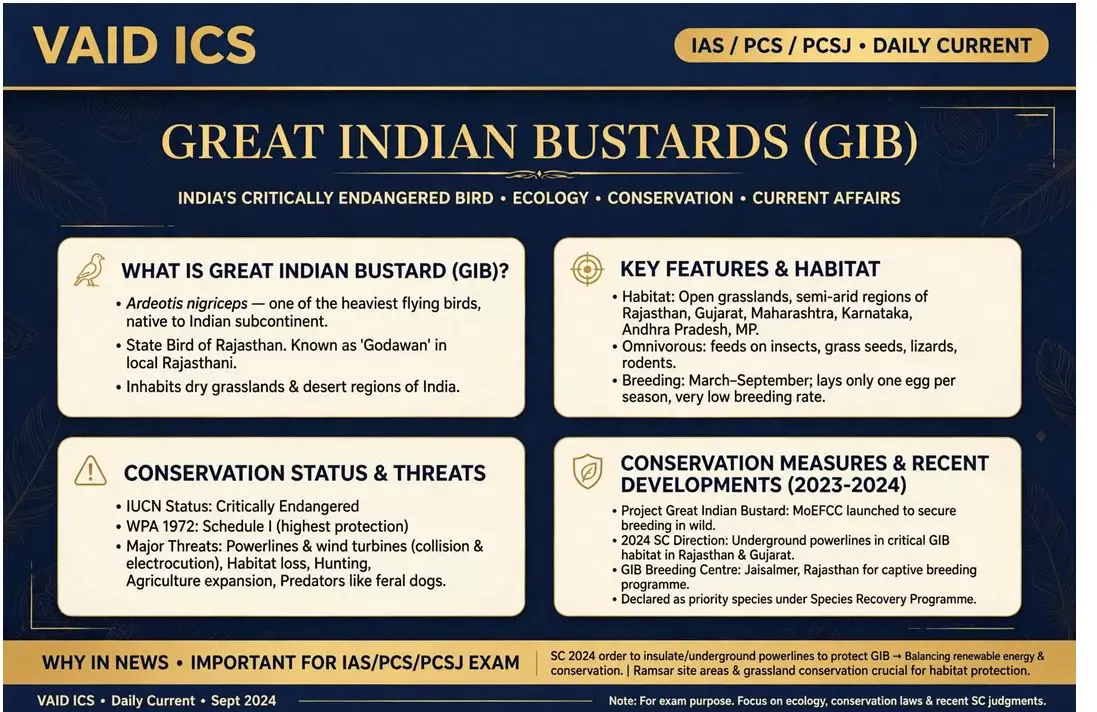
Project Great Indian Bustard:
-
The project was launched by the Government of India to prevent the extinction of the Great Indian Bustard and increase its wild population.
-
It focuses on captive breeding, habitat protection, scientific monitoring and reintroduction into natural habitats.
-
The programme is implemented with the support of the Wildlife Institute of India (WII) and state forest departments.
-
Captive breeding centres have been established at Sam and Ramdevra in Rajasthan.
-
These centres maintain captive-bred birds and protect their genetic diversity for future conservation.
Recent Reintroduction Initiative:
-
Four captive-bred male bustards were released into the wild at Desert National Park, Rajasthan.
-
The initiative was jointly carried out by the Wildlife Institute of India and the Forest Departments of Rajasthan and Gujarat.
-
Authorities have approved the phased release of up to 25 captive-bred bustards during 2026–27.
-
Up to 10 birds are planned for release in the initial phase.
-
However, the death of bird R3 due to fox predation within 12 days of release highlights the risks involved in reintroducing captive-bred birds into the wild.
Major Threats to the Great Indian Bustard:
Habitat Loss:
-
Conversion of grasslands into agricultural fields, industries and infrastructure projects reduces its natural habitat.
-
Degradation of open grasslands affects its feeding and breeding grounds.
Power Transmission Lines:
-
Overhead power lines are among the major threats to the species.
-
Due to its poor frontal vision and large body size, the bird may collide with power lines.
-
Such collisions can cause serious injuries and death.
Predation:
-
Eggs and chicks are vulnerable to predators such as foxes and other wild animals.
-
Foxes cause significant egg losses in the Thar landscape, reducing successful hatching.
-
Nearly 50% of eggs may be lost to predation, with hatching success falling to around 40% in affected areas.
Low Reproductive Rate:
-
The species has a very low reproductive rate.
-
Generally, a female lays only one egg per breeding attempt.
-
Therefore, even a small number of deaths can seriously affect population recovery.
Other Threats:
-
Human disturbance in breeding areas.
-
Expansion of roads and other infrastructure.
-
Decline and fragmentation of suitable grassland habitats.
Conservation Status and Legal Protection:
-
IUCN Red List: Critically Endangered (CR).
-
Wild Life (Protection) Act, 1972: Schedule I protection.
-
CITES: Appendix I.
-
Convention on Migratory Species (CMS): Appendix I.
Conservation Measures:
Captive Breeding:
-
Captive breeding helps increase the population under controlled conditions.
-
Eggs and chicks are protected from predators and other environmental threats.
-
It also helps maintain the genetic diversity of the species.
Habitat Protection:
-
Protection of grasslands and breeding areas is essential.
-
Special attention is given to the Thar Desert landscape, particularly in Rajasthan.
Power Line Management:
-
Identification of high-risk transmission lines.
-
Undergrounding of power lines in selected priority areas, wherever feasible.
-
Installation of bird diverters to make overhead wires more visible to birds.
Monitoring and Tracking:
-
GPS transmitters are used to monitor the movement of released birds.
-
Tracking helps identify their habitat preferences, movement patterns and possible threats.
-
However, delays in GPS data transmission and weak mobile networks in remote areas can affect timely monitoring and rescue operations.
Important Scientific and Technical Concepts:
Rewilding:
Rewilding means releasing captive-bred or relocated animals into their natural habitats so that they can survive, reproduce and gradually establish self-sustaining wild populations.
Ex-situ Conservation:
Conservation of species outside their natural habitats, such as in zoos, breeding centres and other controlled facilities.
In-situ Conservation:
Protection and conservation of species within their natural habitats, such as national parks and wildlife sanctuaries.
Telemetry Tracking:
A scientific method of monitoring animal movements and behaviour from a distance using electronic devices such as GPS transmitters and satellite communication systems.
Fission-Fusion Dynamics:
A social grouping behaviour in which animals periodically split into smaller groups and later combine to form larger groups.
Important Protected Area:
Desert National Park, Rajasthan
-
Located in Jaisalmer and Barmer districts of Rajasthan.
-
One of the most important habitats of the Great Indian Bustard.
-
Represents the arid ecosystem of the Thar Desert.
-
Established in 1980.
-
It is an important protected area for the conservation of desert wildlife.
Conclusion:
The Great Indian Bustard is an important indicator of the health of India’s grassland ecosystems. Captive breeding and reintroduction programmes offer hope for its survival. However, long-term conservation requires habitat protection, control of predation, power-line safety and continuous scientific monitoring to establish a viable wild population.

May 19, 2026
October 17, 2025
October 16, 2025
October 6, 2025

