June 1, 2026
Gist of daily Aticle/ The Hindu/Janjati Suraksha Manch (JSM)/What does “Delisted” mean?
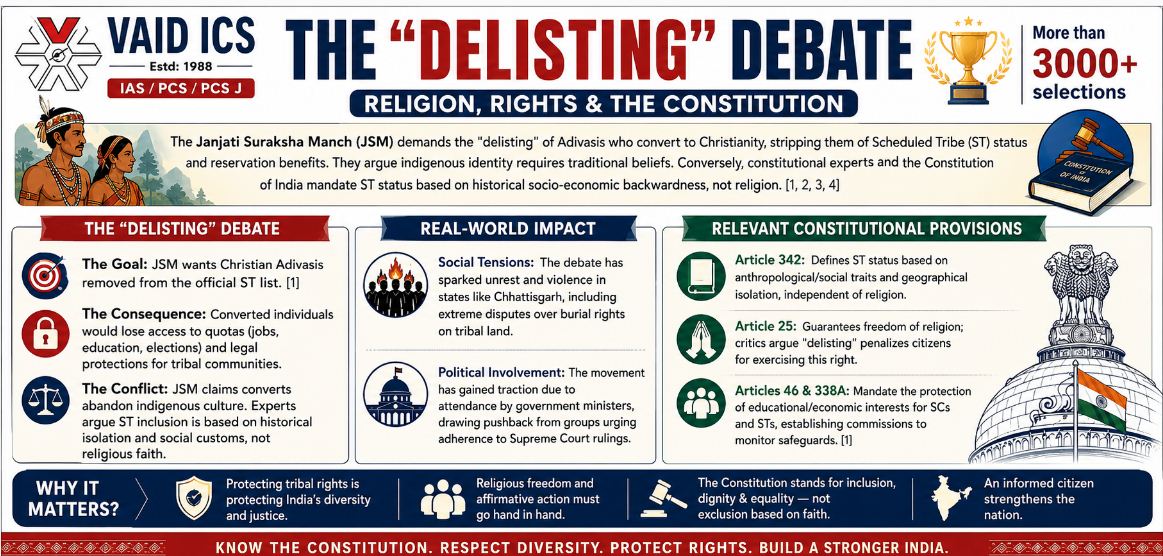
A group called the Janjati Suraksha Manch (JSM) is demanding that any Adivasi who has converted to Christianity should be “delisted.”
- What does “Delisted” mean? It means they want the government to remove these people from the official list of Scheduled Tribes.
- The Consequence: If they are removed from the list, they would no longer be eligible for government reservations (quotas in jobs, schools, and elections) or other legal protections reserved for tribal communities.
Why are they doing this?
The JSM argues that Adivasi identity is tied to their traditional, indigenous religious beliefs. They claim that if an Adivasi converts to Christianity, they have abandoned their culture and traditions, and therefore, they are no longer “truly” Adivasi.
What is the counter-argument?
Most legal and constitutional experts—and the Indian Constitution itself—take a different view:
- The Criteria: Being an “Adivasi” is not about what religion you pray to. It is about a community’s history of isolation, their specific social customs, and their economic backwardness.
- The Constitution: The law defines Scheduled Tribes based on their unique way of life and social status, not their religious faith. Therefore, changing one’s religion does not change one’s tribal roots or socio-economic situation.
Why is this a big deal?
It is not just a debate; it is leading to real-world conflict:
- Violence: In states like Chhattisgarh, there have been reports of groups pressuring or forcing Christian Adivasis to renounce their faith. There have even been extreme cases where they have tried to dig up the graves of converted Adivasis because they claim Christians cannot be buried on “tribal land.”
- Government Role: The reason this is making headlines is that top government ministers attended a meeting organized by the group pushing for this “delisting.” This makes it feel like the government is supporting this movement, even though the Supreme Court has previously told groups to stop these activities and respect the law.
Relevant Constitutional Provisions:
- Article 342 (Specification of Scheduled Tribes): * This article empowers the President of India to identify and list communities as “Scheduled Tribes” in a specific State or Union Territory.
The Rule: ST status is not based on religion. It is based on anthropological and social criteria like:
- Indications of primitive traits.
- Geographical isolation.
- Distinct culture and lifestyle.
- Shyness of contact with the wider community.
- General economic backwardness.
Key Point: Once a community is notified as an ST, they are entitled to Constitutional protections, regardless of the religion they practice.
Article 25 (Freedom of Religion):
- This article guarantees every citizen the right to freedom of conscience and the right to freely profess, practice, and propagate their religion.
- The Conflict: Critics argue that “delisting” penalizes individuals for exercising their fundamental right to choose their faith.
Article 46 (Directive Principles):
- This article mandates that the State must promote the educational and economic interests of Scheduled Castes and Scheduled Tribes with “special care” and protect them from social injustice and all forms of exploitation.
Article 338A (National Commission for Scheduled Tribes):
- This body is established to monitor the implementation of safeguards for STs and investigate complaints regarding the violation of their rights.
Summary:
- The Group’s Goal: “If you convert to Christianity, you lose your tribal status and your reservation benefits.”
- The Core Conflict: Is being a “tribe” about your ancestry and social history, or is it about your religious practices?
The Reality: This is causing serious tension and fighting within tribal villages, and it is putting pressure on the Indian legal system to decide if someone’s religious freedom (the right to choose a faith) should cost them their identity and government protections.

May 19, 2026
October 17, 2025
October 16, 2025
October 6, 2025

