August 17, 2026
Gist of Daily Articles: Daily Mains Qn/Model Answer/Mains Concise Note :The Hindu/Indian Express/17 AUGUST 2026
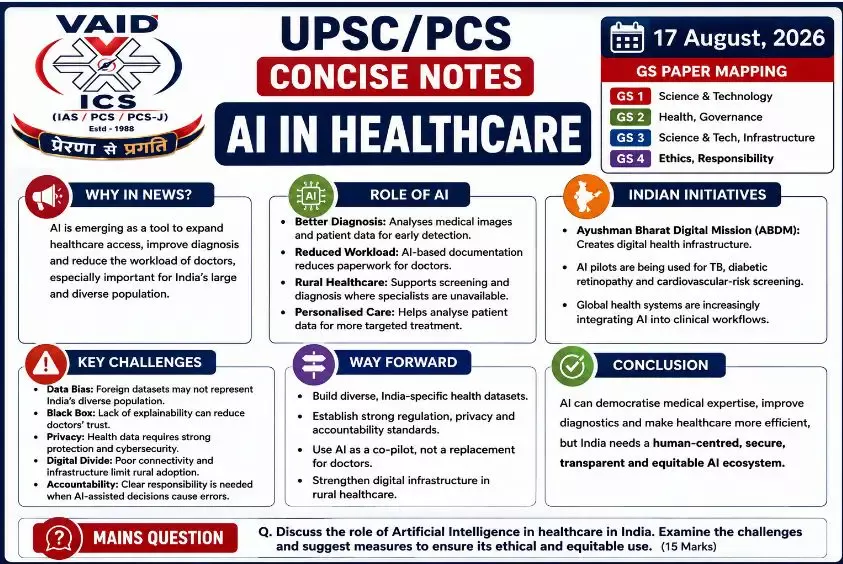
Why in News?
Modern medicine possesses vast clinical knowledge, but bridging the gap between this expertise and patients who need it immediately remains challenging due to the limited number of trained clinicians and healthcare infrastructure. For India, where healthcare capacity is expanding alongside an increasingly complex disease burden, leveraging Artificial Intelligence (AI) to scale medical expertise has become a critical national discussion.
Role of AI in Healthcare:
AI acts as a bridge to make accumulated medical knowledge available directly at the point of care, augmenting clinical workflows and expanding access.
-
Enhanced Diagnostics: AI algorithms analyze complex imaging and data rapidly, assisting clinicians in identifying conditions earlier and with greater precision.
-
Administrative Relief: Ambient AI scribing tools automatically document patient-doctor consultations, reducing paperwork and administrative burnout.
-
Democratizing Expertise: AI-driven diagnostic tools deployed in remote or rural clinics enable primary health workers to screen for specialized diseases without needing a resident specialist on-site.
Examples:
-
Global Regulatory Milestones: By January 2025, the U.S. Food and Drug Administration (FDA) authorized over 1,000 AI-enabled medical devices spanning radiology, cardiology, and other diagnostic fields.
-
Time Optimization in the U.K.: The UK National Health Service (NHS) issued guidance in April 2025 for AI-enabled ambient scribing, with programs showing that the technology can give doctors up to $25\%$ more time to focus directly on patient care.
Recent Steps Taken:
-
Global Adoption Frameworks: Major health systems in Western countries have moved from pilot projects to national programs integrating AI for documentation and workflow efficiency.
-
Indian Policy Initiatives: The Indian government and health bodies have introduced digital health frameworks (such as the Ayushman Bharat Digital Mission) that lay the foundational digital architecture necessary for deploying data-intensive AI solutions safely.
-
Diagnostic Pilots: Various public and private hospitals across India have begun testing AI-powered screening tools for tuberculosis, diabetic retinopathy, and cardiovascular risks in primary care settings.
Key Challenges:
-
Data Representation and Bias: Most AI models are trained on Western datasets, risking diagnostic inaccuracies when applied to diverse Indian genetic and socio-economic demographics.
-
Explainability and Trust: The “black box” nature of some AI algorithms makes it difficult for doctors to understand how a specific clinical recommendation was reached, creating hesitation.
-
Data Privacy and Security: Managing sensitive patient health records without robust data protection laws risks breaches and loss of public trust.
-
Infrastructure Deficits: Uneven internet connectivity and a lack of digital hardware in rural primary health centres hinder seamless deployment.
Way Forward:
-
Curate Diverse Indigenous Datasets: Build robust, localized health data repositories representing India’s demographic diversity to train accurate and unbiased AI models.
-
Establish Clear Regulatory Guardrails: Formulate transparent legal frameworks and accountability standards to govern medical AI errors, ensuring patient safety and data privacy.
-
Adopt an Augmented Intelligence Approach: Position AI as a supportive co-pilot for clinicians rather than a replacement, preserving essential human empathy and clinical judgment.
-
Invest in Digital Infrastructure: Upgrade primary healthcare centers with reliable connectivity and necessary computing tools to ensure equitable tech access across rural and urban areas.
Conclusion:
AI holds transformative potential to reshape healthcare delivery by democratizing medical expertise, improving diagnostic accuracy, and optimizing clinical time. However, its success in India depends on a balanced, regulated approach that prioritizes indigenous data security, clinical trust, and equitable access for every segment of society.
खबरे में क्यों?:
आधुनिक चिकित्सा के पास विशाल नैदानिक ज्ञान है, लेकिन इस विशेषज्ञता और इसे तुरंत चाहने वाले रोगियों के बीच की दूरी को पाटना अभी भी एक चुनौती बना हुआ है, क्योंकि प्रशिक्षित चिकित्सकों और स्वास्थ्य बुनियादी ढाँचे की संख्या सीमित है। भारत जैसे देश के लिए, जहाँ स्वास्थ्य सेवा की क्षमता जटिल होती बीमारियों के बीच विस्तारित हो रही है, चिकित्सा विशेषज्ञता को व्यापक स्तर पर पहुँचाने के लिए आर्टिफिशियल इंटेलिजेंस (AI) का उपयोग करना एक महत्वपूर्ण राष्ट्रीय चर्चा बन गया है।
स्वास्थ्य सेवा में एआई की भूमिका:
एआई एक ऐसे पुल के रूप में कार्य करता है जो संचित चिकित्सा ज्ञान को सीधे उपचार के समय (पॉइंट ऑफ केयर) उपलब्ध कराता है, नैदानिक वर्कफ़्लो को बेहतर बनाता है और स्वास्थ्य सेवाओं तक पहुँच का विस्तार करता है।
-
बेहतर निदान: एआई एल्गोरिदम जटिल इमेजिंग और डेटा का तेजी से विश्लेषण करते हैं, जिससे चिकित्सकों को अधिक सटीकता और कम समय में बीमारियों की पहचान करने में मदद मिलती है।
-
प्रशासनिक राहत: एआई-सक्षम ‘एम्बिएंट स्क्राइबिंग’ उपकरण रोगी और डॉक्टर के बीच की बातचीत को स्वचालित रूप से दर्ज करते हैं, जिससे कागजी काम और प्रशासनिक थकान कम होती है।
-
विशेषज्ञता का लोकतंत्रीकरण: दूरदराज या ग्रामीण क्लीनिकों में तैनात एआई-संचालित डायग्नोस्टिक उपकरण प्राथमिक स्वास्थ्य कार्यकर्ताओं को मौके पर किसी विशेषज्ञ डॉक्टर के बिना विशिष्ट बीमारियों की जाँच करने में सक्षम बनाते हैं।
उदाहरण:
-
वैश्विक नियामक मील के पत्थर: जनवरी 2025 तक, अमेरिकी खाद्य एवं औषधि प्रशासन (FDA) ने रेडियोलॉजी, कार्डियोलॉजी और अन्य निदान क्षेत्रों में 1,000 से अधिक एआई-सक्षम चिकित्सा उपकरणों को अधिकृत किया है।
-
यूके में समय का अनुकूलन: यूके नेशनल हेल्थ सर्विस (NHS) ने अप्रैल 2025 में एआई-सक्षम एम्बिएंट स्क्राइबिंग के लिए मार्गदर्शन जारी किया, जिसमें शुरुआती साक्ष्यों से पता चला कि यह तकनीक डॉक्टरों को सीधे रोगी की देखभाल पर ध्यान केंद्रित करने के लिए $25\%$ तक अधिक समय दे सकती है।
हाल ही में उठाए गए कदम:
-
वैश्विक अपनाव फ्रेमवर्क: पश्चिमी देशों की प्रमुख स्वास्थ्य प्रणालियों ने प्रलेखन (documentation) और वर्कफ़्लो दक्षता के लिए एआई को एकीकृत करते हुए पायलट प्रोजेक्ट्स से राष्ट्रीय कार्यक्रमों की ओर कदम बढ़ाया है।
-
भारतीय नीतिगत पहल: भारतीय स्वास्थ्य निकायों और सरकार ने डिजिटल स्वास्थ्य फ्रेमवर्क (जैसे आयुष्मान भारत डिजिटल मिशन) की शुरुआत की है, जो डेटा-गहन एआई समाधानों को सुरक्षित रूप से तैनात करने के लिए आवश्यक बुनियादी डिजिटल ढांचा तैयार करते हैं।
-
डायग्नोस्टिक पायलट: भारत भर के विभिन्न सार्वजनिक और निजी अस्पतालों ने प्राथमिक स्वास्थ्य देखभाल सेटिंग्स में तपेदिक (टीबी), डायबिटिक रेटिनोपैथी और हृदय संबंधी जोखिमों के लिए एआई-संचालित स्क्रीनिंग टूल का परीक्षण करना शुरू कर दिया है।
मुख्य चुनौतियाँ:
-
डेटा प्रतिनिधित्व और पूर्वाग्रह: अधिकांश एआई मॉडल पश्चिमी डेटासेट पर प्रशिक्षित होते हैं, जिससे विविध भारतीय आनुवंशिक और सामाजिक-आर्थिक जनसांख्यिकी पर लागू होने पर नैदानिक अशुद्धियों का जोखिम बढ़ जाता है।
-
व्याख्यात्मकता और विश्वास: कुछ एआई एल्गोरिदम की “ब्लैक बॉक्स” प्रकृति डॉक्टरों के लिए यह समझना मुश्किल बनाती है कि कोई विशेष नैदानिक सिफारिश किस प्रकार की गई, जिससे संकोच पैदा होता है।
-
डेटा गोपनीयता और सुरक्षा: मजबूत डेटा सुरक्षा कानूनों के बिना संवेदनशील रोगी स्वास्थ्य रिकॉर्ड का प्रबंधन करने से डेटा लीक होने और जन विश्वास कम होने का जोखिम रहता है।
-
बुनियादी ढाँचे की कमी: ग्रामीण प्राथमिक स्वास्थ्य केंद्रों में असमान इंटरनेट कनेक्टिविटी और डिजिटल हार्डवेयर की कमी सुचारू रूप से तकनीक को लागू करने में बाधा डालती है।
आगे की राह:
-
विविध स्वदेशी डेटासेट तैयार करना: सटीक और निष्पक्ष एआई मॉडल को प्रशिक्षित करने के लिए भारत की जनसांख्यिकीय विविधता का प्रतिनिधित्व करने वाले मजबूत, स्थानीयकृत स्वास्थ्य डेटा भंडार का निर्माण करना।
-
स्पष्ट नियामक सुरक्षा उपाय तैयार करना: चिकित्सा एआई त्रुटियों को विनियमित करने, रोगी सुरक्षा और डेटा गोपनीयता सुनिश्चित करने के लिए पारदर्शी कानूनी फ्रेमवर्क और जवाबदेही मानक तैयार करना।
-
संवर्धित बुद्धिमत्ता दृष्टिकोण अपनाना: एआई को चिकित्सकों के विकल्प के रूप में नहीं, बल्कि एक सहायक सह-पायलट के रूप में स्थापित करना ताकि आवश्यक मानवीय संवेदना और नैदानिक निर्णय सुरक्षित रहें।
-
डिजिटल बुनियादी ढांचे में निवेश: ग्रामीण और शहरी क्षेत्रों में तकनीकी की समान पहुँच सुनिश्चित करने के लिए विश्वसनीय कनेक्टिविटी और आवश्यक कंप्यूटिंग टूल के साथ प्राथमिक स्वास्थ्य केंद्रों का उन्नयन करना।
निष्कर्ष:
एआई में चिकित्सा विशेषज्ञता का लोकतंत्रीकरण करके, नैदानिक सटीकता में सुधार करके और नैदानिक समय का अनुकूलन करके स्वास्थ्य सेवा वितरण को बदलने की अपार क्षमता है। हालांकि, भारत में इसकी सफलता एक संतुलित, विनियमित दृष्टिकोण पर निर्भर करती है जो स्वदेशी डेटा सुरक्षा, नैदानिक विश्वास और समाज के हर वर्ग के लिए समान पहुँच को प्राथमिकता देता है।

May 19, 2026
October 17, 2025
October 16, 2025
October 6, 2025

