July 21, 2026
Gist of Daily Articles: 21 July 2026/ Daily Mains Qn/Model Answer/Mains Concise Note The Hindu/Indian Express
Right to Protest, Legal Restrictions & Constitutional Framework
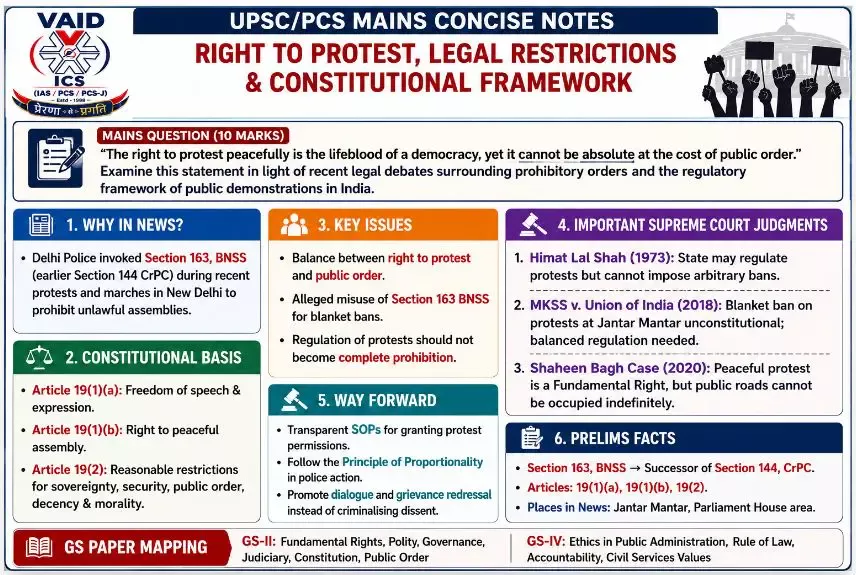
Why in News?
- Recent protests and the “Chalo Sansad” march organized by the Cockroach Janata Party (CJP) near Parliament House and Jantar Mantar in New Delhi triggered heavy security clampdowns and intense public debate.
- The Delhi Police invoked Section 163 of the Bharatiya Nagarik Suraksha Sanhita (BNSS)—the successor to Section 144 of the erstwhile CrPC—to prohibit unlawful assemblies and public marches without prior permission.
Articles in Focus:
- Article 19(1)(a) guarantees freedom of speech and expression, while Article 19(1)(b) protects the right to assemble peacefully and without arms.
- However, Article 19(2) empowers the state to impose reasonable restrictions on these freedoms in the interest of the sovereignty and integrity of India, the security of the State, public order, decency, or morality.
Key Issues Involved:
- The primary challenge lies in balancing civil liberties vs. public order, reflecting the constant tension between a citizen’s democratic right to voice dissent and the state’s mandate to maintain public tranquility.
- Other major concerns include the misuse of preventative measures through over-reliance on blanket prohibitory orders and the thin line of regulation vs. prohibition, where authorities often use prior-permission rules to enact absolute bans rather than framing accommodating guidelines.
Constitutional Provisions & Court Interpretations:
- The Supreme Court has consistently held that the right to protest is vital to democracy, but it is not an absolute right and can be regulated.
- In Himat Lal K. Shah v. Commissioner of Police (1973), the Court ruled that the state can regulate public meetings but cannot impose unreasonable bans. Later, in Mazdoor Kisan Shakti Sangathan v. Union of India (2018), it struck down blanket prohibitions at Jantar Mantar, while the Shaheen Bagh Case (2019/2020) reaffirmed that public spaces cannot be occupied indefinitely to the detriment of daily commuters.
Recent Example:
- The invocation of Section 163 BNSS during recent political demonstrations and civil society marches in New Delhi highlights ongoing legal contestations over prior-permission mandates, internet shutdowns, and the administrative policing of public dissent.
Way Forward:
- Law enforcement agencies must establish transparent Standard Operating Procedures (SOPs) rather than resorting to arbitrary denials of protest permissions. Actions must strictly adhere to the proportionality principle to minimize physical disruption, while the state must prioritize constructive dialogue over criminalizing civil expressions of discontent.
Model Mains Question for Practice:
“The right to protest peacefully is the lifeblood of a democracy, yet it cannot be absolute at the cost of public order.” Examine this statement in light of recent legal debates surrounding prohibitory orders and the regulatory framework of public demonstrations in India. (150 words / 10 marks).
विरोध प्रदर्शन का अधिकार, कानूनी प्रतिबंध और संवैधानिक ढांचा
सुर्खियों में क्यों:
हाल ही में नई दिल्ली में संसद भवन और जंतर-मंतर के पास ‘कॉकローチ जनता पार्टी’ (CJP) द्वारा आयोजित “चलो संसद” मार्च और संबंधित विरोध प्रदर्शनों के कारण भारी सुरक्षा घेराबंदी और तीव्र सार्वजनिक बहस छिड़ गई। दिल्ली पुलिस ने बिना पूर्व अनुमति के गैरकानूनी सभाओं और सार्वजनिक मार्च पर रोक लगाने के लिए पूर्ववर्ती CrPC की धारा 144 के उत्तराधिकारी के रूप में भारतीय नागरिक सुरक्षा संहिता (BNSS) की धारा 163 लागू कर दी।
चर्चा में आए अनुच्छेद (संवैधानिक आधार):
अनुच्छेद 19(1)(a) भाषण और अभिव्यक्ति की स्वतंत्रता की गारंटी देता है, जबकि अनुच्छेद 19(1)(b) शांतिपूर्वक और बिना हथियारों के एकत्र होने के अधिकार की रक्षा करता है। हालाँकि, अनुच्छेद 19(2) भारत की संप्रभुता और अखंडता, राज्य की सुरक्षा, सार्वजनिक व्यवस्था, शिष्टाचार या नैतिकता के हित में इन स्वतंत्रताओं पर उचित प्रतिबंध (reasonable restrictions) लगाने का अधिकार देता है।
शामिल प्रमुख मुद्दे:
मुख्य चुनौती नागरिक स्वतंत्रता बनाम सार्वजनिक व्यवस्था के बीच संतुलन बनाने की है, जो नागरिक के असहमति व्यक्त करने के लोकतांत्रिक अधिकार और सार्वजनिक शांति बनाए रखने के राज्य के दायित्व के बीच निरंतर तनाव को दर्शाती है। अन्य प्रमुख चिंताओं में व्यापक प्रतिबंधात्मक आदेशों के अत्यधिक उपयोग के माध्यम से निवारक उपायों का दुरुपयोग और विनियमन बनाम प्रतिबंध की बारीक रेखा शामिल है, जहाँ अधिकारी accommodating दिशानिर्देश तैयार करने के बजाय पूर्ण प्रतिबंध लगाने के लिए पूर्व-अनुमति नियमों का उपयोग करते हैं।
संवैधानिक प्रावधान और न्यायालय की व्याख्या:
सर्वोच्च न्यायालय ने लगातार यह माना है कि विरोध करने का अधिकार लोकतंत्र के लिए महत्वपूर्ण है, लेकिन यह पूर्ण अधिकार नहीं है और इसे विनियमित किया जा सकता है। हिम्मत लाल के. शाह बनाम पुलिस आयुक्त (1973) के मामले में, अदालत ने फैसला सुनाया कि राज्य सार्वजनिक बैठकों को विनियमित कर सकता है लेकिन अनुचित प्रतिबंध नहीं लगा सकता। बाद में, मजदूर किसान शक्ति संगठन बनाम भारत संघ (2018) में, इसने जंतर-मंतर पर पूर्ण प्रतिबंधों को रद्द कर दिया, जबकि शाहीन बाग मामले (2019/2020) ने पुनपुष्टि की कि दैनिक यात्रियों के अधिकारों की कीमत पर सार्वजनिक स्थानों पर अनिश्चित काल तक कब्जा नहीं किया जा सकता है।
हालिया उदाहरण:
नई दिल्ली में हालिया राजनीतिक प्रदर्शनों और नागरिक समाज के मार्च के दौरान BNSS की धारा 163 को लागू किया जाना पूर्व-अनुमति आदेशों, इंटरनेट शटडाउन और सार्वजनिक असहमति की प्रशासनिक पुलिसिंग पर जारी कानूनी विवादों को उजागर करता है।
आगे की राह:
कानून प्रवर्तन एजेंसियों को विरोध प्रदर्शन की अनुमति से मनमाने ढंग से इनकार करने का सहारा लेने के बजाय पारदर्शी मानक संचालन प्रक्रियाएं (SOPs) स्थापित करनी चाहिए। कार्रवाई को शारीरिक व्यवधान को कम करने के लिए आनुपातिकता के सिद्धांत (proportionality principle) का कड़ाई से पालन करना चाहिए, जबकि राज्य को नागरिक असंतोष की अभिव्यक्ति को आपराधिक बनाने के बजाय रचनात्मक संवाद को प्राथमिकता देनी चाहिए।
अभ्यास के लिए मॉडल मुख्य परीक्षा प्रश्न:
“शांतिपूर्वक विरोध करने का अधिकार लोकतंत्र का जीवन रक्त है, फिर भी यह सार्वजनिक व्यवस्था की कीमत पर पूर्ण नहीं हो सकता है।” भारत में सार्वजनिक प्रदर्शनों के नियामक ढांचे और प्रतिबंधात्मक आदेशों के आसपास की हालिया कानूनी बहसों के आलोक में इस कथन का परीक्षण कीजिए। (150 शब्द / 10 अंक)

May 19, 2026
October 17, 2025
October 16, 2025
October 6, 2025

