May 28, 2026
Gist of Daily Article/UPSC MAINS CURRENT QN : 28 MAY 2026
Why in News ? The Supreme Court Collegium, headed by Chief Justice of India Surya Kant, in consecutive meetings held on May 22 and May 27, 2026, recommended the appointment of four High Court Chief Justices and one woman senior advocate as judges of the Supreme Court.
Key Points:
- Total Appointments: The Collegium has recommended a total of five new judges to the apex court.
- Emphasis on Diversity: The proposal includes senior advocate V. Mohana, a practicing lawyer in the Supreme Court.
- Significance: Mohana was a leading counsel in landmark cases highlighting structural career inequalities for women officers in the Indian Armed Forces, signaling a push for greater representation of women from the Bar to the Bench.
What is the Collegium System:
- Origin: It is a system of appointment and transfer of judges that has evolved through Supreme Court judgments (the ‘Three Judges Cases’), rather than by an Act of Parliament or a specific provision in the Constitution.
- Composition: The Supreme Court Collegium is headed by the CJI and comprises four other senior-most judges of the Court.
Constitutional Provisions:
- Article 124(2): States that judges of the Supreme Court are appointed by the President after consultation with such judges of the Supreme Court and of the High Courts as the President deems necessary.
- Article 217: Deals with the appointment of High Court judges.
Evolution of the System (Three Judges Cases):
- First Judges Case (1981): Ruled that the “primacy” of the CJI’s recommendation on appointments could be refused for “cogent reasons.”
- Second Judges Case (1993): Introduced the Collegium system, establishing that “consultation” actually meant “concurrence” of the judiciary.
- Third Judges Case (1998): Expanded the Collegium to a five-member body (CJI + 4 senior-most judges) for Supreme Court appointments.
Key Issues:
- Lack of Transparency: The deliberative process behind selections remains largely opaque to the public.
- Accountability: The system is essentially self-appointing, leading to debates regarding institutional checks and balances.
- Vacancy Delays: Significant time lags often occur between recommendations and final executive approval.
Committees/Commissions on Judicial Appointments:
- Law Commission of India (121st Report, 1987): Recommended the establishment of a National Judicial Appointments Commission (NJAC) to make the appointment process more participatory.
- Venkatachaliah Commission (2002): Suggested a five-member NJAC comprising the CJI, two senior judges, the Law Minister, and a nominee of the Prime Minister/Leader of Opposition to balance judicial independence with executive accountability.
- Justice M.N. Venkatachaliah Committee (2003): Further reinforced the need for an independent commission to handle appointments instead of the current system.
Way Forward:
- Transparency: Establishing a formal, objective, and transparent mechanism for evaluating candidates.
- Diversity: Sustaining the effort to increase representation of women, and marginalized sections of society to ensure the judiciary reflects the diversity of the nation.
- Timely Processing: Adherence to a fixed timeline for the government to process recommendations to prevent judicial vacancies from impacting court efficiency.
Conclusion:
While the Collegium system is a safeguard for judicial independence, there is a persistent need for reforms that harmonize judicial supremacy in appointments with the requirements of transparency and public accountability to strengthen the credibility of the Indian judiciary.
सुप्रीम कोर्ट कॉलेजियम सिफारिशें:
सुर्खियों में क्यों:
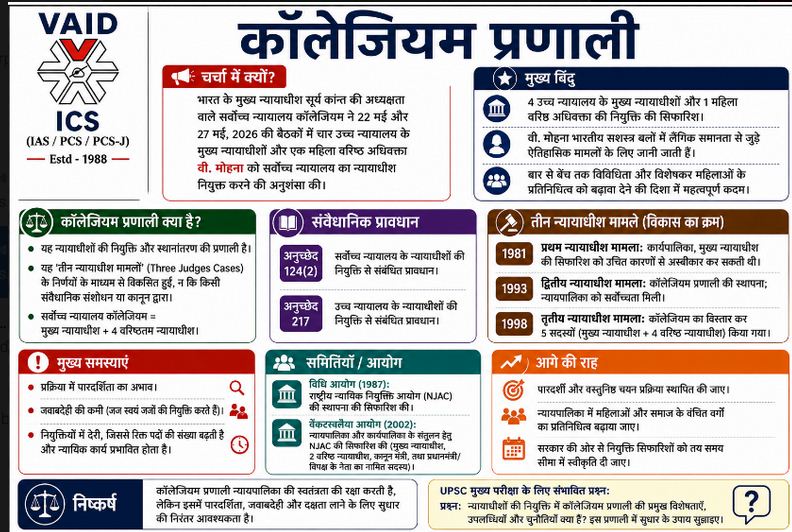
भारत के मुख्य न्यायाधीश सूर्य कांत की अध्यक्षता में सुप्रीम कोर्ट कॉलेजियम ने 22 मई और 27 मई, 2026 को आयोजित बैठकों में चार उच्च न्यायालयों के मुख्य न्यायाधीशों और एक महिला वरिष्ठ अधिवक्ता को सुप्रीम कोर्ट के न्यायाधीश के रूप में नियुक्त करने की सिफारिश की है।
मुख्य बिंदु:
-
कुल नियुक्तियाँ: कॉलेजियम ने सर्वोच्च न्यायालय के लिए कुल पाँच नए न्यायाधीशों की सिफारिश की है।
-
विविधता पर जोर: इस प्रस्ताव में वरिष्ठ अधिवक्ता वी. मोहना का नाम शामिल है, जो सुप्रीम कोर्ट में प्रैक्टिस करने वाली वकील हैं।
-
महत्व: सुश्री मोहना भारतीय सशस्त्र बलों में महिला अधिकारियों के लिए संरचनात्मक करियर असमानताओं को उजागर करने वाले ऐतिहासिक मामलों में अग्रणी वकील रही हैं। यह ‘बार’ से ‘बेंच’ तक महिलाओं के अधिक प्रतिनिधित्व के प्रयास को दर्शाता है।
कॉलेजियम प्रणाली क्या है:
-
उत्पत्ति: यह न्यायाधीशों की नियुक्ति और स्थानांतरण की एक प्रणाली है जो सुप्रीम कोर्ट के निर्णयों (‘थ्री जजेस केसेस’) के माध्यम से विकसित हुई है, न कि संसद के किसी अधिनियम या संविधान के किसी विशिष्ट प्रावधान द्वारा।
-
संरचना: सुप्रीम कोर्ट कॉलेजियम की अध्यक्षता सीजेआई (CJI) करते हैं और इसमें कोर्ट के चार अन्य सबसे वरिष्ठ न्यायाधीश शामिल होते हैं।
संवैधानिक प्रावधान:
-
अनुच्छेद 124(2): कहता है कि सुप्रीम कोर्ट के न्यायाधीशों की नियुक्ति राष्ट्रपति द्वारा की जाती है, जो सुप्रीम कोर्ट और उच्च न्यायालयों के उन न्यायाधीशों से परामर्श करते हैं जिन्हें राष्ट्रपति आवश्यक समझते हैं।
-
अनुच्छेद 217: उच्च न्यायालय के न्यायाधीशों की नियुक्ति से संबंधित है।
प्रणाली का विकास (थ्री जजेस केस):
-
प्रथम न्यायाधीश केस (1981): निर्णय दिया कि न्यायिक नियुक्तियों पर सीजेआई की सिफारिश की “प्रधानता” को “ठोस कारणों” के लिए अस्वीकार किया जा सकता है।
-
द्वितीय न्यायाधीश केस (1993): कॉलेजियम प्रणाली की शुरुआत की, यह स्थापित करते हुए कि “परामर्श” का अर्थ वास्तव में न्यायपालिका की “सहमति” है।
-
तृतीय न्यायाधीश केस (1998): सुप्रीम कोर्ट की नियुक्तियों के लिए कॉलेजियम को पाँच सदस्यीय निकाय (CJI + 4 वरिष्ठतम न्यायाधीश) के रूप में विस्तारित किया।
प्रमुख मुद्दे:
-
पारदर्शिता का अभाव: चयन के पीछे की विचार-विमर्श प्रक्रिया जनता के लिए काफी हद तक अपारदर्शी बनी हुई है।
-
जवाबदेही: यह प्रणाली अनिवार्य रूप से स्वयं-नियुक्ति (self-appointing) है, जिससे संस्थागत नियंत्रण और संतुलन को लेकर बहस होती है।
-
नियुक्ति में देरी: सिफारिशों और अंतिम कार्यकारी अनुमोदन के बीच अक्सर काफी समय लग जाता है।
न्यायिक नियुक्तियों पर समितियाँ/आयोग:
-
भारत का विधि आयोग (121वीं रिपोर्ट, 1987): नियुक्ति प्रक्रिया को अधिक सहभागी बनाने के लिए राष्ट्रीय न्यायिक नियुक्ति आयोग (NJAC) की स्थापना की सिफारिश की।
-
वेंकटचलैया आयोग (2002): न्यायिक स्वतंत्रता और कार्यकारी जवाबदेही को संतुलित करने के लिए सीजेआई, दो वरिष्ठ न्यायाधीशों, कानून मंत्री और प्रधानमंत्री/विपक्ष के नेता के नामित व्यक्ति को शामिल करते हुए पांच सदस्यीय NJAC का सुझाव दिया।
-
न्यायमूर्ति एम.एन. वेंकटचलैया समिति (2003): वर्तमान प्रणाली के स्थान पर नियुक्तियों को संभालने के लिए एक स्वतंत्र आयोग की आवश्यकता पर बल दिया।
आगे की राह:
-
पारदर्शिता: उम्मीदवारों के मूल्यांकन के लिए एक औपचारिक, वस्तुनिष्ठ और पारदर्शी तंत्र स्थापित करना।
-
विविधता: महिलाओं और समाज के हाशिए पर मौजूद वर्गों का प्रतिनिधित्व बढ़ाने के प्रयासों को जारी रखना।
-
समयबद्ध प्रक्रिया: न्यायिक रिक्तियों को न्यायालय की दक्षता को प्रभावित करने से रोकने के लिए सरकार द्वारा सिफारिशों को संसाधित करने के लिए एक निश्चित समयरेखा का पालन करना।
निष्कर्ष:
हालाँकि कॉलेजियम प्रणाली न्यायिक स्वतंत्रता का एक सुरक्षा कवच है, लेकिन भारतीय न्यायपालिका की विश्वसनीयता को मजबूत करने के लिए नियुक्तियों में न्यायिक सर्वोच्चता और पारदर्शिता व सार्वजनिक जवाबदेही की आवश्यकताओं के बीच तालमेल बिठाने वाले सुधारों की निरंतर आवश्यकता है।

May 19, 2026
October 17, 2025
October 16, 2025
October 6, 2025

