May 27, 2026
Gist of daily Article/the Hindu/ Daily UPSC Mains Current Qn:27 May 2026
Why is this in the news?
The claim by seven AAP Rajya Sabha MPs that they are merging with the Bharatiya Janata Party (BJP) under the “merger” provision of the 10th Schedule represents a significant challenge to the party structure. By invoking this clause, these MPs seek to avoid disqualification. The situation is legally complex because it involves the national-level Rajya Sabha, raising questions about whether numerical support in the legislature is sufficient to claim a merger without the formal consent of the original political party’s organizational leadership.
Key Points of the Anti-Defection Law:
- Origin: Introduced by the 52nd Amendment Act (1985), which added the 10th Schedule to the Constitution to curb the “Aaya Ram, Gaya Ram” culture of frequent floor-crossing.
- Objective: To ensure political stability, maintain the integrity of the electoral mandate, and prevent legislators from switching parties for personal gain or political office.
- Grounds for Disqualification:
-
- Voluntary Resignation: A member formally resigns from their party.
- Defying the Whip: A member votes or abstains from voting contrary to party instructions without prior permission.
- Independent Members: Joining a political party after being elected as an independent.
- Nominated Members: Joining a political party after six months of being nominated.
- The “Merger” Exception: Under Paragraph 4 of the 10th Schedule, a member is not disqualified if their party merges with another party, provided that at least two-thirds of the members of the legislature party agree to the merger.
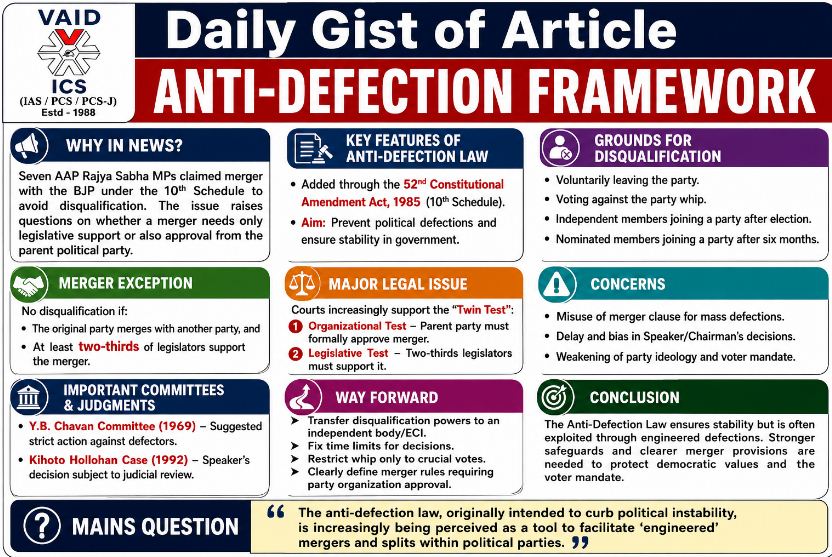
Key Provisions & Legal Issues:
The core controversy often hinges on the interpretation of the Merger Exception.
- The “Twin Test” of Merger: Legal experts and recent judicial trends (such as the Subhash Desai case) suggest that a valid merger requires:
- Organizational Test: The parent party (the organizational wing outside the legislature) must formally agree to merge.
- Legislative Test: At least two-thirds of the legislators must support the merger.
- The Loophole: Political factions often claim a “merger” based solely on the numerical strength (two-thirds) within the legislature, bypassing the need for an organizational-level merger. This effectively treats the party as a collection of individuals rather than a cohesive political organization.
- Role of the Speaker/Chairman: The Presiding Officer (Speaker in Lok Sabha/Assembly, Chairman in Rajya Sabha) has the authority to decide disqualification. Critics argue this process is often marred by:
-
- Perceived Bias: The Presiding Officer may be influenced by party loyalties.
- Procedural Delays: Delays in deciding petitions allow defecting factions to exert influence or consolidate power.
- Lack of Impartiality: The Speaker’s role as both a party member and a quasi-judicial authority is inherently prone to conflict.
Relevant Committees and Commissions:
Various bodies have examined the challenges of this law over the decades:
- Committee on Defections (1969): Chaired by Y.B. Chavan, this committee was established to address the crisis of floor-crossing in the 1960s. It recommended that defectors should be barred from holding ministerial positions or remunerative political posts until re-elected.
- Various Law Commission Reports: Multiple reports have underscored the need for clarity in the Speaker’s role and the definition of “voluntary giving up of membership.”
- Supreme Court Rulings (e.g., Kihoto Hollohan v. Zachillhu, 1992): The Court affirmed the law’s validity but emphasized that the Speaker’s decision is subject to judicial review, effectively removing the “finality” of the Speaker’s order from being immune to court scrutiny.
Way Forward:
Reforming the Anti-Defection Law to uphold democratic values while maintaining stability requires addressing several structural gaps:
- Transferring Authority: Consider moving the power to decide disqualification from the Speaker to an independent tribunal or the Election Commission of India to ensure impartiality.
- Time-Bound Decisions: Establishing a strictly defined, reasonable time limit for the Presiding Officer to dispose of defection petitions.
- Narrowing the Definition of “Whip”: Limiting the application of the whip only to crucial votes—such as no-confidence motions or budget votes—to allow legislators more freedom to express their conscience on routine policy matters.
- Clarifying the Merger Clause: Explicitly legislating that a “merger” under the 10th Schedule requires the concurrence of the parent political organization, not just a numerical majority of legislators.
Conclusion:
The Anti-Defection Law was intended to bring stability to Indian politics; however, its evolution has shown that it is frequently exploited, turning it into a tool for mass, engineered party shifts. Addressing the constitutional ambiguity surrounding the “merger” provision and reforming the adjudication process is essential to ensure the law reflects the will of the voters rather than just the tactical maneuvers of political parties.
Mains Practice Question
Question: “The anti-defection law, originally intended to curb political instability, is increasingly being perceived as a tool to facilitate ‘engineered’ mergers and splits within political parties.” In light of recent events, critically analyze the ‘merger’ exception under the 10th Schedule of the Constitution and suggest reforms necessary to uphold the sanctity of the electoral mandate. (250 words, 15 Marks)
यह चर्चा में क्यों है?
आम आदमी पार्टी (AAP) के 10 राज्यसभा सांसदों में से सात का यह दावा कि वे भारतीय जनता पार्टी (BJP) के साथ विलय कर रहे हैं, संवैधानिक और राजनीतिक रूप से अत्यंत गंभीर है। इन्होंने संविधान की 10वीं अनुसूची के ‘विलय’ (Merger) प्रावधान का हवाला दिया है। यह मामला इसलिए विशेष है क्योंकि यह राज्य विधानसभाओं से आगे बढ़कर अब राष्ट्रीय स्तर (राज्यसभा) तक पहुँच गया है, जिससे दलबदल विरोधी कानून की प्रभावशीलता पर गंभीर सवाल खड़े हो गए हैं।
दलबदल विरोधी कानून के मुख्य बिंदु:
-
पृष्ठभूमि: इसे 1985 के 52वें संविधान संशोधन के माध्यम से लाया गया था। इसका मुख्य उद्देश्य ‘आया राम-गया राम’ की राजनीति को समाप्त करना और राजनीतिक स्थिरता सुनिश्चित करना था।
-
अयोग्यता के आधार:
-
यदि कोई सदस्य स्वेच्छा से अपनी पार्टी की सदस्यता छोड़ देता है।
-
यदि कोई सदस्य सदन में अपनी पार्टी के ‘व्हिप’ (Whip) के विपरीत मतदान करता है या मतदान से अनुपस्थित रहता है।
-
निर्दलीय सदस्य द्वारा चुनाव के बाद किसी पार्टी में शामिल होना।
-
नामित सदस्य (Nominated member) द्वारा शपथ ग्रहण के छह महीने बाद किसी पार्टी में शामिल होना।
-
-
‘विलय’ का अपवाद (पैराग्राफ 4): दलबदल विरोधी कानून के तहत, यदि किसी दल का किसी अन्य दल में विलय हो जाता है, तो दलबदल के आधार पर अयोग्यता लागू नहीं होती, बशर्ते उस दल के कम से कम दो-तिहाई (2/3) सदस्य इस विलय के लिए सहमत हों।
मुख्य कानूनी मुद्दे और विवाद:
वर्तमान विवाद इस बात पर केंद्रित है कि ‘विलय’ की व्याख्या क्या होनी चाहिए:
-
विलय का दोहरा परीक्षण (Twin Test): कानूनी विशेषज्ञों का मानना है कि केवल विधायी दल (Legislators) की संख्या पर्याप्त नहीं है। एक वैध विलय के लिए यह भी आवश्यक है कि पार्टी के संगठनात्मक ढांचे (Organizational wing) की भी सहमति हो।
-
कानून का दुरुपयोग: अक्सर राजनीतिक गुट केवल विधायी संख्या (दो-तिहाई) का सहारा लेकर पार्टी के विभाजन को ‘विलय’ का नाम दे देते हैं, जबकि पार्टी का संगठनात्मक नेतृत्व इसके विरुद्ध होता है।
-
पीठासीन अधिकारी की भूमिका: लोकसभा अध्यक्ष या राज्यसभा के सभापति का निर्णय अंतिम माना जाता है, लेकिन अक्सर उन पर पक्षपात का आरोप लगता है। न्यायिक समीक्षा (Judicial Review) के बावजूद, निर्णय लेने में होने वाली देरी दलबदल करने वाले गुटों को अनुचित लाभ पहुँचाती है।
संबंधित समितियां और आयोग:
-
दलबदल पर समिति (1969): वाई.बी. चव्हाण की अध्यक्षता वाली इस समिति ने सिफारिश की थी कि दलबदल करने वाले सदस्यों को मंत्री या कोई अन्य लाभकारी पद तब तक नहीं मिलना चाहिए जब तक वे दोबारा चुनाव न जीत लें।
-
किहोतो होलोहन बनाम ज़ाचिल्हू (1992) मामला: सुप्रीम कोर्ट ने कानून को संवैधानिक रूप से वैध माना, लेकिन यह स्पष्ट किया कि पीठासीन अधिकारी का निर्णय न्यायिक समीक्षा के दायरे में है।
आगे की राह (Way Forward):
-
स्वतंत्र न्यायाधिकरण (Independent Tribunal): अयोग्यता संबंधी मामलों पर निर्णय लेने का अधिकार स्पीकर के बजाय एक स्वतंत्र निकाय या चुनाव आयोग को सौंपा जाना चाहिए।
-
समयबद्ध निर्णय: दलबदल की याचिकाओं पर एक निश्चित समय-सीमा (जैसे 3 या 6 महीने) के भीतर फैसला करना अनिवार्य होना चाहिए।
-
विलय की स्पष्ट परिभाषा: कानून में यह स्पष्ट किया जाना चाहिए कि ‘विलय’ का अर्थ केवल विधायी संख्या नहीं, बल्कि राजनीतिक दल का संगठनात्मक विलय भी है।
-
व्हिप की सीमा: व्हिप के दायरे को केवल महत्वपूर्ण सरकारी विधेयकों (जैसे अविश्वास प्रस्ताव) तक सीमित किया जाना चाहिए, ताकि सांसदों को नीतिगत मामलों में स्वतंत्र अभिव्यक्ति मिल सके।
निष्कर्ष:
दलबदल विरोधी कानून का मूल उद्देश्य राजनीतिक स्थिरता बनाए रखना था, न कि इसे राजनीतिक हथकंडे के रूप में इस्तेमाल करना। वर्तमान स्थिति यह दर्शाती है कि कानून में मौजूद अस्पष्टताएं लोकतंत्र की नींव को कमजोर कर रही हैं। यदि संवैधानिक गरिमा और जनादेश का सम्मान करना है, तो इस कानून में तत्काल सुधार और स्पष्टता की आवश्यकता है ताकि ‘विलय’ के नाम पर जनता के फैसले को पलटने की कवायद पर लगाम लगाई जा सके।

May 19, 2026
October 17, 2025
October 16, 2025
October 6, 2025

