May 23, 2026
Gist of Article/The Hindu-23 May 2026/Sustainable Marine Fishing
Marine fisheries form the bedrock of the coastal economy, food security, and livelihoods in India. India is the world’s 3rd largest fish producer, accounting for roughly 8% of global production.
Recent Context: The Odisha government has approved a proposal to enact the Odisha Marine Fishing Regulation Bill, 2026. This legislation aims to establish a robust, modern, and inclusive legal framework for the marine fisheries sector, replacing a 44-year-old outdated law (the 1982 Act). It serves as a benchmark for balancing environmental conservation with economic growth under India’s “Blue Economy” framework.
Key Demographic and Statistical Facts:
-
Coastline: India possesses a vast coastline of 7,516 km, out of which Odisha alone shares a coastline of more than 500 km.
-
Size of Community: Odisha is home to nearly 15 lakh fishermen, ranking 8th among Indian states in terms of the size of its fishing communities.
-
Export Target: India aims to aggressively scale its seafood export market. Backed by the new Bill, Odisha aims to scale its seafood exports to ₹25,000 crore by 2036 from the current estimate of ₹5,000 crore per year.
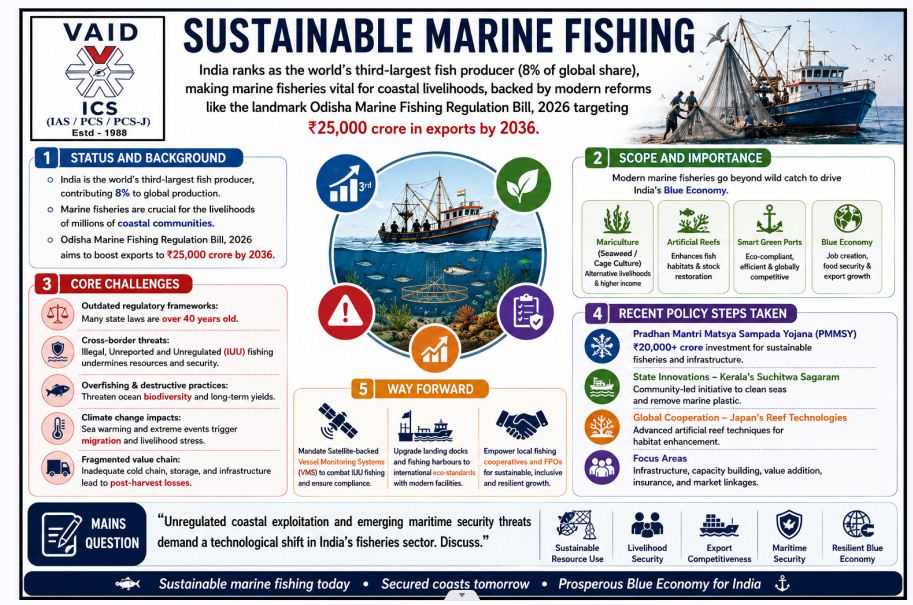
Scope and Importance:
Sustainable marine fishing extends far beyond the traditional catching of fish. Its modern scope encompasses:
-
Promoting the Blue Economy: An economic model that drives sustainable use of ocean resources for economic growth, improved livelihoods, and jobs while preserving the health of the marine ecosystem.
-
Mariculture Promotion: Scaling up economically viable ventures such as marine cage culture and seaweed cultivation, which provide alternative livelihoods and reduce pressure on wild fish stocks.
-
Rejuvenation of Territorial Waters: Deployment of artificial reefs to rebuild depleted marine habitats and boost local biodiversity.
-
Smart & Green Infrastructure: Modernizing and managing fishing harbors and landing centers using green integrated technologies to reduce post-harvest losses.
-
Global Market Expansion: Meeting stringently regulated international safety standards to boost penetration into major global markets like China, the US, Japan, the European Union, and Gulf countries.
Core Challenges in Marine Fishing:
The sector has long been plagued by structural bottlenecks and outdated regulatory mechanisms:
-
Outdated Regulatory Frameworks: Older laws (such as Odisha’s 1982 Act) were limited in scope. They were entirely inadequate for addressing modern challenges like resource conservation, climate resilience, and advanced tracking.
-
Coastal and National Security: Preventing the unauthorized entry of foreign fishing vessels into India’s territorial waters and curbing Illegal, Unreported, and Unregulated (IUU) fishing.
-
Over-Exploitation (Over-fishing): Unregulated deep-sea trawling in coastal waters leading to the destruction of marine floor ecosystems (benthic zones) and a rapid decline in juvenile fish stocks.
-
Climate Change & Pollution: Rising sea surface temperatures, ocean acidification, and marine plastic pollution disrupting fish migration patterns and breeding grounds.
-
Fragile Supply Chain: Lack of cold-chain integration, modern processing centers, and smart harbors leading to high post-harvest wastage and lower income for traditional fishermen.
Recent Policy Steps Taken:
A. The Odisha Model Example:
-
Odisha Marine Fishing Regulation Bill, 2026: Paves the way for strict regulation of deep-sea fishing and active promotion of mariculture (cage and seaweed culture).
-
Deep Sea Fishing Mission: Provides structural alignment to phase out shallow-water over-fishing by equipping traditional fishermen with technologies to venture safely into deeper international waters.
B. National Level Initiatives:
-
Pradhan Mantri Matsya Sampada Yojana (PMMSY): A flagship scheme with an investment of over ₹20,000 crores aimed at ecologically sustainable and economically viable development of the fisheries sector.
-
Sagar Parikrama: A nationwide outreach program to understand the challenges of coastal fishermen and resolve them through direct policy interventions.
-
Fisheries and Aquaculture Infrastructure Development Fund (FIDF): Provides concessional finance for modernizing landing centers and setting up ice plants/cold storages.
C. Best Practices from Other States and Global Arenas:
-
Kerala’s ‘Suchitwa Sagaram’ (Clean Sea Project): A participatory model where traditional fishermen are incentivized to collect plastic waste from the ocean floor and bring it back to shore for recycling.
-
Japan and Taiwan (Advanced Artificial Reefs): These nations extensively deploy engineered sub-surface structures and smart satellite monitoring to artificially cultivate high-value marine zones, serving as a global gold standard for habitat rejuvenation.
Way Forward:
-
Upgrading Legacy Laws Globally: Other coastal states (like Andhra Pradesh, Tamil Nadu, and Gujarat) must follow Odisha’s lead to replace their 30-to-40-year-old marine laws with modern, threat-perceptive legislations.
-
Scaling Green Infrastructure: Upgrading fishing harbors into “Smart Green Ports” by using solar power and automated waste disposal, ensuring Indian seafood complies with the carbon-border or eco-label norms of the EU and US markets.
-
Vessel Monitoring Systems (VMS): Mandating satellite-based transponders on all deep-sea vessels to ensure real-time tracking, coastal security, and the safety of fishermen near maritime international borders.
-
Community-Led Conservation: Promoting cooperative models for mariculture and artificial reef deployment, ensuring that traditional fishing communities remain active stakeholders rather than passive observers.
Conclusion:
Sustainable marine fishing is not just a tool for economic growth, but an ecological obligation directly tied to UN Sustainable Development Goal 14 (SDG 14: Life Below Water). Odisha’s new legislative step perfectly illustrates how robust legal architectures can bridge the gap between resource conservation and commercial development. For India to truly harness its maritime destiny, it must transition from exploitative fishing practices to a balanced “Blue Economy” model, ensuring that the oceans remain productive for generations to come.
Mains qn: “Unregulated coastal exploitation and emerging maritime security threats demand a technological shift in India’s fisheries sector.
सतत समुद्री मत्स्य पालन (Sustainable Marine Fishing)
समुद्री मत्स्य पालन भारत के तटीय राज्यों की अर्थव्यवस्था, खाद्य सुरक्षा और आजीविका का एक मुख्य आधार है। भारत दुनिया का तीसरा सबसे बड़ा मछली उत्पादक देश है और वैश्विक उत्पादन में इसकी हिस्सेदारी लगभग 8% है।
हालिया संदर्भ: मई 2026 में, ओडिशा सरकार ने 44 साल पुराने पुराने कानून को निरस्त कर ‘ओडिशा समुद्री मत्स्यन नियमन विधेयक, 2026’ (Odisha Marine Fishing Regulation Bill, 2026) लाने के प्रस्ताव को मंजूरी दी है। यह कानून आधुनिक कानूनी ढांचे के माध्यम से पर्यावरण संरक्षण और आर्थिक लाभ को संतुलित करते हुए ‘ब्लू इकोनॉमी’ (Blue Economy) को बढ़ावा देने की दिशा में एक बड़ा कदम है।
प्रमुख सांख्यिकीय तथ्य (Key Facts):
-
तटीय सीमा: भारत की तटरेखा लगभग 7,516 किलोमीटर लंबी है, जिसमें से अकेले ओडिशा की तटरेखा 500 किमी से अधिक है।
-
समुदाय का आकार: ओडिशा में लगभग 15 लाख मछुआरे हैं, और मछली पकड़ने वाले समुदायों के आकार के मामले में यह भारतीय राज्यों में आठवें स्थान पर है।
-
निर्यात क्षमता: भारत का लक्ष्य अपने समुद्री खाद्य निर्यात को बढ़ाना है। उदाहरण के लिए, ओडिशा का लक्ष्य इस नए विधेयक के माध्यम से अपने समुद्री खाद्य निर्यात को वर्तमान के ₹5,000 करोड़ वार्षिक से बढ़ाकर 2036 तक ₹25,000 करोड़ करना है।
महत्व एवं कार्यक्षेत्र (Scope and Importance):
सतत समुद्री मत्स्यन केवल मछली पकड़ने तक सीमित नहीं है, बल्कि इसका दायरा अत्यंत व्यापक है:
-
ब्लू इकोनॉमी (Blue Economy) को बढ़ावा: सतत समुद्री संसाधनों का उपयोग करके आर्थिक विकास को गति देना, आजीविका सृजन करना और समुद्री पारिस्थितिकी तंत्र (Marine Ecosystem) के स्वास्थ्य को बनाए रखना।
-
मैरीकल्चर (Mariculture – समुद्री संवर्धन): इसके अंतर्गत समुद्री केज कल्चर (Marine Cage Culture), सीवीड (समुद्री घास) की खेती, और जलीय कृषि जैसी आर्थिक रूप से व्यवहार्य गतिविधियों की अपार संभावनाएं हैं।
-
पारिस्थितिकी तंत्र का कायाकल्प: समुद्र में कृत्रिम चट्टानों (Artificial Reefs) को स्थापित करके क्षेत्रीय जल (Territorial Waters) का पुनरुद्धार करना और जैव विविधता को बढ़ाना।
-
बुनियादी ढांचे का आधुनिकीकरण: ‘स्मार्ट ग्रीन इंटीग्रेटेड इंफ्रास्ट्रक्चर’ के तहत मछली पकड़ने के बंदरगाहों (Fishing Harbours) और लैंडिंग केंद्रों का आधुनिकीकरण करना।
-
वैश्विक बाजार में पैठ: चीन, संयुक्त राज्य अमेरिका (US), जापान, यूरोपीय संघ (EU) और खाड़ी देशों जैसे प्रमुख वैश्विक बाजारों में भारतीय सीफूड (Seafood) की मांग को पूरा करना।
समुद्री मत्स्यन क्षेत्र की चुनौतियाँ (Challenges):
पारंपरिक और पुराने नियामक ढांचे के कारण यह क्षेत्र कई गंभीर चुनौतियों से जूझ रहा है:
-
पुराने कानून और सीमित दायरा: जैसे ओडिशा का पिछला 1982 का कानून था, वह समुद्री संसाधन संरक्षण, मछुआरों की सुरक्षा और तकनीकी प्रगति जैसे उभरते मुद्दों से निपटने में असमर्थ था।
-
तटीय और राष्ट्रीय सुरक्षा: सीमाओं पर विदेशी मछली पकड़ने वाले जहाजों (Foreign Fishing Vessels) का अनधिकृत प्रवेश और अवैध, गैर-पंजीकृत व अनियमित (IUU) मत्स्यन।
-
ओवर-फिशिंग (Over-fishing): गहरे समुद्र में अनियंत्रित रूप से मछली पकड़ने के कारण समुद्री संसाधनों का तेजी से घटना।
-
जलवायु परिवर्तन और प्रदूषण: समुद्र के बढ़ते तापमान, अम्लीकरण (Acidification) और प्लास्टिक प्रदूषण के कारण तटीय और समुद्री पारिस्थितिकी तंत्र को नुकसान।
-
बुनियादी ढांचे का अभाव: आधुनिक कोल्ड स्टोरेज, प्रसंस्करण (Processing) इकाइयों और सुरक्षित लैंडिंग केंद्रों की कमी के कारण मूल्य श्रृंखला (Value Chain) का कमजोर होना।
हालिया नीतिगत प्रयास (Recent Steps Taken):
अ. ओडिशा का अनुकरणीय उदाहरण (Odisha State Example):
-
ओडिशा समुद्री मत्स्यन नियमन विधेयक, 2026: यह कानून गहरे समुद्र में मछली पकड़ने के नियमन और मैरीकल्चर गतिविधियों (सीवीड और केज कल्चर) को बढ़ावा देने के लिए मार्ग प्रशस्त करता है।
-
डीप सी फिशिंग मिशन: यह मिशन मछुआरों को पारंपरिक तटीय क्षेत्रों से आगे जाकर गहरे समुद्र में सुरक्षित और टिकाऊ तरीके से आजीविका कमाने के लिए तकनीकी रूप से सक्षम बनाता है।
ब. राष्ट्रीय स्तर पर प्रयास (National Initiatives):
-
प्रधानमंत्री मत्स्य संपदा योजना (PMMSY): मत्स्य पालन क्षेत्र के सतत विकास के लिए ₹20,000 करोड़ से अधिक के निवेश वाली प्रमुख योजना।
-
सागर परिक्रमा (Sagar Parikrama): तटीय मछुआरा समुदायों की समस्याओं को जानने और सरकारी योजनाओं को सीधे उन तक पहुँचाने के लिए शुरू किया गया एक राष्ट्रव्यापी कार्यक्रम।
-
मत्स्य पालन और जलीय कृषि अवसंरचना विकास कोष (FIDF): बुनियादी ढांचे के आधुनिकीकरण के लिए रियायती वित्तपोषण प्रदान करना।
स. अन्य राज्यों/वैश्विक सर्वोत्तम अभ्यास (Other States / Global Best Practices):
-
केरल (सचेत प्रबंधन): केरल ने ‘त्रिवेंद्रम मॉडल’ के तहत मछुआरों के सहयोग से समुद्री मलबे और प्लास्टिक को इकट्ठा करने के लिए ‘सुचित्व सागरम’ (Suchitwa Sagaram) परियोजना शुरू की, जो समुद्री पारिस्थितिकी तंत्र को साफ रखने का बेहतरीन उदाहरण है।
-
जापान और ताइवान (समुद्री संवर्धन): इन देशों ने कृत्रिम चट्टानों (Artificial Reefs) के निर्माण और तटीय मैरीकल्चर में उन्नत तकनीक का उपयोग करके मछलियों के स्टॉक को कई गुना बढ़ाया है।
आगे की राह (Way Forward):
-
स्मार्ट और ग्रीन इंफ्रास्ट्रक्चर: मछली पकड़ने के बंदरगाहों और बोट-लैंडिंग केंद्रों को ‘स्मार्ट और ग्रीन’ तर्ज पर आधुनिक बनाया जाए ताकि कार्बन फुटप्रिंट कम हो और सीफूड की गुणवत्ता अंतरराष्ट्रीय मानकों के अनुरूप बनी रहे।
-
संसाधन संरक्षण और कायाकल्प: क्षेत्रीय जल में मरीन केज कल्चर और कृत्रिम चट्टानों की स्थापना को अनिवार्य किया जाए ताकि मछलियों के प्राकृतिक आवास को नुकसान पहुंचाए बिना उत्पादन बढ़ाया जा सके।
-
सुरक्षा और निगरानी तकनीक: उपग्रह आधारित ट्रैकिंग (Vessel Monitoring System – VMS) को सभी नावों पर लागू किया जाए ताकि विदेशी जहाजों की घुसपैठ रोकी जा सके और संकट के समय मछुआरों की सुरक्षा सुनिश्चित हो।
-
सहकारी संघवाद (Cooperative Federalism): अन्य तटीय राज्यों (जैसे आंध्र प्रदेश, तमिलनाडु, गुजरात) को भी ओडिशा के 2026 के मॉडल की तर्ज पर अपने 30-40 साल पुराने कानूनों को आधुनिक आवश्यकताओं के अनुसार अपग्रेड करना चाहिए।
निष्कर्ष (Conclusion)
सतत समुद्री मत्स्य पालन केवल आर्थिक समृद्धि का जरिया नहीं है, बल्कि यह संयुक्त राष्ट्र के सतत विकास लक्ष्य-14 (SDG 14: जल के नीचे जीवन – Life Below Water) की प्राप्ति के लिए भी आवश्यक है। ओडिशा का नया समुद्री मत्स्यन नियमन विधेयक, 2026 इस बात का सटीक उदाहरण है कि कैसे मजबूत कानूनी ढांचे के माध्यम से पर्यावरण संरक्षण (Conservation) और आर्थिक विकास (Development) को एक साथ साधा जा सकता है। भारत को अपनी विशाल तटरेखा का लाभ उठाने के लिए पारिस्थितिक संतुलन को प्राथमिकता देते हुए ‘ब्लू इकोनॉमी’ मॉडल को देशव्यापी स्तर पर मजबूती से लागू करना होगा।

May 19, 2026
October 17, 2025
October 16, 2025
October 6, 2025

