March 26, 2026
Finance Bill 2026
Why in News?
Finance Minister Nirmala Sitharaman addressed the Lok Sabha during the discussion on the Finance Bill 2026-27. The Bill outlines the government’s fiscal roadmap, proposing an aggregate expenditure of ₹53.47 lakh crore, emphasizing “reforms with conviction” rather than compulsion.
Key Financial Statistics (Budget 2026-27):
-
Total Expenditure: ₹53.47 lakh crore (7.7% increase from FY 2025-26).
-
Capital Expenditure (CapEx): Pegged at ₹12.2 lakh crore. This continues the trend of high public investment to crowd-in private investment.
-
Gross Tax Revenue: Targeted at ₹44.04 lakh crore.
-
Gross Borrowing: Set at ₹17.2 lakh crore.
The Five Pillars of Finance Bill 2026-27:
The Finance Minister categorized the Bill’s objectives into five core principles:
-
Trust-based Tax Administration: Reducing litigation and simplifying compliance.
-
Ease of Living: Direct benefits and simplified services for common citizens.
-
Empowerment: Focused support for MSMEs, Farmers, and Cooperatives.
-
Global Business Hub: Making India an attractive destination for FDI and manufacturing.
-
Seamless Trade: Deepening customs reforms and trade facilitation.
The Finance Bill: Constitutional & Procedural Framework:
1. Definition & Constitutional Provision:
-
Article 110: Defines a Money Bill. A Finance Bill is a broader category.
-
Article 117: Deals with Financial Bills.
-
Financial Bill (I): Contains matters of Article 110 plus general legislative matter.
-
Financial Bill (II): Contains provisions involving expenditure from the Consolidated Fund of India.
-
-
The Annual Finance Bill: Specifically, it is the Bill submitted annually to give effect to the taxation proposals of the Government for the following financial year.
2. Difference Between Money Bill and Finance Bill:
“All Money Bills are Finance Bills, but not all Finance Bills are Money Bills.”
| Feature | Money Bill (Art. 110) | Finance Bill (Art. 117) |
| Certification | Requires Speaker’s certification as a Money Bill. | Does not require certification. |
| Introduction | Only in Lok Sabha. | Only in Lok Sabha (for Type I). |
| Rajya Sabha Role | Can only make recommendations; must return in 14 days. | Has the power to reject or amend (except for Type I’s intro). |
| Joint Sitting | No provision for a joint sitting. | Provision for a joint sitting exists if there is a deadlock. |
3. The Legislative Process of the Finance Bill:
-
Introduction: Introduced by the Finance Minister in the Lok Sabha immediately after the Budget speech.
-
Provisional Collection of Taxes: Under the Provisional Collection of Taxes Act, 1931, certain tax proposals can take effect immediately upon introduction, even before the Bill is passed.
-
Discussion: General discussion in both houses.
-
Voting on Demands: While the Lok Sabha votes on “Demands for Grants” (Expenditure), the Finance Bill (Revenue) is discussed simultaneously.
-
Passing: It must be passed by the Parliament and receive Presidential Assent within 75 days of its introduction.
- Money Bill (Article 110):
A Bill is deemed to be a Money Bill if it contains only provisions dealing with all or any of the matters specified in Article 110.
- Core Subjects: * Imposition, abolition, remission, or regulation of any tax.
- Regulation of borrowing of money by the Union Government.
- Custody of the Consolidated Fund of India (CFI) or the Contingency Fund of India.
- Appropriation of money out of the CFI.
- Declaration of any expenditure as “Expenditure Charged” on the CFI.
- Deciding Authority: The Speaker of the Lok Sabha has the final authority to certify whether a bill is a Money Bill. Their decision cannot be questioned in any court or by either House.
- Financial Bill (Type I) – Article 117 (1):
This bill contains not only any of the matters mentioned in Article 110 (Money Bill) but also other matters of general legislation.
- Comparison with Money Bill: It is similar to a Money Bill in two ways:
- It can be introduced only in the Lok Sabha.
- It can be introduced only on the recommendation of the President.
- The Difference: Once introduced, it is treated as an Ordinary Bill in all other respects. This means the Rajya Sabha has the power to reject or amend it, and a Joint Sitting can be summoned by the President in case of a deadlock.
- Financial Bill (Type II) – Article 117 (3)
This bill contains provisions involving expenditure from the Consolidated Fund of India, but does not include any of the specific matters mentioned in Article 110.
- Procedure: It is treated as an Ordinary Bill in every sense.
- Introduction: It can be introduced in either House of Parliament.
- Presidential Role: Recommendation of the President is not required for introduction, but it is required for the consideration (passage) of the bill by either House.
- Powers: Both Houses have equal powers to amend or reject it, and a Joint Sitting is possible.
Comparative Table for Quick Reference
| Feature | Money Bill (Art. 110) | Financial Bill – I (Art. 117 (1)) | Financial Bill – II (Art. 117 (3)) |
| Speaker’s Certificate | Mandatory | Not Required | Not Required |
| House of Introduction | Lok Sabha Only | Lok Sabha Only | Either House |
| President’s Recommendation | Required for Intro | Required for Intro | Required for Consideration |
| Rajya Sabha’s Power | Cannot amend/reject | Can amend/reject | Can amend/reject |
| Joint Sitting | No | Yes | Yes |
About Annual Finance Bill:
The Annual Finance Bill, introduced with the Union Budget, specifically legalizes tax proposals for the coming year under Article 110 (Money Bill). A Financial Bill (I or II) under Article 117 is broader, covering general financial matters, can be introduced in either house, and is not always certified as a Money Bill.
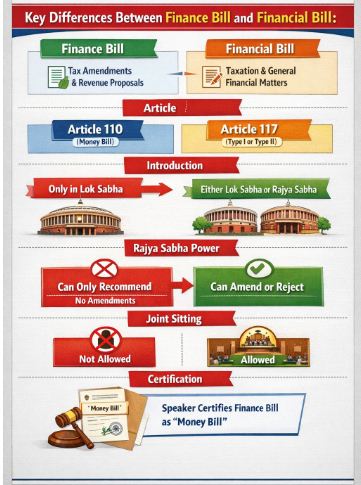
Key Differences Between Finance Bill and Financial Bill:
- Definition & Content:The Finance Bill is a specific, annual bill containing only tax amendments and revenue proposals for the year. Financial Bills are broader, incorporating taxation, government expenditures, or other financial matters, and are classified under Article 117.
- Article:The Finance Bill is a Money Bill (Article 110), specifically Part I. Financial Bills are categorized under Articles 117(1) (Type I) or 117(3) (Type II).
- Introduction:The Finance Bill can only be introduced in the Lok Sabha. Financial Bills (Type II) can be introduced in either house.
- Rajya Sabha Power:Rajya Sabha can only recommend amendments to the Finance Bill (must pass within 75 days). For a Financial Bill, the Rajya Sabha has full powers to amend or reject it.
- Joint Sitting:A Joint Sitting is not allowed for the Finance Bill (Money Bill), but it is allowed for a Financial Bill.
- Certification:The Speaker of the Lok Sabha certifies a Finance Bill as a Money Bill.

October 17, 2025
October 16, 2025
October 6, 2025
September 24, 2025

