March 24, 2026
FCRA Amendment Bill: 2026
FCRA Amendment Bill: 2026
The primary goal of this bill is to give the Government of India greater control over the assets (land, buildings, equipment) of Non-Governmental Organizations (NGOs) whose licenses have been cancelled or have expired.
Key Provisions
State Takeover of “Orphaned” Assets (Section 14B):
- The Rule: If an NGO’s FCRA registration is cancelled, surrendered, or not renewed on time, all assets created using foreign funds will now be taken over by the government.
- Designated Authority: The government will appoint a specific officer or authority to safeguard and manage these assets.
- Public Use: The government can use these buildings or equipment for public welfare projects or transfer them to other ministries/local departments.
- Sale Proceeds: If the authority decides to sell the assets, the money will be deposited into the Consolidated Fund of India.
Freezing Assets During Investigation (Section 13):
- The Rule: Even if an NGO is only under suspension (meaning a final decision hasn’t been made), it cannot sell, gift, or mortgage its assets.
- Permission: To deal with any asset during this phase, the organization must get explicit written approval from the Central Government.
New Grounds for Expiry:
- The bill clarifies that a registration automatically ceases if the certificate expires, if renewal is denied, or if the organization simply fails to apply for renewal in the prescribed format.
Reduction in Jail Term (Penal Provisions):
- The maximum jail term for violating FCRA rules (like illegally accepting or using foreign funds) is proposed to be reduced from 5 years to 1 year.
- The Logic: This shifts the focus from criminal prosecution of individuals to the financial and physical control of assets, making the law faster to implement.
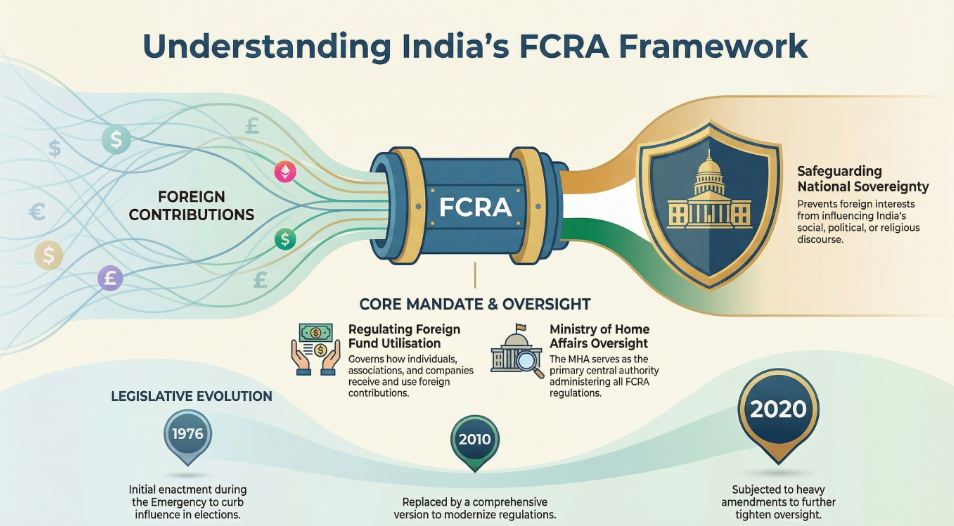
What is FCRA?
The Foreign Contribution Regulation Act (FCRA) is an Indian law that regulates the receipt and utilization of foreign funds by individuals, associations, and companies. It is administered by the Ministry of Home Affairs (MHA).
- Primary Objective: To ensure that foreign contributions do not adversely affect the sovereignty, integrity, and internal security of India. It prevents foreign interests from influencing India’s social, political, economic, or religious discourse.
- Historical Context: First enacted in 1976 (during the Emergency) to curb foreign influence in elections, it was replaced by a more comprehensive version in 2010 and heavily amended in 2020.
Key Provisions (The “Rules of the Game”):
To legally receive foreign money, an organization must follow these strict mandates:
- Mandatory Registration: Organizations must have a definite cultural, economic, educational, religious, or social program. Registration is valid for 5 years.
- The SBI Account Rule: All foreign funds must be received in a designated “FCRA Account” at the State Bank of India (Main Branch), New Delhi.
- No Sub-Granting: A registered NGO cannot transfer foreign funds to any other NGO or person, even if that second NGO is also FCRA-registered.
- Administrative Cap: Only 20% of the foreign funds can be used for administrative expenses (salaries, rent, etc.). Previously, this limit was 50%.
- Aadhaar Requirement: Aadhaar is mandatory for all office bearers or directors of the NGO.
Who is Prohibited from Receiving Foreign Funds?
Under Section 3, the following are strictly barred from accepting any foreign contribution to prevent “foreign interference”:
- Candidates contesting elections.
- Members of any Legislature (MP/MLA).
- Political parties or their office-bearers.
- Public Servants, Judges, or Government employees.
- Journalists, Columnists, Cartoonists, Editors, or Publishers of registered newspapers/media houses.
Recent Developments (2024-2026):
As we discussed regarding the new Bill, the government is now moving toward Asset Takeover.
- 2024 Amendment: New rules effective Jan 2025 allow NGOs to “carry forward” unspent administrative expenses to the next year (providing some flexibility).
- 2026 Proposed Bill: If an NGO’s license lapses or is cancelled, the government can now seize its assets (buildings, land) and put the sale proceeds into the Consolidated Fund of India.

October 17, 2025
October 16, 2025
October 6, 2025
September 24, 2025

