March 16, 2026
Delhi Water Master Plan & Yamuna Rejuvenation
Why in the News?The Delhi government has unveiled a structural reset of its 40-year-old water network, aiming for 24×7 supply and zero untreated sewage discharge.
-
Institutional Shift: For the first time, Delhi is moving toward a zonal command-and-control model with private sector participation in water management.
-
Environmental Crisis: Recent reports of “pink froth” in the Yamuna and critical pollution levels despite billions spent have forced a “mission mode” approach.
Key Features of the New Water Master Plan:
-
Zonal Decentralization: The city is divided into 9 operational zones, each anchored by a major Water Treatment Plant (WTP) (e.g., Haiderpur, Wazirabad, Chandrawal).
-
Command Centres: Each zone will have a “Command Hub” to monitor real-time supply, billing, and leakages.
-
Infrastructure Overhaul: Replacement of over 1,000 km of colonial-era/ageing pipelines to prevent contamination and “Non-Revenue Water” (NRW) losses.
-
Terminal Pressure: The plan aims to maintain a pressure of 22 metres, eliminating the need for private booster pumps in households.
-
District Metered Areas (DMAs): Creation of 147 DMAs to digitally map water flow and identify theft or leakages instantly.
Yamuna Rejuvenation: The 2028 Roadmap:
-
Zero Discharge Goal: A target to ensure no untreated sewage enters the river by December 2028.
-
Sewage Capacity Expansion: * Current capacity: ~814 MGD (Million Gallons per Day).
-
Target capacity: 1,500 MGD through 35 new decentralized STPs and upgrading 10 existing ones.
-
-
Sewer Connectivity: Plans to connect all 1,799 unauthorized colonies to the formal sewer network by 2028.
-
Amphibious Technology: Deployment of high-tech amphibious excavators (e.g., at Najafgarh Drain) to remove decades of accumulated silt (approx. 10 million metric tonnes).
Challenges & Issues:
-
The “Summer Deficit”: Delhi produces ~1,000 MGD against a demand of 1,200 MGD. The gap widens during peak summer, leading to tanker dependencies.
-
Inter-State Friction: 75% of Yamuna’s pollution in the Delhi stretch comes from only 2% of its length. Heavy reliance on Haryana (Carrier Line Channel) and UP often leads to “water wars.”
-
Legacy Pollution: Industrial effluents (dye/textile units) causing chemical froth (Pink/White) despite STP presence.
-
Governance Silos: Overlap between Delhi Jal Board (DJB), DDA (floodplains), and DPCC (pollution monitoring).
Steps Taken / Way Forward:
-
PPP Model: Roping in private firms for the management of command centres to improve efficiency and revenue collection.
-
Summer Action Plan 2026: Colony-wise water mapping, tanker route optimization, and cleaning of underground reservoirs.
-
Nature-Based Solutions: Revitalizing city lakes and using the “Sponge City” concept to recharge groundwater and reduce dependence on the Yamuna.
-
Circular Economy: Mandating the use of treated wastewater for non-potable purposes (gardening, thermal plants, construction).
Conclusion:
The transition from a centralized, engineering-heavy approach to a decentralized, technology-driven zonal model marks a paradigm shift in Delhi’s urban governance. However, the success of the 2028 goal hinges on inter-state cooperation and strict enforcement of pollution norms on illegal industrial units.
What is Non-Revenue Water (NRW):
Non-Revenue Water (NRW) is a critical metric used to measure the efficiency of a city’s water utility (like the Delhi Jal Board).
Simply put, NRW is water that has been produced and treated but is “lost” before it reaches the customer, meaning the utility receives no payment for it.
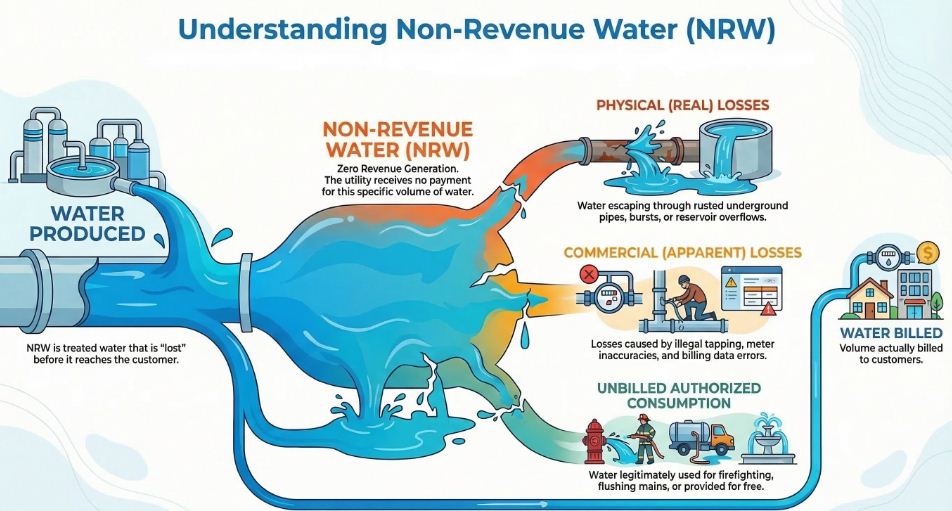
The Three Components of NRW
NRW is generally divided into three categories:
-
Physical (Real) Losses:
-
Leakages: Water escaping from old, rusted, or burst underground pipes.
-
Overflows: Water lost from storage reservoirs or tanks.
-
-
Commercial (Apparent) Losses:
-
Water Theft: Illegal tapping into the main supply lines.
-
Metering Inaccuracies: Under-registration by old or broken water meters.
-
Data Errors: Mistakes in billing or accounting.
-
-
Unbilled Authorized Consumption:
-
Water used for operational purposes (e.g., flushing mains, firefighting) or provided for free to certain institutions where no bill is generated.
-
Why NRW Matters for UPSC (Issues & Challenges)
-
Financial Burden: High NRW makes water utilities financially unsustainable. They spend money on electricity and chemicals to treat water, only to lose a large portion of it.
-
Resource Scarcity: In water-stressed cities like Delhi, losing 30–50% of treated water to NRW worsens the gap between demand and supply.
-
Contamination Risk: Wherever water can leak out of a pipe, pollutants can leak in when the pressure drops, leading to water-borne diseases.
-
Equity Issues: High NRW often means the “lost” water is being diverted via illegal tankers, which then sell it back to the poor at high prices.
The “Master Plan” Solution
In the new Water Master Plan mentioned in your notes, the goal is to reduce NRW through:
-
District Metered Areas (DMAs): Breaking the network into small, manageable sectors to pinpoint exactly where the water is disappearing.
-
Smart Metering: Replacing mechanical meters with ultrasonic or digital ones to prevent “commercial losses.”
-
Pipe Replacement: Moving away from “reactive repairs” (fixing bursts) to “proactive replacement” of the entire ageing network.

October 17, 2025
October 16, 2025
October 6, 2025
September 24, 2025

