May 6, 2026
Delhi Police Reform Initiative (2026):
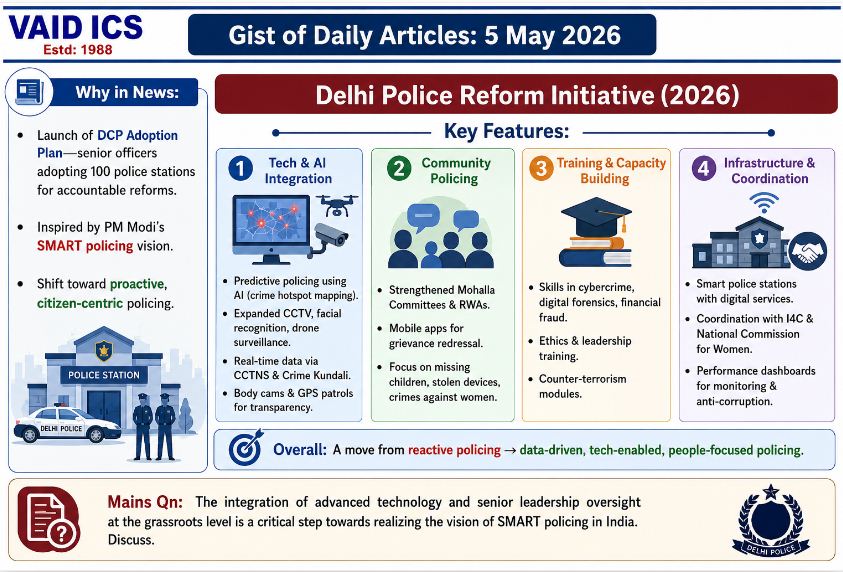
Why in News ?The 2026 Delhi Police Reform Initiative represents a paradigm shift in urban law enforcement, moving from traditional reactive methods to a SMART (Strict, Sensitive, Modern, Mobile, Alert, Accountable, Reliable, and Techno-savvy) policing framework.
-
DCP Adoption Plan: Senior officers have adopted 100 police stations to ensure direct accountability and grassroot-level reform.
-
Visionary Alignment: Inspired by PM Modi’s SMART policing mandate to modernize the force.
-
Proactive Shift: Transitioning toward a citizen-centric model that prioritizes prevention over mere response.
Key Features of the 2026 Initiative:
A. Tech & AI Integration:
-
Predictive Policing: Utilizing AI for crime hotspot mapping to deploy resources before crimes occur.
-
Surveillance: Expanded CCTV networks, facial recognition, and drone-based monitoring.
-
Data Systems: Real-time data sharing via CCTNS (Crime and Criminal Tracking Network & Systems) and the Crime Kundali database.
-
Transparency: Mandatory Body-worn cameras and GPS tracking for all patrol units.
B. Community-Centric Policing;
-
Grassroots Engagement: Empowering Mohalla Committees and Resident Welfare Associations (RWAs).
-
Digital Redressal: Mobile apps for instant grievance filing and tracking.
-
Social Focus: Dedicated units for missing children, stolen mobile tracking, and crimes against women.
C. Specialized Training:
-
Modern Threats: Specialized modules for cybercrime, digital forensics, and financial frauds.
-
Soft Skills: Mandatory training in ethics, leadership, and victim empathy.
-
Security: Advanced counter-terrorism protocols.
D. Infrastructure & Monitoring:
-
Smart Stations: Transitioning physical stations into digital service hubs.
-
Inter-Agency Linkage: Seamless coordination with I4C (Indian Cyber Crime Coordination Centre).
-
Accountability: Use of performance dashboards to monitor officer efficiency and curb corruption.
Historical Context of Police Reforms in India:
Police reforms have been a long-standing demand due to the colonial-era origins of the force.
-
Police Act of 1861: The current bedrock of Indian policing, designed by the British to suppress dissent rather than serve the public.
-
National Police Commission (1977-81): The first major body to recommend autonomy and separation of investigation from law and order.
-
Prakash Singh Case (2006): The Supreme Court issued seven landmark directives to state and central governments to kickstart reforms (e.g., setting up State Police Boards and a Police Complaints Authority).
Key Issues & Challenges;
Despite initiatives, several systemic hurdles remain:
-
Political Interference: Lack of functional autonomy often leads to the misuse of police machinery.
-
Overburdened Force: Severe vacancy rates lead to long working hours (often 14–16 hours) and high stress.
-
Obsolescence: While the 2026 plan addresses this, many local units still struggle with outdated weaponry and poor forensic facilities.
-
Public Distrust: A historical “trust deficit” between the police and the common citizen, often due to perceived high-handedness.
Important Committees on Police Reform;
| Committee | Year | Key Focus |
| Ribeiro Committee | 1998 | Proposed the creation of Police Performance Boards. |
| Padmanabhaiah Committee | 2000 | Recommended recruitment changes and police training modernization. |
| Malimath Committee | 2003 | Suggested reforms in the Criminal Justice System. |
| Second ARC | 2007 | Emphasized local policing and public-police relations. |
Conclusion;
The Delhi Police Reform Initiative (2026) acts as a blueprint for urban policing in India. By integrating AI and community feedback, it aims to transform the “Ruler’s Police” into a “People’s Police,” aligning with the broader goal of Minimum Government, Maximum Governance.

May 19, 2026
October 17, 2025
October 16, 2025
October 6, 2025

