May 20, 2026
Daily UPSC Current Affairs : 20 May 2026/Eastern Zonal Agriculture Conference 2026
Context & Background:
Addressing the Eastern Zonal Agriculture Conference 2026 in Bhubaneswar, Odisha, the Union Minister for Agriculture and Farmers’ Welfare highlighted contemporary challenges in Indian agriculture, geopolitical disruptions to inputs, and the strategic policy pivot required for long-term sustainability.
Geopolitical Disrupted Supply Chains & Fertilizer Autonomy:
- International Procurement Constraints: Global geopolitical tensions have severely restricted the international market availability of chemical fertilizers, resulting in sharp price volatility and global supply constraints.
- Fiscal Cushioning via Subsidies: To protect domestic farmers from rising global prices, the Union Cabinet recently approved an additional ₹41,000 crore towards fertilizer subsidies, reaffirming the government’s commitment to absorbing input price shocks.
- Resource Diversion Control: Amid the ongoing supply crunch, the Centre has directed state governments to strictly monitor and eliminate the leakage or diversion of heavily subsidized agricultural fertilizers to non-agricultural or industrial sectors.
- Quality Assurance: States have been urged to crack down on the distribution of duplicate or substandard fertilizers, which deteriorate soil health and compromise crop yields.
The Pivot to Sustainable Agriculture (Organic Farming):
- Ecological and Input Alternative: As a structural response to global supply vulnerabilities and deteriorating soil health, the Centre is strongly promoting the adoption of alternative farming paradigms.
- Micro-Targeted Adoption Strategy: Farmers are being encouraged to shift at least a portion of their land holdings (such as an initial 20%) to organic or natural farming to gradually lower input costs, enhance soil microbiology, and reduce foreign import dependence.
Upcoming Legislative Reforms in Agriculture:
To curb the menace of counterfeit agricultural inputs, which the government classifies as a severe economic offense against farmers, the Centre plans to introduce two critical legislative frameworks in Parliament:
- New Pesticides Management Bill: Aimed at modernizing quality control metrics, checking the proliferation of spurious pesticides, and imposing stringent penalties on fraudulent manufacturers.
- New Seeds Bill: Focused on establishing robust legal frameworks to ensure the domestic availability of certified, high-yielding seed varieties while protecting farmers from market adulteration.
Climate Vulnerability & Contingency Planning:
- The El Niño Threat: Meteorological forecasts for the current crop season indicate a high likelihood of deficient rainfall during the crucial mid-season phase.
- Resilient Crop Diversification: In response to potential dry spells, agricultural advisories are shifting focus toward climate-resilient crop varieties. Farmers are being nudged away from water-intensive monocultures (like paddy) toward low-water-vulnerable alternatives, specifically pulses, oilseeds, and millets.
- Integrated Farming Systems (IFS) for Eastern India: Given the predominance of small and marginal operational land holdings in eastern states, the policy narrative emphasizes combining core crop cultivation with horticulture, poultry, fisheries, and agro-forestry to hedge against climate risks.
Public Outreach and Awareness Drive:
- Campaign Initiative: ‘Save the Farm Campaign’ (Khet Bachao Abhiyan).
- Timeline: Scheduled to run nationwide from June 1 to June 15, 2026.
- Core Objective: To directly engage with farming communities and drive awareness regarding balanced fertilizer applications, modern agritech adoption, climate adaptation methodologies, and central welfare schemes.
Key Mains Value-Addition Takeaways:
- Redefining Self-Reliance: True strategic autonomy in agriculture must transcend mere output volume (foodgrain security) to achieve input security—specifically by accelerating target missions in pulses/oilseeds and scaling organic alternatives to reduce exposure to international geopolitical friction.
- Unlocking Eastern India (Mission Purvodaya): Fostering agricultural resilience in the eastern belt (Odisha, Bihar, Jharkhand, West Bengal, Chhattisgarh) is pivotal to securing India’s second green revolution, driven by sustainable diversification rather than resource-intensive models.
What is Organic farming?
Organic farming is a holistic production management system that avoids the use of synthetic fertilizers, chemical pesticides, genetically modified organisms (GMOs), and growth regulators.
Instead, it relies on ecologically balanced practices like crop rotation, green manures, organic waste recycling, and biological pest control to maintain soil productivity, supply plant nutrients, and control weeds and pests.
Core Principles of Organic Farming:
- Principle of Health: It must sustain and enhance the health of soil, plants, animals, humans, and the planet as one and indivisible.
- Principle of Ecology: It must be based on living ecological systems and cycles, working with them, emulating them, and helping to sustain them.
- Principle of Fairness: It should build relationships that ensure fairness with regard to the common environment and life opportunities.
Principle of Care: It should be managed in a precautionary and responsible manner to protect the health and well-being of current and future generations.Critical Components & Techniques:
Nutrient Management:
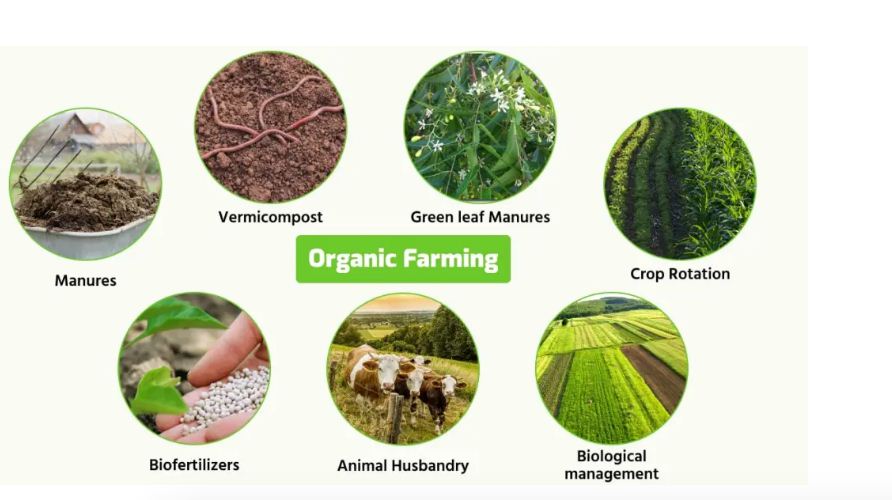
- Crop Rotation: Growing different types of crops in a planned sequence on the same land to preserve soil nutrients, break pest cycles, and prevent soil erosion.
- Green Manure: Plowing or turning specific undecomposed green plant tissue (typically legumes like dhaincha or sunn hemp) into the soil to improve organic matter and nitrogen content.
- Biofertilizers: Utilizing living microorganisms (such as Rhizobium, Azotobacter, and Blue-Green Algae) that enrich the nutrient quality of the soil by fixing atmospheric nitrogen or solubilizing phosphorus.
- Composting and Vermicomposting: Converting organic waste matter, plant residues, and animal dung into nutrient-rich humus using earthworms and microbes.
Pest and Weed Management:
- Biological Control: Deploying natural predators, parasites, or beneficial insects (like ladybird beetles or Trichoderma) to keep pest populations below economic injury levels.
- Botanical Pesticides: Using natural plant extracts (such as Neem kernel water extract, garlic, or chili sprays) to repel or manage pests without toxic chemical residues.
- Mechanical Measures: Utilizing manual weeding, mulching (covering soil with organic sheets or straw to suppress weeds), and pheromone traps to physically disrupt pests and weeds.
Significance:
Environmental Benefits:
- Restoring Soil Microbiology: Reverses the soil degradation and compaction caused by decades of excessive chemical inputs.
- Mitigating Water Pollution: Eliminates the chemical runoff and leaching that causes eutrophication in freshwater bodies and contaminates groundwater tables.
- Climate Resilience: Organic soils have higher organic carbon and humus content, which significantly enhances their water-retention capacity, making crops more resilient to climate-induced droughts.
Economic Benefits:
- Reducing Input Costs: Decreases dependency on expensive, imported, and volatile chemical inputs (like urea or DAP), lowering the debt burden on small and marginal farmers.
- Export Potential and Premium Pricing: Taps into growing global and domestic premium markets for certified organic products, offering higher profit margins for farmers.
Key Government Initiatives in India:
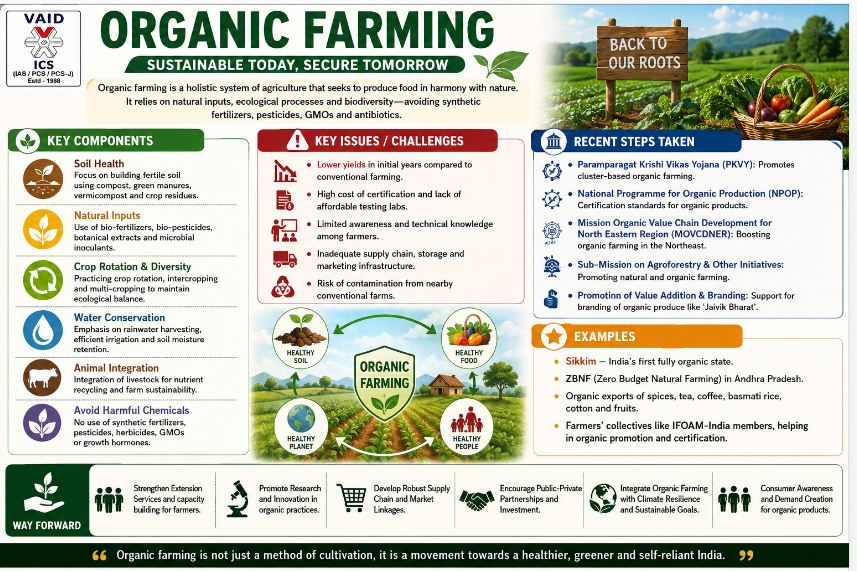
- Paramparagat Krishi Vikas Yojana (PKVY): Promotes cluster-based organic farming with a focus on participatory guarantee certification (PGS) and financial assistance for inputs.
- Mission Organic Value Chain Development for Northeastern Region (MOVCDNER): A dedicated scheme aiming to develop certified organic production hubs in the NE region to link farmers with domestic and international value chains.
- National Programme for Organic Production (NPOP): Managed by APEDA under the Ministry of Commerce, it regulates export standards and provides third-party certification required for international markets.
- Bhartiya Prakritik Krishi Paddhati (BPKP): A sub-scheme under PKVY emphasizing traditional indigenous practices, completely eliminating chemical or external inputs, and promoting on-farm biomass recycling.
Structural Challenges & Bottlenecks:
- Initial Yield Drop: Transitioning from chemical to organic methods typically causes a sharp drop in crop yields during the first three years (the conversion period), creating financial strain for smallholders.
- Inadequate Certification Ecosystem: The high cost of formal third-party certification and complex documentation frameworks remain a barrier for small and marginal farmers.
- Supply Chain Deficits: A lack of dedicated cold storage, transport infrastructure, and separate marketing channels leads to organic produce being mixed with conventional crops, depriving farmers of premium pricing.
- High Labor Intensity: Organic techniques, especially mechanical weeding and biomass preparation, demand significantly more labor compared to quick chemical sprays.
Way Forward:
- Targeted Transition Subsidies: The government should provide direct financial support to farmers during the initial three-year conversion phase to cushion the yield drop.
- Decentralized Certification: Scaling up the Participatory Guarantee System (PGS-India) to provide low-cost, peer-reviewed, and locally accessible certification options.
- Integration with Livestock: Re-establishing the traditional crop-livestock symbiotic model to ensure a steady on-farm supply of bio-inputs, organic manure, and draft power.
- Phased Zone Mapping: Identifying and fast-tracking naturally chemical-free zones (such as rainfed regions, tribal belts, and hilly areas like Sikkim and parts of the Northeast) for immediate organic conversion to maximize returns.
अवधारणा एवं परिभाषा:
जैविक खेती (Organic Farming) एक समग्र उत्पादन प्रबंधन प्रणाली है जो कृत्रिम (synthetic) उर्वरकों, रासायनिक कीटनाशकों, आनुवंशिक रूप से संशोधित जीवों (GMOs) और विकास नियामकों (growth regulators) के उपयोग को पूरी तरह से प्रतिबंधित करती है।
इसके विपरीत, यह प्रणाली मिट्टी की उत्पादकता बनाए रखने, पौधों को पोषक तत्व प्रदान करने तथा खरपतवार और कीटों को नियंत्रित करने के लिए फसल चक्र, हरी खाद, जैविक अपशिष्ट पुनर्चक्रण और जैविक कीट नियंत्रण जैसी पारिस्थितिक रूप से संतुलित प्रथाओं पर निर्भर करती है।
‘पूर्वी क्षेत्रीय कृषि सम्मेलन 2026′:
संदर्भ एवं पृष्ठभूमि:
ओडिशा के भुवनेश्वर में आयोजित ‘पूर्वी क्षेत्रीय कृषि सम्मेलन 2026′ (Eastern Zonal Agriculture Conference 2026) को संबोधित करते हुए केंद्रीय कृषि एवं किसान कल्याण मंत्री शिवराज सिंह चौहान ने वैश्विक अनिश्चितताओं के बीच भारतीय कृषि के समक्ष मौजूद समकालीन चुनौतियों और उनके नीतिगत समाधानों को रेखांकित किया।
उर्वरक आपूर्ति संकट और वैश्विक भू-राजनीति:
- आयात संबंधी चुनौतियाँ: वैश्विक स्तर पर (विशेष रूप से पश्चिम एशिया संकट के कारण) रासायनिक उर्वरकों की उपलब्धता सीमित हुई है और इनकी अंतरराष्ट्रीय कीमतों में भारी उछाल आया है। भारत वर्तमान में अपनी आवश्यकताओं को पूरा करने के लिए लगभग 28 देशों के संपर्क में है।
- वित्तीय प्रतिबद्धता: अंतरराष्ट्रीय बाजार में बढ़ी हुई लागत के बावजूद किसानों को सस्ती दरों पर इनपुट प्रदान करने के लिए केंद्रीय कैबिनेट ने हाल ही में ₹41,000 करोड़ की अतिरिक्त उर्वरक सब्सिडी को मंजूरी दी है।
- अपव्यय और डायवर्जन पर रोक: आपूर्ति में कमी को देखते हुए केंद्र सरकार ने राज्यों को सख्त निर्देश दिए हैं कि सब्सिडी वाले कृषि-उर्वरकों का गैर-कृषि या औद्योगिक क्षेत्रों में अवैध डायवर्जन रोका जाए।
नीतिगत विकल्प: जैविक और प्राकृतिक खेती:
- सतत विकल्प: उर्वरकों की वैश्विक कमी और मिट्टी के गिरते स्वास्थ्य (Soil Health Degradation) से निपटने के लिए सरकार ने वैकल्पिक कृषि पद्धतियों को अपनाने पर बल दिया है।
- अपील और रणनीति: प्रत्येक किसान को अपनी भूमि के कम से कम एक हिस्से (लगभग 20%) पर प्रायोगिक तौर पर जैविक या प्राकृतिक खेती की शुरुआत करनी चाहिए। इससे बिना मिट्टी परीक्षण के रासायनिक उर्वरकों के अंधाधुंध उपयोग और इनपुट लागत (Input Cost) को कम करने में मदद मिलेगी।
कृषि क्षेत्र में आगामी वैधानिक सुधार (Legislative Reforms):
नकली कृषि इनपुट (Spurious Inputs) को “किसानों के खिलाफ एक गंभीर अपराध” बताते हुए केंद्र सरकार गुणवत्ता नियंत्रण सुनिश्चित करने के लिए संसद में दो नए विधेयक लाने की योजना बना रही है:
- नया कीटनाशक प्रबंधन कानून (New Pesticides Management Law): यह बाजार में नकली और घटिया कीटनाशकों की बिक्री को रोकने और ऐसा करने वालों के खिलाफ कड़े दंडात्मक प्रावधान करने के लिए लाया जा रहा है।
- नया बीज कानून (New Seeds Law): इसका उद्देश्य किसानों को प्रमाणित और उच्च उपज देने वाले बीजों की उपलब्धता सुनिश्चित कराना और बीज बाजार में धोखाधड़ी को समाप्त करना है।
जलवायु परिवर्तन और आकस्मिक योजना (Contingency Planning):
- एल नीनो (El Nino) का खतरा: चालू फसल सीजन के मध्य में ‘एल नीनो’ के प्रभाव के कारण मानसून की वर्षा में कमी/कमी की भविष्यवाणी (Deficient Rainfall Forecast) की गई है।
- फसल विविधीकरण (Crop Diversification): सरकार ने किसानों को पारंपरिक धान और गेहूं के चक्र से हटकर ऐसी फसलें उगाने की सलाह दी है जो वर्षा के उतार-चढ़ाव के प्रति कम संवेदनशील हों (जैसे मोटे अनाज/मिलेट्स, दलहन और तिलहन)।
- पूर्वी भारत के लिए एकीकृत कृषि मॉडल: पूर्वी राज्यों में छोटे और सीमांत खेतों की प्रधानता को देखते हुए फसलों के साथ-साथ बागवानी, मत्स्य पालन, पशुपालन, मधुमक्खी पालन और कृषि-वानिकी (Agro-forestry) को मिलाने की वकालत की गई है ताकि जोखिम को कम कर आय बढ़ाई जा सके।
जागरूकता एवं लोक आउटरीच अभियान:
- अभियान का नाम: ‘खेत बचाओ अभियान’ (Save the Farm Campaign)।
- अवधि: 1 जून से 15 जून 2026 तक देशव्यापी स्तर पर संचालित किया जाएगा।
- उद्देश्य: किसानों को संतुलित उर्वरक उपयोग, मिट्टी के स्वास्थ्य के संरक्षण, आधुनिक कृषि प्रौद्योगिकियों को अपनाने और विभिन्न कल्याणकारी सरकारी योजनाओं के बारे में सीधे जागरूक करना।
मुख्य परीक्षा (Mains) के लिए मुख्य टेकअवे (Value Addition):
उत्तर लेखन में इन मुख्य बिंदुओं का उपयोग किया जा सकता है:
- कृषि में आत्मनिर्भरता: आत्मनिर्भरता का दायरा केवल ‘अनाज उत्पादन’ तक सीमित नहीं होना चाहिए, बल्कि इसमें इनपुट आत्मनिर्भरता (उर्वरकों पर विदेशी निर्भरता को कम करना) और दलहन-तिलहन मिशन (जैसे 2030-31 तक केंद्रीय एजेंसियों द्वारा पूरी अरहर, उड़द और मसूर की सुनिश्चित खरीद) शामिल होनी चाहिए।
- मिशन पूर्वोदय (Purvodaya Mission): पूर्वी राज्यों (ओडिशा, बिहार, झारखंड, छत्तीसगढ़, पश्चिम बंगाल) में कृषि क्षेत्र का विकास भारत की खाद्य सुरक्षा और ग्रामीण अर्थव्यवस्था के विविधीकरण के लिए गेम-चेंजर साबित हो सकता है।
जैविक खेती के मुख्य सिद्धांत:
-
स्वास्थ्य का सिद्धांत: जैविक खेती को मिट्टी, पौधों, जानवरों, मनुष्यों और पूरे ग्रह के स्वास्थ्य को एक और अविभाज्य मानकर उसे संवर्धित और सुदृढ़ करना चाहिए।
-
पारिस्थितिकी का सिद्धांत: यह जीवित पारिस्थितिक तंत्र और चक्रों पर आधारित होनी चाहिए, उनके साथ मिलकर काम करने वाली, उनका अनुकरण करने वाली और उन्हें बनाए रखने में सहायक होनी चाहिए।
-
न्यायसंगतता का सिद्धांत: इसे ऐसे संबंधों का निर्माण करना चाहिए जो साझा पर्यावरण और जीवन के अवसरों के संबंध में निष्पक्षता और न्याय सुनिश्चित करें।
-
देखभाल का सिद्धांत: वर्तमान और भावी पीढ़ियों के स्वास्थ्य और कल्याण की रक्षा के लिए इसका प्रबंधन एहतियाती और जिम्मेदार तरीके से किया जाना चाहिए।
प्रमुख घटक एवं तकनीकें:
पोषक तत्व प्रबंधन (Nutrient Management):
-
फसल चक्र (Crop Rotation): मिट्टी के पोषक तत्वों को सुरक्षित रखने, कीट चक्रों को तोड़ने और मृदा अपरदन (soil erosion) को रोकने के लिए एक ही भूमि पर नियोजित अनुक्रम में विभिन्न प्रकार की फसलें उगाना।
-
हरी खाद (Green Manure): मिट्टी में जैविक पदार्थ और नाइट्रोजन की मात्रा बढ़ाने के लिए विशिष्ट न सड़े-गले हरे पौधों के ऊतकों (आमतौर पर ढैंचा या सनई जैसी फलदार फसलें) को खेत में ही जोतकर मिट्टी में मिला देना।
-
जैव उर्वरक (Biofertilizers): ऐसे जीवित सूक्ष्मजीवों (जैसे राइजोबियम, एज़ोटोबैक्टर और नील-हरित शैवाल) का उपयोग करना जो वायुमंडलीय नाइट्रोजन को स्थिर करके या फास्फोरस को घुलनशील बनाकर मिट्टी की पोषक गुणवत्ता को समृद्ध करते हैं।
-
कम्पोस्ट और केंचुआ खाद (Vermicomposting): केंचुओं और रोगाणुओं की मदद से जैविक अपशिष्ट पदार्थों, पौधों के अवशेषों और गोबर को पोषक तत्वों से भरपूर ह्यूमस (humus) में बदलना।
कीट और खरपतवार प्रबंधन (Pest and Weed Management):
-
जैविक नियंत्रण (Biological Control): कीटों की आबादी को आर्थिक नुकसान के स्तर से नीचे रखने के लिए प्राकृतिक शिकारियों, परजीवियों या लाभकारी कीटों (जैसे लेडीबर्ड बीटल या ट्राइकोडरमा) का उपयोग करना।
-
वानस्पतिक कीटनाशक (Botanical Pesticides): बिना किसी जहरीले रासायनिक अवशेषों के कीटों को दूर भगाने या प्रबंधित करने के लिए प्राकृतिक पौधों के अर्क (जैसे नीम के बीज का अर्क, लहसुन या मिर्च का स्प्रे) का उपयोग करना।
-
यांत्रिक उपाय (Mechanical Measures): खरपतवारों को दबाने के लिए मैन्युअल रूप से निराई-गुड़ाई करना, मल्चिंग (मृदा को सूखी घास या जैविक चादरों से ढकना) और कीटों को शारीरिक रूप से आकर्षित कर नष्ट करने के लिए फेरोमोन ट्रैप (pheromone traps) का उपयोग करना।
भारत के लिए महत्व एवं उपयोगिता:
पर्यावरणीय लाभ:
-
मृदा सूक्ष्म जीव विज्ञान की बहाली: दशकों से अत्यधिक रासायनिक इनपुट के कारण हुए मृदा क्षरण और मिट्टी के कड़ेपन की समस्या को उलट देता है।
-
जल प्रदूषण में कमी: रासायनिक अपवाह (runoff) और रिसाव को समाप्त करता है, जो जल निकायों में सुपोषण (eutrophication) का कारण बनता है और भूजल तालिकाओं को दूषित करता है।
-
जलवायु सुदृढ़ता (Climate Resilience): जैविक मिट्टी में जैविक कार्बन और ह्यूमस की मात्रा अधिक होती है, जो उनकी जल-धारण क्षमता (water-retention capacity) को काफी बढ़ा देती है, जिससे फसलें जलवायु-प्रेरित सूखे के प्रति अधिक लचीली बनती हैं।
आर्थिक लाभ:
-
इनपुट लागत में कमी: महंगे, आयातित और अस्थिर रासायनिक इनपुट्स (जैसे यूरिया या डीएपी) पर निर्भरता को कम करता है, जिससे छोटे और सीमांत किसानों पर कर्ज का बोझ कम होता है।
-
निर्यात क्षमता और प्रीमियम मूल्य निर्धारण: प्रमाणित जैविक उत्पादों के लिए बढ़ते वैश्विक और घरेलू प्रीमियम बाजारों तक पहुंच स्थापित करता है, जिससे किसानों को अधिक लाभ मार्जिन मिलता है।
भारत सरकार की प्रमुख पहलें:
-
परंपरागत कृषि विकास योजना (PKVY): क्लस्टर-आधारित जैविक खेती को बढ़ावा देती है जिसमें भागीदारी गारंटी प्रमाणन (PGS) और इनपुट के लिए वित्तीय सहायता पर ध्यान केंद्रित किया जाता है।
-
पूर्वोत्तर क्षेत्र के लिए मिशन जैविक मूल्य श्रृंखला विकास (MOVCDNER): पूर्वोत्तर क्षेत्र में प्रमाणित जैविक उत्पादन हब विकसित करने के उद्देश्य से एक समर्पित योजना, ताकि किसानों को घरेलू और अंतर्राष्ट्रीय मूल्य श्रृंखलाओं से जोड़ा जा सके।
-
राष्ट्रीय जैविक उत्पादन कार्यक्रम (NPOP): वाणिज्य मंत्रालय के तहत एपीएडीए (APEDA) द्वारा प्रबंधित, यह निर्यात मानकों को नियंत्रित करता है और अंतर्राष्ट्रीय बाजारों के लिए आवश्यक तृतीय-पक्ष (third-party) प्रमाणन प्रदान करता है।
-
भारतीय प्राकृतिक कृषि पद्धति (BPKP): PKVY के तहत एक उप-योजना जो पारंपरिक स्वदेशी प्रथाओं पर जोर देती है, रासायनिक या बाहरी इनपुट को पूरी तरह से समाप्त करती है और ऑन-फार्म बायोमास पुनर्चक्रण को बढ़ावा देती है।
संरचनात्मक चुनौतियाँ एवं बाधाएँ:
-
शुरुआती पैदावार में गिरावट: रासायनिक से जैविक पद्धतियों की ओर बढ़ने पर आमतौर पर पहले तीन वर्षों (रूपांतरण अवधि/conversion period) के दौरान फसल की पैदावार में भारी गिरावट आती है, जिससे छोटे किसानों पर वित्तीय दबाव पड़ता है।
-
अपर्याप्त प्रमाणन पारिस्थितिकी तंत्र: औपचारिक तृतीय-पक्ष प्रमाणन की उच्च लागत और जटिल दस्तावेज़ीकरण प्रक्रियाएं छोटे और सीमांत किसानों के लिए एक बड़ी बाधा बनी हुई हैं।
-
आपूर्ति श्रृंखला का अभाव: समर्पित कोल्ड स्टोरेज, परिवहन बुनियादी ढांचे और अलग विपणन चैनलों की कमी के कारण जैविक उत्पाद पारंपरिक फसलों के साथ मिल जाते हैं, जिससे किसान प्रीमियम मूल्य निर्धारण से वंचित रह जाते हैं।
-
अत्यधिक श्रम-गहनता: जैविक तकनीकें, विशेष रूप से यांत्रिक निराई और बायो-इनपुट (जीवामृत, बीजामृत) तैयार करना, त्वरित रासायनिक स्प्रे की तुलना में काफी अधिक श्रम की मांग करते हैं।
आगे की राह:
-
लक्षित संक्रमण सब्सिडी (Transition Subsidies): पैदावार में शुरुआती गिरावट के प्रभाव को कम करने के लिए सरकार को प्रारंभिक तीन साल के रूपांतरण चरण के दौरान किसानों को प्रत्यक्ष वित्तीय सहायता (DBT) प्रदान करनी चाहिए।
-
विकेंद्रीकृत प्रमाणन: कम लागत वाले, सहकर्मी-समीक्षित (peer-reviewed) और स्थानीय रूप से सुलभ प्रमाणन विकल्प प्रदान करने के लिए भागीदारी गारंटी प्रणाली (PGS-India) का बड़े पैमाने पर विस्तार करना।
-
पशुधन के साथ एकीकरण: जैव-इनपुट, जैविक खाद और श्रम शक्ति की निरंतर ऑन-फार्म आपूर्ति सुनिश्चित करने के लिए पारंपरिक फसल-पशुधन सहजीवी मॉडल (crop-livestock symbiotic model) को पुनर्जीवित करना।
-
चरणबद्ध क्षेत्र मानचित्रण: स्वाभाविक रूप से रसायन मुक्त क्षेत्रों (जैसे वर्षा आधारित क्षेत्रों, आदिवासी पट्टियों और सिक्किम व पूर्वोत्तर के पहाड़ी क्षेत्रों) की पहचान कर उन्हें तत्काल जैविक क्षेत्रों के रूप में अधिसूचित करना ताकि न्यूनतम लागत में अधिकतम लाभ प्राप्त किया जा सके।

May 19, 2026
October 17, 2025
October 16, 2025
October 6, 2025

