October 13, 2026
Daily UPSC Current Affairs- 13 Oct 2026/Intergovernmental Panel on Climate Change (IPCC)/जलवायु परिवर्तन पर अंतर-सरकारी पैनल (
Why in News?
The IPCC is facing a deadlock among its 195 member countries over the timeline for publishing its next assessment reports. The disagreement could delay scientific inputs for the 2028 UN climate negotiations and decisions under the Paris Agreement.
What is the IPCC?
-
Established: 1988.
-
Established by: United Nations Environment Programme (UNEP) and World Meteorological Organization (WMO).
-
Headquarters: Geneva, Switzerland.
-
Members: 195 countries.
-
Nature: An intergovernmental scientific body that assesses existing scientific knowledge on climate change.
-
Objective: To provide scientific evidence on the causes, impacts, risks and possible solutions to climate change.
Important: The IPCC assesses and synthesises existing scientific research; it does not independently conduct most of the research it evaluates.
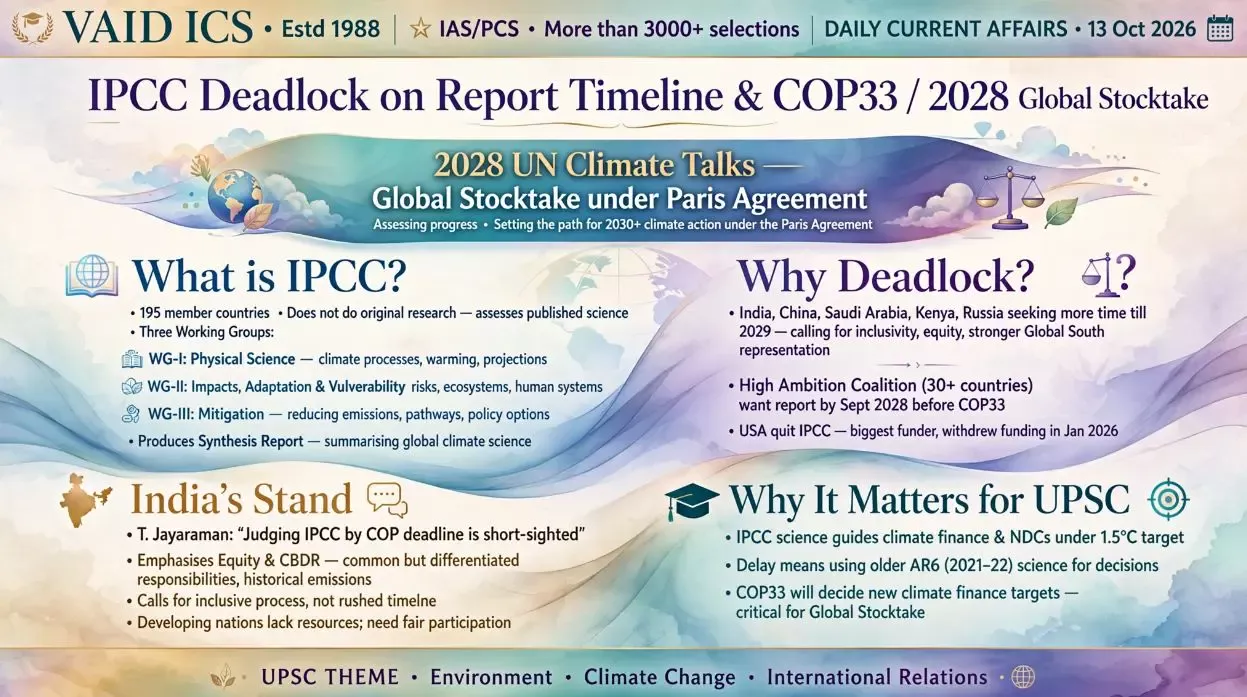
What is the Current Deadlock?
-
Issue: Disagreement over the publication schedule of the IPCC’s next assessment reports.
-
Proposed timeline: Scientists leading the report groups have proposed approving all three reports by September 2028.
-
Alternative proposal: Some countries favour postponing the second and third reports until 2029.
-
Countries seeking more time: India, China, Russia, Saudi Arabia and Kenya, among others, have called for sufficient time to ensure broader participation.
-
Concern of developing countries: Limited financial resources, research capacity and availability of experts may prevent their perspectives from being adequately represented.
What are the Three Major Assessment Reports?
The IPCC plans to prepare three key reports covering:
-
Climate Science: The extent, causes and scientific basis of climate change.
-
Impacts, Vulnerability and Adaptation: Effects of climate change on people, ecosystems and economies, along with ways to adapt.
-
Climate Change Mitigation: Options for reducing greenhouse gas emissions and limiting global warming.
Why are IPCC Reports Important?
-
Scientific basis: They provide authoritative assessments for international climate negotiations and policymaking.
-
Climate action: They help governments understand climate risks and design mitigation and adaptation strategies.
-
Paris Agreement: They inform assessments of collective progress towards global climate goals.
-
Climate finance: They support discussions on funding climate action, particularly in developing countries.
-
National climate targets: They help countries assess the adequacy of their emission-reduction commitments.
Why are the 2028 UN Climate Talks Important?
The 2028 climate negotiations are expected to assess progress under the Paris Agreement and guide future decisions on climate finance and national emission-reduction targets.
A delay in IPCC reports could reduce the availability of updated scientific assessments for these discussions.
What are the Major Challenges?
-
Underrepresentation of developing countries: Limited research funding and scientific capacity.
-
Political disagreements: Differences between countries over climate responsibilities and development priorities.
-
Industrial competitiveness: Concerns about the economic costs of reducing greenhouse gas emissions.
-
Time constraints: Producing scientifically rigorous reports while ensuring adequate participation and review.
-
Equity concerns: Balancing climate action with poverty reduction, energy access and economic development.
What is the Global Stocktake?
-
Meaning: A periodic assessment of collective progress towards achieving the goals of the Paris Agreement.
-
Frequency: Every five years.
-
Purpose: To evaluate global progress on emission reduction, adaptation and climate finance.
-
First Global Stocktake: Concluded at COP28 in Dubai in 2023.
-
Significance: Its findings help countries strengthen their climate commitments and actions.
Important distinction: The IPCC provides scientific assessments, while the Global Stocktake evaluates collective progress under the Paris Agreement.
What is the UNFCCC?
-
Full Form: United Nations Framework Convention on Climate Change.
-
Adopted: 1992, at the Rio Earth Summit.
-
Objective: To stabilise greenhouse gas concentrations at a level that prevents dangerous human interference with the climate system.
-
Nature: An international treaty providing the framework for global climate negotiations.
-
Paris Agreement: Adopted in 2015 under the UNFCCC framework.
What is the Paris Agreement?
-
Adopted: 2015, at COP21 in Paris.
-
Nature: A legally binding international climate treaty.
-
Temperature Goal: Hold the increase in global average temperature to well below 2°C above pre-industrial levels and pursue efforts to limit it to 1.5°C.
-
Nationally Determined Contributions (NDCs): Countries communicate their climate action plans and are expected to strengthen them over time.
-
Global Stocktake: Reviews collective progress every five years.
Way Forward:
-
Provide adequate time and resources for comprehensive scientific assessments.
-
Strengthen the participation of scientists from developing countries.
-
Improve access to research funding, data and peer-reviewed scientific literature.
-
Maintain scientific independence while ensuring inclusive intergovernmental decision-making.
-
Ensure timely publication of reports to support climate negotiations and evidence-based policymaking.
Conclusion;
The IPCC deadlock highlights the need to balance scientific urgency, inclusive participation and equitable climate action. Timely and credible assessments are essential for implementing the Paris Agreement and addressing the global climate crisis.
जलवायु परिवर्तन पर अंतर-सरकारी पैनल (IPCC):
चर्चा में क्यों?
जलवायु परिवर्तन पर अंतर-सरकारी पैनल (IPCC) की अगली आकलन रिपोर्टों के प्रकाशन की समय-सीमा को लेकर इसके 195 सदस्य देशों के बीच गतिरोध उत्पन्न हो गया है। इससे वर्ष 2028 की संयुक्त राष्ट्र जलवायु वार्ताओं के लिए आवश्यक वैज्ञानिक जानकारी उपलब्ध कराने में देरी हो सकती है।
IPCC क्या है?
-
स्थापना: 1988
-
स्थापना करने वाले संगठन: संयुक्त राष्ट्र पर्यावरण कार्यक्रम (UNEP) तथा विश्व मौसम विज्ञान संगठन (WMO)।
-
मुख्यालय: जिनेवा, स्विट्जरलैंड।
-
सदस्य: 195 देश।
-
प्रकृति: जलवायु परिवर्तन से संबंधित वैज्ञानिक साक्ष्यों का आकलन करने वाला अंतर-सरकारी निकाय।
-
उद्देश्य: जलवायु परिवर्तन के कारणों, प्रभावों, जोखिमों तथा संभावित समाधानों के संबंध में वैज्ञानिक जानकारी उपलब्ध कराना।
महत्त्वपूर्ण तथ्य: IPCC मुख्यतः उपलब्ध वैज्ञानिक अनुसंधानों का आकलन और संश्लेषण करता है। यह स्वयं अधिकांश वैज्ञानिक अनुसंधान नहीं करता।
वर्तमान गतिरोध क्या है?
-
मुख्य मुद्दा: अगली आकलन रिपोर्टों के प्रकाशन की समय-सीमा पर सदस्य देशों के बीच मतभेद।
-
प्रस्तावित समय-सीमा: वैज्ञानिक समूहों के अध्यक्षों ने तीनों रिपोर्टों को सितंबर 2028 तक अनुमोदित करने का प्रस्ताव दिया है।
-
वैकल्पिक प्रस्ताव: कुछ देश दूसरी और तीसरी रिपोर्ट को वर्ष 2029 तक स्थगित करने के पक्ष में हैं।
-
अधिक समय की मांग करने वाले देश: भारत, चीन, रूस, सऊदी अरब और केन्या सहित कुछ अन्य देश।
-
विकासशील देशों की चिंता: वित्तीय संसाधनों, विशेषज्ञों और अनुसंधान क्षमता की कमी के कारण उनकी समस्याओं तथा दृष्टिकोणों को रिपोर्टों में पर्याप्त प्रतिनिधित्व नहीं मिल पाता।
IPCC की तीन प्रमुख आकलन रिपोर्टें कौन-सी हैं?
-
जलवायु विज्ञान: जलवायु परिवर्तन की सीमा, कारण और वैज्ञानिक आधार।
-
प्रभाव, संवेदनशीलता एवं अनुकूलन: मानव समाज, पारिस्थितिकी तंत्र और अर्थव्यवस्था पर प्रभाव तथा उनसे निपटने के उपाय।
-
जलवायु परिवर्तन शमन: ग्रीनहाउस गैस उत्सर्जन कम करने और वैश्विक तापवृद्धि सीमित करने के विकल्प।
IPCC की रिपोर्टें क्यों महत्त्वपूर्ण हैं?
-
वैज्ञानिक आधार: अंतरराष्ट्रीय जलवायु समझौतों और नीतियों के लिए विश्वसनीय वैज्ञानिक आकलन उपलब्ध कराती हैं।
-
जलवायु कार्रवाई: जलवायु जोखिमों की पहचान और शमन एवं अनुकूलन संबंधी नीतियों के निर्माण में सहायता करती हैं।
-
पेरिस समझौता: वैश्विक जलवायु लक्ष्यों की दिशा में सामूहिक प्रगति का आकलन करने में उपयोगी हैं।
-
जलवायु वित्त: विकासशील देशों सहित विभिन्न देशों की जलवायु संबंधी वित्तीय आवश्यकताओं पर निर्णय लेने में सहायता करती हैं।
-
राष्ट्रीय लक्ष्य: ग्रीनहाउस गैस उत्सर्जन कम करने के लिए देशों की प्रतिबद्धताओं को निर्धारित और मजबूत करने में वैज्ञानिक आधार प्रदान करती हैं।
वर्ष 2028 की जलवायु वार्ताएँ क्यों महत्त्वपूर्ण हैं?
वर्ष 2028 की जलवायु वार्ताओं का उद्देश्य पेरिस समझौते के अंतर्गत हुई प्रगति का आकलन करना तथा जलवायु वित्त और राष्ट्रीय उत्सर्जन-कटौती लक्ष्यों से संबंधित भविष्य के निर्णयों को दिशा देना है।
IPCC की रिपोर्टों में देरी होने से इन वार्ताओं के लिए नवीनतम वैज्ञानिक जानकारी की उपलब्धता प्रभावित हो सकती है।
प्रमुख चुनौतियाँ क्या हैं?
-
विकासशील देशों का अपर्याप्त प्रतिनिधित्व: अनुसंधान के लिए सीमित वित्त और वैज्ञानिक क्षमता।
-
राजनीतिक मतभेद: जलवायु परिवर्तन की जिम्मेदारी और विकास संबंधी प्राथमिकताओं पर देशों के अलग-अलग दृष्टिकोण।
-
औद्योगिक प्रतिस्पर्धा: उत्सर्जन घटाने से उद्योगों की लागत और प्रतिस्पर्धात्मकता पर पड़ने वाला प्रभाव।
-
समय-सीमा का दबाव: वैज्ञानिक विश्वसनीयता बनाए रखते हुए समय पर रिपोर्ट तैयार करना।
-
जलवायु न्याय: जलवायु कार्रवाई के साथ गरीबी उन्मूलन, ऊर्जा की उपलब्धता और आर्थिक विकास में संतुलन स्थापित करना।
वैश्विक स्टॉकटेक (Global Stocktake) क्या है?
-
अर्थ: पेरिस समझौते के लक्ष्यों की दिशा में वैश्विक स्तर पर हुई सामूहिक प्रगति का आकलन।
-
आवृत्ति: प्रत्येक पाँच वर्ष में।
-
उद्देश्य: उत्सर्जन में कमी, जलवायु अनुकूलन और जलवायु वित्त के क्षेत्र में हुई प्रगति का मूल्यांकन।
-
प्रथम वैश्विक स्टॉकटेक: वर्ष 2023 में दुबई में आयोजित COP28 के दौरान पूरा हुआ।
-
महत्त्व: इसके निष्कर्ष देशों को अपनी जलवायु प्रतिबद्धताओं और कार्रवाइयों को मजबूत करने में सहायता करते हैं।
IPCC और वैश्विक स्टॉकटेक में अंतर: IPCC वैज्ञानिक आकलन उपलब्ध कराता है, जबकि वैश्विक स्टॉकटेक पेरिस समझौते के अंतर्गत सामूहिक प्रगति का मूल्यांकन करता है।
UNFCCC क्या है?
-
पूरा नाम: जलवायु परिवर्तन पर संयुक्त राष्ट्र फ्रेमवर्क अभिसमय।
-
अंगीकरण: वर्ष 1992 में रियो पृथ्वी शिखर सम्मेलन के दौरान।
-
उद्देश्य: वायुमंडल में ग्रीनहाउस गैसों की सांद्रता को ऐसे स्तर पर स्थिर करना, जिससे जलवायु प्रणाली पर खतरनाक मानवीय हस्तक्षेप रोका जा सके।
-
प्रकृति: अंतरराष्ट्रीय जलवायु वार्ताओं के लिए एक संधि-आधारित ढाँचा।
-
पेरिस समझौता: वर्ष 2015 में UNFCCC के अंतर्गत अंगीकृत किया गया।
पेरिस समझौता क्या है?
-
अंगीकरण: वर्ष 2015 में COP21, पेरिस।
-
प्रकृति: जलवायु परिवर्तन से संबंधित कानूनी रूप से बाध्यकारी अंतरराष्ट्रीय संधि।
-
तापमान लक्ष्य: वैश्विक औसत तापमान वृद्धि को पूर्व-औद्योगिक स्तर से 2°C से काफी नीचे रखना तथा इसे 1.5°C तक सीमित करने के प्रयास करना।
-
राष्ट्रीय स्तर पर निर्धारित योगदान (NDCs): देश अपने जलवायु कार्रवाई संबंधी लक्ष्य और योजनाएँ प्रस्तुत करते हैं तथा समय के साथ उन्हें अधिक प्रभावी बनाने की अपेक्षा की जाती है।
-
वैश्विक स्टॉकटेक: प्रत्येक पाँच वर्ष में सामूहिक प्रगति का आकलन।
आगे की राह:
-
वैज्ञानिक आकलन के लिए पर्याप्त समय और वित्तीय संसाधन उपलब्ध कराना।
-
विकासशील देशों के वैज्ञानिकों की भागीदारी बढ़ाना।
-
अनुसंधान वित्त, वैज्ञानिक आँकड़ों और शोध-पत्रों तक पहुँच में सुधार करना।
-
वैज्ञानिक स्वतंत्रता के साथ समावेशी निर्णय-प्रक्रिया सुनिश्चित करना।
-
जलवायु वार्ताओं के लिए रिपोर्टों का समय पर प्रकाशन सुनिश्चित करना।
निष्कर्ष:
IPCC का वर्तमान गतिरोध वैज्ञानिक तात्कालिकता, समावेशी भागीदारी और जलवायु न्याय के बीच संतुलन स्थापित करने की आवश्यकता को दर्शाता है। पेरिस समझौते के प्रभावी कार्यान्वयन तथा जलवायु संकट से निपटने के लिए समयबद्ध, विश्वसनीय और समावेशी वैज्ञानिक आकलन आवश्यक हैं।

May 19, 2026
October 17, 2025
October 16, 2025
October 6, 2025

